Pragmatic Meaning
Meaning beyond what is said
We mainly focused on information and how it is packaged as more or less prominent within sentences. We will move on to consider another key area of interest in pragmatics, namely, how we can mean much more than we say or express. We also start to move beyond a focus on sentence-level to a consideration of meaning as it arises in talk exchanges.
Consider example [4.1] from the comic strip Peanuts.
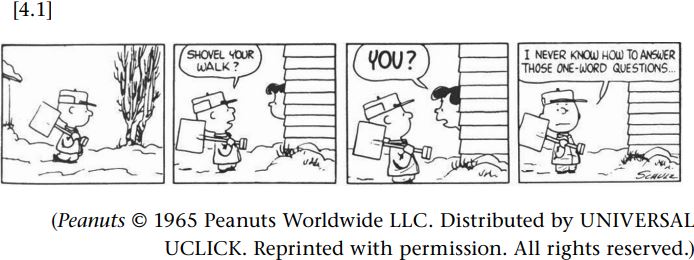
While Lucy responds with just one word here, it is clear that she means something else in addition to what she has said. More specifically, she implies that she doesn’t want Charlie Brown to shovel her walk (evident from the fact that she closes the door and so does not take up his offer), and perhaps also that Charlie Brown is somehow unsuitable for the task. The latter implication is in part indeterminate in that we do not know for what reason Lucy thinks Charlie Brown is unsuitable for shoveling snow (e.g. he is too weak, too incompetent, unlikely to finish and so on) and, moreover, just how certain she is about this evaluation. But it seems fair to say that Lucy has indeed meant something beyond what she has said here, namely, some kind of negative evaluation of Charlie Brown’s suitability for the task, and a refusal of his offer. We know this intuitively because her answer invites an inference in order to count as an adequate answer to Charlie Brown’s question, and also because we know (if we read Peanuts comics) that Lucy is always putting Charlie Brown down, and her behavior here is consistent with that. The former involves some form of pragmatic inferencing in order to figure out what counts as an adequate answer, while the latter arises through the kind of knowledge-based associative inferencing we briefly discussed. Pragmatic meaning thus involves content that is not straightforwardly expressed by the words someone utters but rather arises through some kind of inferencing, and so can be broadly characterized as meaning beyond what is said.
In pragmatics, just as in semantics, we generally conceptualize such meanings in terms of cognitive representations. A representation is essentially a generalized meaning form or interpretation that we find displayed in or through natural language constructions. Meaning representations are important because they are usually held to have considerable theoretical significance. An important foundational claim in pragmatics made by H. P. Grice (1967, 1989), a British-educated philosopher of language, is that meanings like the ones above, which go beyond what is said, can be broadly classified as speaker-intended implicatures, that is, meanings that are implied or suggested rather than said. He further proposed that what is implicated, either by a speaker or an utterance, can be contrasted with what is said. This distinction between what is implicated (cf. implying) and what is said (cf. saying) lies at the core of almost all of the subsequent attempts at theorizing about meaning representations in pragmatics, even those which have moved radically beyond it. We will thus start here by outlining Grice’s claims in more detail, before turning, in the latter sections, to the more fi ne-grained distinctions of pragmatic meaning that have since been proposed.








