Focus and syntactic structures
Deviations from canonical word order can be pragmatic strategies to lend focus, whether cognitive or semantic, to particular elements or to de-focus or tropicalize others. Such constructions do not represent a breakdown in the syntax. They are typical of spoken discourse, where they can serve additional functions such as holding the conversational floor and giving the speaker thinking time in which to plan ahead. Here, we will briefly note some constructions (for more detail, see Birner and Ward 1998 and Lambrecht 1994).
Preposed or fronted structures involve constituents you would expect to appear after the verb being placed before, as in the following example:
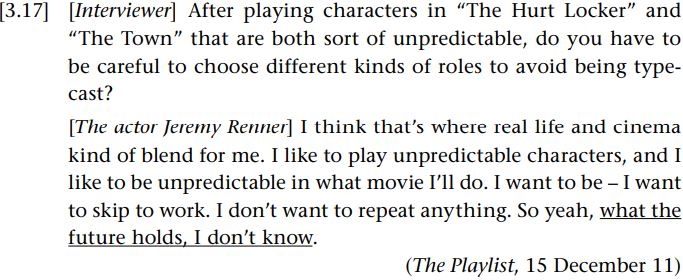
The preposed item is the semantic topic, as it is what the clause is about. Usually, the preposed item contains information that is to some degree given (often discourse-old, but at least familiar), leaving the rest of the clause for end-focus. Indeed, what the future holds clearly picks up on the interviewer’s question – it is old information; the new information is that he does not know what it holds. What is less usual is that the first constitutent is also the longest constituent, thus breeching the maxim of end-weight and fore-grounding the structure against canonical word order norms. What is made salient, then, is the topic. The structure is used to revitalize the earlier topic broached by the interviewer (an expanded version might be: “so yeah, in answer to your question about the kinds of roles I’d be taking on in the future, I don’t know”).
In dislocated structures, the noun phrase immediately to the left or right of the main clause of the sentence co-refers with a pronoun in that clause. The following is an example of left dislocation taken from a mountain climbing blog describing a jolly doctor:
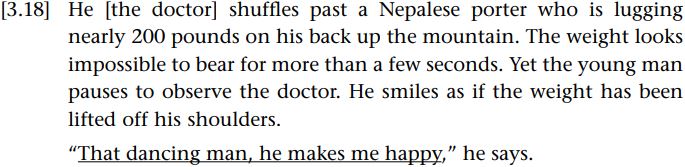
Here, the referent of dancing man (i.e. the doctor) has been introduced earlier, as has, before this quotation, the fact that he dances on the way up the mountain. That dancing man involves old information and is the topic. He co-refers to the same dancing doctor and is thus obviously old information. The remainder contains new information and is the semantic focus. However, in this foregrounded structure, it is the topic that seems to be more salient. The implication seems to be that this topic in particular is worthy of comment. We should also remember that in conversation flagging the topic in this way enables one to hold the conversational floor while formulating the comment one wants to make. Left-dislocated phrases can in fact contain new information, although this is not typical of semantic topics. Consider the first line of this English nursery rhyme: “The three little kittens, they lost their mittens.” The notion of the three little kittens is entirely new (of course, the presence of this structure here may be partly to facilitate the rhythm and the rhyme scheme).
With right dislocation there is a much stronger requirement that what is referred to in the right-dislocated phrase refers to something that is not only participant-old but also discourse-old. This tallies with the fact that such structures tend to function to clarify the reference of a pronoun in the main clause, as in the following examples (both taken from Biber et al. 1999):

The right-dislocated phrases do not usually carry the focal accent.
We briefly met cleft sentences, our example being an it-cleft: It wasn’t me that drove fast. Cleft sentences are complex sentences, where what could have been represented as a simple sentence (e.g. I didn’t drive fast) is cleft (split) into two clauses. In our it-cleft example the main clause is It wasn’t me and the subordinate clause is that drove fast. It-clefts tend to foreground the new information they carry in the clefted constituent, after the verb “to be”. Thus, me carries the focus. Conversely, the subordinate clause, that drove fast, is presupposed, old information and the topic. Compare our it-cleft example with I didn’t drive fast. Here, I is the topic and the rest the focus.
Other functions are possible with cleft sentences. In the following example, the information in both the main clause and the subordinate clause is new; the focus seems to be on the entire sentence:

As illustrated by this example, it-clefts often play a role in propelling the narrative.








