

Grammar


Tenses


Present

Present Simple

Present Continuous

Present Perfect

Present Perfect Continuous


Past

Past Simple

Past Continuous

Past Perfect

Past Perfect Continuous


Future

Future Simple

Future Continuous

Future Perfect

Future Perfect Continuous


Parts Of Speech


Nouns

Countable and uncountable nouns

Verbal nouns

Singular and Plural nouns

Proper nouns

Nouns gender

Nouns definition

Concrete nouns

Abstract nouns

Common nouns

Collective nouns

Definition Of Nouns

Animate and Inanimate nouns

Nouns


Verbs

Stative and dynamic verbs

Finite and nonfinite verbs

To be verbs

Transitive and intransitive verbs

Auxiliary verbs

Modal verbs

Regular and irregular verbs

Action verbs

Verbs


Adverbs

Relative adverbs

Interrogative adverbs

Adverbs of time

Adverbs of place

Adverbs of reason

Adverbs of quantity

Adverbs of manner

Adverbs of frequency

Adverbs of affirmation

Adverbs


Adjectives

Quantitative adjective

Proper adjective

Possessive adjective

Numeral adjective

Interrogative adjective

Distributive adjective

Descriptive adjective

Demonstrative adjective


Pronouns

Subject pronoun

Relative pronoun

Reflexive pronoun

Reciprocal pronoun

Possessive pronoun

Personal pronoun

Interrogative pronoun

Indefinite pronoun

Emphatic pronoun

Distributive pronoun

Demonstrative pronoun

Pronouns


Pre Position


Preposition by function

Time preposition

Reason preposition

Possession preposition

Place preposition

Phrases preposition

Origin preposition

Measure preposition

Direction preposition

Contrast preposition

Agent preposition


Preposition by construction

Simple preposition

Phrase preposition

Double preposition

Compound preposition

prepositions


Conjunctions

Subordinating conjunction

Correlative conjunction

Coordinating conjunction

Conjunctive adverbs

conjunctions


Interjections

Express calling interjection

Phrases

Sentences


Grammar Rules

Passive and Active

Preference

Requests and offers

wishes

Be used to

Some and any

Could have done

Describing people

Giving advices

Possession

Comparative and superlative

Giving Reason

Making Suggestions

Apologizing

Forming questions

Since and for

Directions

Obligation

Adverbials

invitation

Articles

Imaginary condition

Zero conditional

First conditional

Second conditional

Third conditional

Reported speech

Demonstratives

Determiners


Linguistics

Phonetics

Phonology

Linguistics fields

Syntax

Morphology

Semantics

pragmatics

History

Writing

Grammar

Phonetics and Phonology

Semiotics


Reading Comprehension

Elementary

Intermediate

Advanced


Teaching Methods

Teaching Strategies

Assessment
Reflection: Exploiting presuppositions in discourses of power and persuasion
المؤلف:
Jonathan Culpeper and Michael Haugh
المصدر:
Pragmatics and the English Language
الجزء والصفحة:
62-3
30-4-2022
791
Reflection: Exploiting presuppositions in discourses of power and persuasion
Presuppositions can be used to trick people into apparently accepting background assumptions which they do not have and/or would not have. Courtroom discourse is a case in point. For example, Izola Curry, on trial for the attempted murder of Dr. Martin Luther King in a restaurant in 1958, was asked:

Clearly, Curry worked out the presupposition embedded in the WH-structure (i.e. that she had found out), despite the fact that it was not common ground. Blocking this kind of presupposition is diffi cult, as one has pointedly to avoid answering the question; to do so would mean accepting what is presupposed. Cross-examination discourse from prosecutors is often designed to get a defendant or witness to accept, inadvertently or otherwise, assumptions that point towards their guilt. And presuppositions are powerful. Loftus and Palmer (1974) tested the sentence with which we began this topic: About how fast were the cars going when they smashed into each other? This is one of the questions they put to subjects about a fi lm they had been shown. The WH-structures presuppose that the cars were going “fast” and, moreover, “smashed” into each other, something which seems to explain the fact that informants were more likely to subsequently recall the presence of broken glass (though none was actually to be seen in the fi lm) than if, instead of “smashed”, the question contained “hit” or “bumped” (see also Loftus 1975).
Another kind of discourse that regularly manipulates common ground is that of advertising. Consider these advertising slogans:
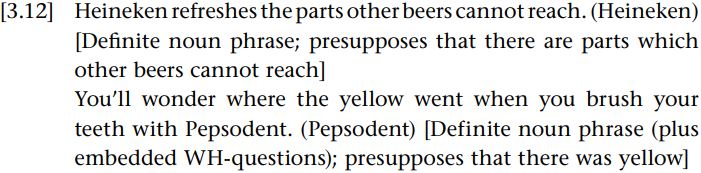
One way of packing in information into the short space available in the slogan, and also of creating a dramatic and memorable slogan, is to deploy presuppositions. In addition, part of the sales pitch can be through the presupposition. Such presuppositions create the ground against which the product shines. In some cases, the presuppositions seem designed to create surreptitiously a problem or need for which the product is the solution. In the Pepsodent toothpaste advertisement, the existence of yellow on your teeth is presupposed (the yellow). In all these cases, presuppositions are part of the advertiser’s “soft sell” strategy. For more on the persuasive use of presuppositions, see Sbisà (1999).
الاكثر قراءة في pragmatics
اخر الاخبار
اخبار العتبة العباسية المقدسة
الآخبار الصحية

قسم الشؤون الفكرية يصدر كتاباً يوثق تاريخ السدانة في العتبة العباسية المقدسة
"المهمة".. إصدار قصصي يوثّق القصص الفائزة في مسابقة فتوى الدفاع المقدسة للقصة القصيرة
(نوافذ).. إصدار أدبي يوثق القصص الفائزة في مسابقة الإمام العسكري (عليه السلام)


