Reflection: Social deixis across languages
Person marking varies hugely from language to language. Consider, for example, that Fijian is said to have 135 person forms, whereas Madurese, an Austronesian language, has only two (Siewierska 2004: 2). One of the reasons for this is that person marking interacts with the socio-cultural contexts of the particular language. As Mühlhäusler and Harré (1990: 207, quoted in Siewierska 2004: 214) comment, “pronominal grammar provides a window to the relationship between themselves and the outside world”. Obviously, this fact is most salient with respect to social deixis. Non-singular second person marking when addressing a single person is often a way of signaling social distance, deference (particularly in the context of an age differential) or formality, as was the case, at least to some extent, with the you-forms in earlier periods of English, and is still the case in many European languages (e.g. French, German, Spanish, Greek, Danish, Swedish, Russian, Czech). Non-singular person marking is also used for single referents in many other languages, but not necessarily for the same social reasons. Some languages achieve such social functions with the use of the third person. For example, in Italian one uses the third person feminine singular lei, and in German the third person plural Sie. Such person marking phenomena are part of linguistic honorifics, conventional systems of forms that “honor” (i.e. express deference to) a participant (usually but not necessarily the addressee) in some way. Such forms include not only person markings, but also forms of address, various affixes, clitics and particles, and choice of vocabulary. Present-day English does not have a rich honorific system, being now largely confined to forms of address, as noted above. Other languages, particularly those of East and South-East Asia (e.g. Thai, Japanese, Nepali, Korean) have remarkably rich systems. In Thai, there are said to be 27 forms used for the first person, 22 for the second and eight for the third. These are used according to, amongst other things, social status, intimacy, age, sex and kinship, and to reflect deference or assertiveness (see Cooke 1968, quoted in Siewierska 2004: 228).
Person markers, as we have seen for all referring expressions, are not always used in such a way that their encoded meaning matches their usage. Mismatches are often deployed for the purpose of generating local social meanings. Consider, for example, the range of possible referents for the English form we (based on the list given in Siewierska 2004: 215):
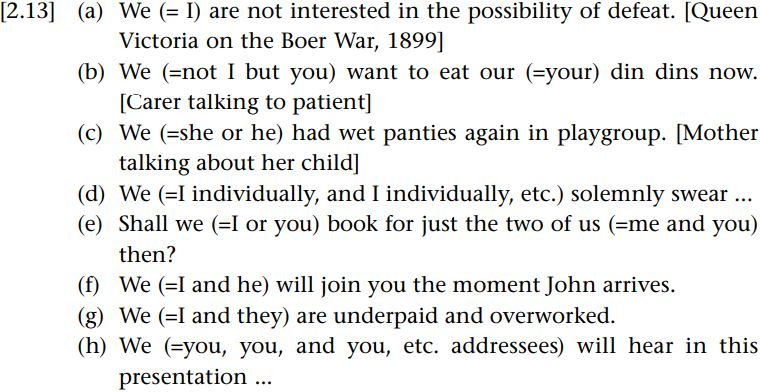
Some of these mismatches have become well established. (a) is of course the royal-we (pragmatically “I”), a more recent example of which are the words of Margaret Thatcher upon discovering that she had become a grandmother in 1989: we have become a grandmother. The royal-we might be said to be a case of self-deference: the speaker is the honorific focus. (b) is a typical usage of the exclusive-we (pragmatically not “I”), where the avoidance of the pronoun you in requests or commands lends a veneer of politeness (see Wales 1996, for a full discussion of we and other English pronouns).
As can be seen from Table 2.2, a category of deictic expressions can express spatial relations. As far as English is concerned, spatial deixis typically expresses a relationship relating to distance between the deictic centre of the speaker and a referent. English has a proximal/distal (as in near/far) contrast, as might be illustrated by items such as here/there and this/that. However, usage of these items, particularly the final set of demonstratives, is not always restricted to physical spatial relations. In the extract from Shakespeare below, John of Gaunt laments the fact that England is not what it was; England has been sold out by Richard II, the current king, in pursuit of his own glory. The contrast is between proximal this England, near in time, and distal that England, further away in time.

We might also briefly note that sometimes the issue is one of focusing the target’s attention. Thus, while here in Here she is! might well convey the fact that somebody has arrived in the vicinity, it also draws attention to that fact; and that in I’d like that one (said of several items all the same distance from the speaker) focuses the target’s attention on one particular item.








