

Grammar


Tenses


Present

Present Simple

Present Continuous

Present Perfect

Present Perfect Continuous


Past

Past Simple

Past Continuous

Past Perfect

Past Perfect Continuous


Future

Future Simple

Future Continuous

Future Perfect

Future Perfect Continuous


Parts Of Speech


Nouns

Countable and uncountable nouns

Verbal nouns

Singular and Plural nouns

Proper nouns

Nouns gender

Nouns definition

Concrete nouns

Abstract nouns

Common nouns

Collective nouns

Definition Of Nouns

Animate and Inanimate nouns

Nouns


Verbs

Stative and dynamic verbs

Finite and nonfinite verbs

To be verbs

Transitive and intransitive verbs

Auxiliary verbs

Modal verbs

Regular and irregular verbs

Action verbs

Verbs


Adverbs

Relative adverbs

Interrogative adverbs

Adverbs of time

Adverbs of place

Adverbs of reason

Adverbs of quantity

Adverbs of manner

Adverbs of frequency

Adverbs of affirmation

Adverbs


Adjectives

Quantitative adjective

Proper adjective

Possessive adjective

Numeral adjective

Interrogative adjective

Distributive adjective

Descriptive adjective

Demonstrative adjective


Pronouns

Subject pronoun

Relative pronoun

Reflexive pronoun

Reciprocal pronoun

Possessive pronoun

Personal pronoun

Interrogative pronoun

Indefinite pronoun

Emphatic pronoun

Distributive pronoun

Demonstrative pronoun

Pronouns


Pre Position


Preposition by function

Time preposition

Reason preposition

Possession preposition

Place preposition

Phrases preposition

Origin preposition

Measure preposition

Direction preposition

Contrast preposition

Agent preposition


Preposition by construction

Simple preposition

Phrase preposition

Double preposition

Compound preposition

prepositions


Conjunctions

Subordinating conjunction

Correlative conjunction

Coordinating conjunction

Conjunctive adverbs

conjunctions


Interjections

Express calling interjection

Phrases

Sentences


Grammar Rules

Passive and Active

Preference

Requests and offers

wishes

Be used to

Some and any

Could have done

Describing people

Giving advices

Possession

Comparative and superlative

Giving Reason

Making Suggestions

Apologizing

Forming questions

Since and for

Directions

Obligation

Adverbials

invitation

Articles

Imaginary condition

Zero conditional

First conditional

Second conditional

Third conditional

Reported speech

Demonstratives

Determiners


Linguistics

Phonetics

Phonology

Linguistics fields

Syntax

Morphology

Semantics

pragmatics

History

Writing

Grammar

Phonetics and Phonology

Semiotics


Reading Comprehension

Elementary

Intermediate

Advanced


Teaching Methods

Teaching Strategies

Assessment
Adjective meanings Overview
المؤلف:
Patrick Griffiths
المصدر:
An Introduction to English Semantics And Pragmatics
الجزء والصفحة:
24-2
10-2-2022
1140
Adjective meanings
Overview
Cruse (2000: 289) notes that adjective meanings are often one dimensional. Think of pairs like thin–thick, fast–slow, cool–warm, young–old, true–false. Thickness concerns only a minor dimension, not length or width; for speed, one can ignore temperature, height, age; and so forth. This makes adjectives a good starting point for trying to understand word meaning. This topic concentrates on various kinds of meaning relationship between adjectives, mainly relationships of similarity and oppositeness. Three other topics are broached: meaning postulates, gradability, and how to account for the meanings that arise when adjectives modify nouns.
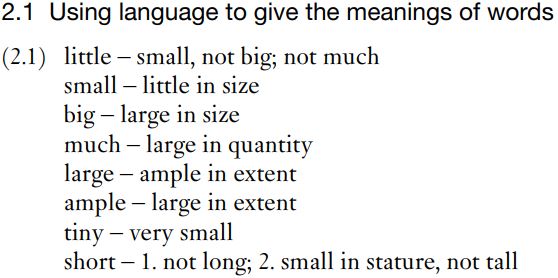
The fragments of entries shown in (2.1) could plausibly appear in a dictionary. In the entry for short, the numbers 1 and 2 distinguish two different senses of the word. It is unlikely you would look up words as familiar as these, but the items in (2.1) illustrate the circularity of a monolingual dictionary. It is reminiscent of a puppy chasing its own tail. Nonetheless, such a dictionary can give useful indications of word meanings. The cryptic hints in (2.1) catalogue relationships between word meanings, such as that all these words have something to do with size/quantity/extent; that little and small have closely similar meanings, as do large and big; that big is opposite in meaning to little; and so on. If the network can be anchored in a few places – if the meanings of some basic words are known – then it is a useful system.
In early childhood we come to know the denotations of our first words in the course of close encounters with the world, painstakingly mediated by our caregivers (sometimes with point-and-say demonstrations of the kind called ostension). But once we have a start in a language, we learn the meanings of most other words through language itself: by having them explained to us (as when a child is told that tiny means ‘very small’) or by inference from the constructions words are put into (for example, when an older child realizes from the title of Gerald Durrell’s book My Family and Other Animals that there is a view according to which people are classified as animals).
The focus of the present topic is the systematic description of meaning relationships within a language, between the senses of expressions (mainly words, but some phrases too). The aim is to state economically and insightfully which expressions are equivalent in meaning to which others – or contrast with them in various ways – according to the linguistic knowledge of individuals competent in the language.
What about denotation? Semanticists tend to regard the building up of links between words and the world, and the perceptual processes that allow us to recognize the “things” that are denoted by words, as a matter for psychologists. However, the semantic study of sense relations contributes to this because the sense of a word places limits on what it can denote. And formal semantics is relevant too because the compositional senses of larger expressions delimit what they can denote.
الاكثر قراءة في Semantics
اخر الاخبار
اخبار العتبة العباسية المقدسة
الآخبار الصحية

قسم الشؤون الفكرية يصدر كتاباً يوثق تاريخ السدانة في العتبة العباسية المقدسة
"المهمة".. إصدار قصصي يوثّق القصص الفائزة في مسابقة فتوى الدفاع المقدسة للقصة القصيرة
(نوافذ).. إصدار أدبي يوثق القصص الفائزة في مسابقة الإمام العسكري (عليه السلام)


