Information Dimension
Define the "information function" to be
![I=-sum_(i=1)^NP_i(epsilon)ln[P_i(epsilon)],](https://mathworld.wolfram.com/images/equations/InformationDimension/NumberedEquation1.gif) |
(1)
|
where  is the natural measure, or probability that element
  is populated, normalized such that
 |
(2)
|
The information dimension is then defined by
If every element is equally likely to be visited, then  is independent of
  , and
, and
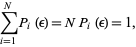 |
(5)
|
so
 |
(6)
|
and
where  is the capacity dimension.
It satisfies
 |
(11)
|
where  is the capacity dimension and
  is the correlation dimension (correcting the typo in Baker and Gollub 1996).
REFERENCES:
Baker, G. L. and Gollub, J. B. Chaotic Dynamics: An Introduction, 2nd ed. Cambridge, England: Cambridge University Press, 1996.
Balatoni, J. and Renyi, A. Pub. Math. Inst. Hungarian Acad. Sci. 1, 9, 1956.
Farmer, J. D. "Chaotic Attractors of an Infinite-dimensional Dynamical System." Physica D 4, 366-393, 1982.
Ott, E. Chaos in Dynamical Systems. New York: Cambridge University Press, p. 79, 1993.
Nayfeh, A. H. and Balachandran, B. Applied Nonlinear Dynamics: Analytical, Computational, and Experimental Methods. New York: Wiley, pp. 545-547, 1995.








