الوضع الليلي


 11:29:10
  2023-06-20
  2108
2108
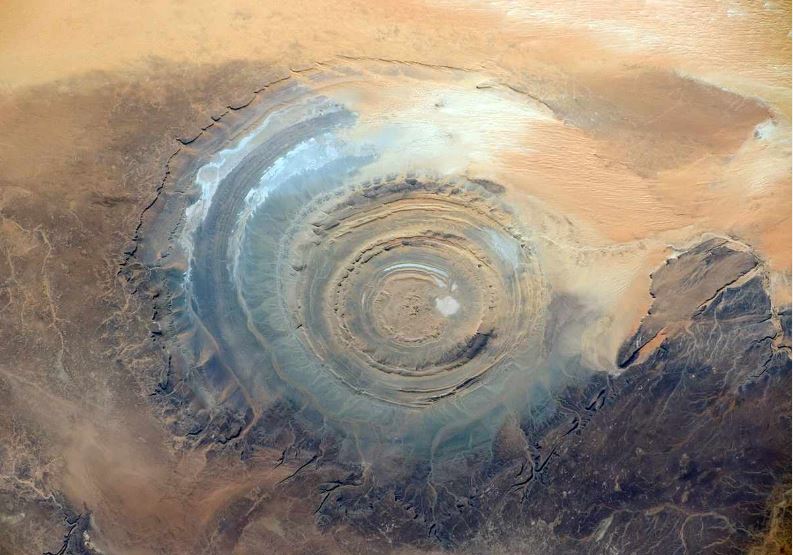
When viewed from above, the Eye of the Sahara looks just like an enormous impact crater sitting in the middle of the Sahara Desert of Mauritania. Stretching 50 kilometers (30 miles) in diameter, comprised of a series of uniform ripples, this crater like anomaly is in fact entirely terrestrial.
This spectacular ancient geological formation was used in the 1960s by Gemini astronauts as a landmark. Geologists initially believed the Eye of the Sahara, aka the Richat Structure, to be an enormous impact crater. However, further studies into the sedimentary rock making up the central dome have dated the formation back to the late Proterozoic, between 1 billion and 542 million years ago.
It's worth noting that some still believe the structure is actually the remains of the lost city of Atlantis, as its circular shape is said to resemble the land described by Plato – but we’re not entertaining that here.
The structure is likely to have actually formed through a process called “folding”, creating what’s called a symmetrical anticline. Folding occurs when tectonic forces acting from either side squeeze sedimentary rock – if the rock is cold and brittle it can fracture, but if it’s warm enough, it will become a fold. Folds that form upwards are called an anticline, while downward folds are called a syncline.
However, in a 2014 paper published in the Journal of African Earth Sciences, researchers proposed an entirely different formation explanation for the Eye. The presence of volcanic rock is said to suggest evidence of molten rock being pushed to the surface, causing the dome shape, before being eroded into the rings we see today. The paper proposed the separation of the supercontinent Pangaea may have played a part in these volcanic formations and tectonic shifts.
The structure is made up of a mixture of sedimentary and igneous rock. Erosion across the structure’s surface reveals fine-grained rhyolite and coarse crystalline gabbro rocks that have undergone hydrothermal alteration. The types of rock found across the rings erode at different speeds, creating different colored patterns across the surface. Large sharp-angled fragments of sedimentary rock called mega breccia add to the swirling colorful irregularities that make up the formation.
The dome center contains a limestone-dolomite shelf with kilometer-wide breccia, ring dikes, and alkaline volcanic rock. The complex geological structure of the Eye has puzzled and interested geologists since its discovery, and it is still widely considered to be one of the most impressive geological features in the world. As such, in 2022 it became one of the first 100 geological heritage sites recognized by the International Union of Geological Science (IUGS).
Due to its vast size, the Eye of the Sahara is best viewed from great heights (preferably space), so for now we’ll have to rely on satellite images to bask in all its glory.
Reality Of Islam |
|

After spend

A study of

Researchers
 9:3:43
2018-11-05
9:3:43
2018-11-05
10 benefits of Marriage in Islam
7:5:22
2019-04-08
benefits of reciting surat yunus, hud &
9:45:7
2018-12-24
advantages & disadvantages of divorce
11:35:12
2018-06-10
6:0:51
2018-10-16
8:15:37
2023-02-16
2:42:26
2023-02-02
a hero waters thirsty wild animals
9:4:9
2022-01-06
7:59:14
2018-06-21
10:47:11
2022-11-22
8:25:12
2022-03-09
bahlool & the throne of haroun rashid
8:20:35
2018-06-21
5:41:46
2023-03-18
| LATEST |
 HOME
HOME