Proposition 1.1 Let R and S be unital rings, let M be an R-S-bimodule and let FSX be a free left S-module on a set X. Then the tensor product M ⊗S FSX is isomorphic, as an R-module, to Γ(X, M), where Γ(X, M) is the left R-module whose elements are represented as functions from X to M with only finitely many non-zero values, and where (λ+µ)(x) = λ(x) +µ(x), and (rλ)(x) = rλ(x) for all λ, µ ∈ Γ(X, M) and r ∈ R.
Proof The elements of the free left S-module FSX are represented as functions from X to S. Let f: M × FSX → Γ(X, M) be the Z-bilinear function defined such that f(m, σ)(x) = mσ(x) for all m ∈ M, σ ∈ FSX and x ∈ X.
Then f(ms, σ) = f(m, sσ) for all m ∈ M, σ ∈ FSX and s ∈ S. It follows from Lemma 1.1in(Tensor Products over Non-Commutative Rings) that the function f induces a unique homomorphism θ: M ⊗S FSX → Γ(X, M) such that θ(m ⊗ σ) = f(m, σ). Moreover θ is an R-module homomorphism.
Given µ ∈ Γ(X, M) we define
ϕ(µ) = ∑x∈supp µ µ(x) ⊗ δx,
where supp µ = {x ∈ X : µ(x) ≠0} and δx denotes the function from X to S which takes the value 1S at x and is zero elsewhere. Then ϕ: Γ(X, M) → M ⊗S FSX is also an R-module homomorphism. Now
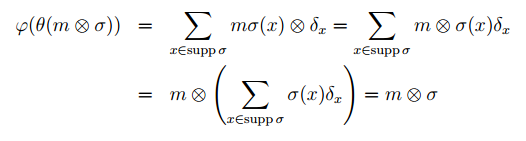
for all m ∈ M and σ ∈ FSX. It follows that ϕ◦θ is the identity automorphism
of the tensor product M ⊗S FSX.
Also
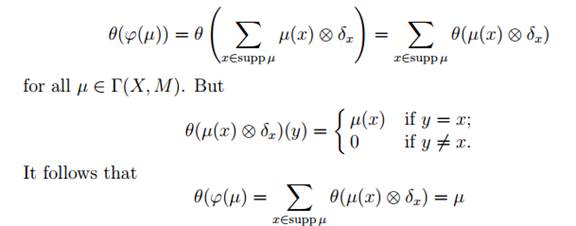
for all µ ∈ Γ(X, M). Thus θ ◦ ϕ is the identity automorphism of Γ(X, M).
We conclude that θ: M ⊗S FSX → Γ(X, M) is an isomorphism of R-modules, as required.
Let R be a unital ring. We can regard R as an R-Z-bimodule, where rn is the sum of n copies of r and r(−n) = −rn for all non-negative integers n and elements r of R. We may therefore form the tensor product R ⊗Z A ofthe ring R with any additive group A. (An additive group as an Abelian group where the group operation is expressed using additive notation.) This tensor product is an R-module. The following corollary is therefore a direct consequence of Proposition 1.1.
Corollary 1.2 Let R be a unital ring, let X be a set, and let FZX be the free Abelian group on the set X. Then R ⊗Z FZX ∼= FRX. Thus the tensor product of the ring R with any free Abelian group is a free R-module.








