Definition Let F be a left module over a unital ring R, and let X be a subset of F. We say that the left R-module F is freely generated by the subset X if, given any left R-module M, and given any function f: X → M, there exists a unique R-module homomorphism ϕ: F → M that extends the function f.
Example Let K be a field. Then a K-module is a vector space over K. Let V be a finite-dimensional vector space over the field K, and let b1, b2, . . . , bn be a basis of V . Then V is freely generated (as a K-module) by the set B, where B = {b1, b2, . . . , bn}. Indeed, given any vector space W over K, and given any function f: B → W, there is a unique linear transformation ϕ: V → W that extends f. Indeed
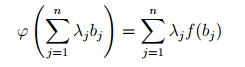
for all λ1, λ2, . . . , λn ∈ K. (Note that a function between vector spaces over some field K is a K-module homomorphism if and only if it is a linear transformation.)
Definition A left module F over a unital ring R is said to be free if there exists some subset of F that freely generates the R-module F.
Lemma 1.1 Let F be a left module over a unital ring R, let X be a set, and let i: X → F be a function. Suppose that the function f: X → F satisfies the following universal property:
given any left R-module M, and given any function f: X → M, there exists a unique R-module homomorphism ϕ: F → M such that ϕ ◦ i = f.
Then the function i: X → F is injective, and F is freely generated by i(X).
Proof Let x and y be distinct elements of the set X, and let f be a function satisfying f(x) = 0R and f(y) = 1R, where 0R and 1R denote the zero element and the multiplicative identity element respectively of the ring R.
The ring R may be regarded as a left R-module over itself. It follows from the universal property of i: X → M stated above that there exists a unique R-module homomorphism θ: F → R for which θ ◦ i = f. Then θ(i(x)) = 0R and θ(i(y)) = 1R. It follows that i(x) ≠i(y). Thus the function i: X → F is injective.
Let M be a left R-module, and let g:i(X) → M be a function defined on i(X). Then there exists a unique homomorphism ϕ: F → M such that ϕ ◦ i = g ◦ i. But then ϕ|i(X) = g. Thus the function g:i(X) → M extends uniquely to a homomorphism ϕ: F → M. This shows that F is freely generated by i(X), as required.
Let F1 and F2 be left modules over a unital ring R, let X1 be a subset of F1, and let X2 be a subset of F2. Suppose that F1 is freely generated by X1, and that F2 is freely generated by X2. Then any function f: X1 → X2 from X1 to X2 extends uniquely to a R-module homomorphism from F1 to F2. We denote by f]: F1 → F2 the unique R-module homomorphism that extends f.
Now let F1, F2 and F3 be left modules over a unital ring R, and let X1, X2 and X3 be subsets of F1, F2 and F3 respectively. Suppose that the left R-module Fi is freely generated by Xi for i = 1, 2, 3. Let f: X1 → X2 andg: X2 → X3 be functions. Then the functions f, g and g ◦ f extend uniquely to R-module homomorphisms f] : F1 → F2, g] : F2 → F3 and (g ◦f)]: F3 → F3.
Moreover the uniqueness of the homomorphism (g◦f)] extending g◦f suffices to ensure that (g ◦ f)] = g] ◦ f]. Also the unique function from the module Fi extending the identity function of Xi is the identity isomorphism of Fi , for each i. It follows that if f: X1 → X2 is a bijection, then f] : F1 → F2 is an isomorphism whose inverse is the unique homomorphism (f−1)]: F2 → F1 extending the inverse f−1 : X2 → X1 of the bijection f.








