Let K be a simplicial complex. For each non-negative integer q, let ∆q(K) be the additive group consisting of all formal sums of the form

where n1, n2, . . . , ns are integers and vr0, vr1, . . . , vrq are (not necessarily distinct) vertices of K that span a simplex of K for r = 1, 2, . . . , s. (In more formal language, the group ∆q(K) is the free Abelian group generated by the set of all (q + 1)-tuples of the form (v0, v1, . . . , vq), where v0, v1, . . . , vq span a simplex of K.)
We recall some basic facts concerning permutations. A permutation of a set S is a bijection mapping S onto itself. The set of all permutations of some set S is a group; the group multiplication corresponds to composition of permutations. A transposition is a permutation of a set S which interchanges two elements of S, leaving the remaining elements of the set fixed. If S is finite and has more than one element then any permutation of S can be expressed as a product of transpositions. In particular any permutation of the set {0, 1, . . . , q} can be expressed as a product of transpositions (j −1, j) that interchange j − 1 and j for some j.
Associated to any permutation π of a finite set S is a number ℰπ, known as the parity or signature of the permutation, which can take on the values ±1.
If π can be expressed as the product of an even number of transpositions, then ℰπ = +1; if π can be expressed as the product of an odd number of transpositions then ℰπ = −1. The function π → π is a homomorphism from the group of permutations of a finite set S to the multiplicative group {+1, −1} (i.e., ℰπρ = ℰπℰρ for all permutations π and ρ of the set S). Note in particular that the parity of any transposition is −1.
Definition The qth chain group Cq(K) of the simplicial complex K is de fined to be the quotient group ∆q(K)/∆0q (K), where ∆0q (K) is the sub group of ∆q(K) generated by elements of the form (v0, v1, . . . , vq) where v0, v1, . . . , vq are not all distinct, and by elements of the form
(vπ(0), vπ(1), . . . , vπ(q)) − ℰπ(v0, v1, . . . , vq)
where π is some permutation of {0, 1, . . . , q} with parity ℰπ. For convenience, we define Cq(K) = {0} when q < 0 or q > dim K, where dim K is the dimension of the simplicial complex K. An element of the chain group Cq(K) is referred to as q-chain of the simplicial complex K.
We denote by 〈v0, v1, . . . , vq〉the element ∆0q (K) + (v0, v1, . . . , vq) of Cq(K) corresponding to (v0, v1, . . . , vq). The following results follow immediately from the definition of Cq(K).
Lemma 1.1 Let v0, v1, . . . , vq be vertices of a simplicial complex K that span a simplex of K. Then
• 〈v0, v1, . . . , vq〉 = 0 if v0, v1, . . . , vq are not all distinct,
• 〈vπ(0), vπ(1), . . . , vπ(q)〉 = ℰπ〈v0, v1, . . . , vq〉 for any permutation π of the set {0, 1, . . . , q}.
Example If v0 and v1 are the endpoints of some line segment then 〈v0, v1〉 = −〈v1, v0〉.
If v0, v1 and v2 are the vertices of a triangle in some Euclidean space then
〈v0, v1, v2〉= 〈v1, v2, v0〉 = 〈v2, v0, v1〉 = −〈v2, v1, v0〉
= −〈v0, v2, v1〉= −〈v1, v0, v2〉.
Definition An oriented q-simplex is an element of the chain group Cq(K) of the form ±〈v0, v1, . . . , vq〉, where v0, v1, . . . , vq are distinct and span a simplex of K.
An oriented simplex of K can be thought of as consisting of a simplex of K (namely the simplex spanned by the prescribed vertices), together with one of two possible ‘orientations’ on that simplex. Any ordering of the vertices determines an orientation of the simplex; any even permutation of the ordering of the vertices preserves the orientation on the simplex, whereas any odd permutation of this ordering reverses orientation.
Any q-chain of a simplicial complex K can be expressed as a sum of the form
n1σ1 + n2σ2 + · · · + nsσs
where n1, n2, . . . , ns are integers and σ1, σ2, . . . , σs are oriented q-simplices of K. If we reverse the orientation on one of these simplices σi then this reverses the sign of the corresponding coefficient ni . If σ1, σ2, . . . , σs represent distinct simplices of K then the coefficients n1, n2, . . . , ns are uniquely determined.
Example Let v0, v1 and v2 be the vertices of a triangle in some Euclidean space. Let K be the simplicial complex consisting of this triangle, together with its edges and vertices. Every 0-chain of K can be expressed uniquely in the form
n0〈v0〉 + n1〈v1〉 + n2〈v2〉
for some n0, n1, n2 ∈ Z. Similarly any 1-chain of K can be expressed uniquely in the form
m0〈v1, v2〉 + m1〈v2, v0〉 + m2〈v0, v1〉
for some m0, m1, m2 ∈ Z, and any 2-chain of K can be expressed uniquely as n〈v0, v1, v2〉 for some integer n
Lemma 1.2 Let K be a simplicial complex, and let A be an additive group.
Suppose that, to each (q + 1)-tuple (v0, v1, . . . , vq) of vertices spanning a simplex of K, there corresponds an element α(v0, v1, . . . , vq) of A, where
• α(v0, v1, . . . , vq) = 0 unless v0, v1, . . . , vq are all distinct,
• α(v0, v1, . . . , vq) changes sign on interchanging any two adjacent vertices vj−1 and vj .
Then there exists a well-defined homomorphism from Cq(K) to A which sends 〈v0, v1, . . . , vq〉 to α(v0, v1, . . . , vq) whenever v0, v1, . . . , vq span a simplex of K. This homomorphism is uniquely determined.
Proof The given function defined on (q + 1)-tuples of vertices of K extends to a well-defined homomorphism α: ∆q(K) → A given by
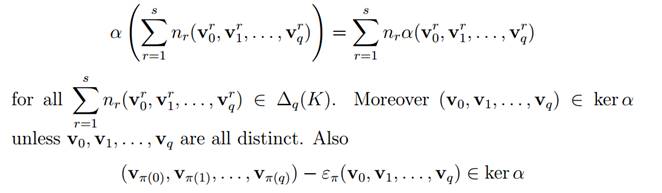
for all permutations π of {0, 1, . . . , q}, since the permutation π can be ex pressed as a product of transpositions (j − 1, j) that interchange j − 1 with j for some j and leave the rest of the set fixed, and the parity επ of π is given by επ = +1 when the number of such transpositions is even, and by επ = −1 when the number of such transpositions is odd. Thus the generators of ∆0q (K) are contained in ker α, and hence ∆0q (K) ⊂ ker α. The required homomorphism α˜: Cq(K) → A is then defined by the formula









