Proposition 1.1 Let p: X˜ → X be a covering map over a topological space X, let α: [0, 1] → X and β: [0, 1] → X be paths in X, where α(0) = β(0) and α(1) = β(1), and let α˜: [0, 1] → X˜ and β˜: [0, 1] → X˜ be paths in X˜ such that p ◦ α˜ = α and p ◦ β˜ = β. Suppose that α˜(0) = β˜(0) and that α ≃ β rel {0, 1}.
Then α˜(1) = β˜(1) and α˜ ≃ β˜ rel {0, 1}.
Proof Let x0 and x1 be the points of X given by
x0 = α(0) = β(0), x1 = α(1) = β(1).
Now α ≅β rel {0, 1}, and therefore there exists a homotopy F: [0, 1]×[0, 1] → X such that F(t, 0) = α(t) and F(t, 1) = β(t) for all t ∈ [0, 1], F(0, τ ) = x0 and F(1, τ ) = x1 for all τ ∈ [0, 1].
It then follows from the Monodromy Theorem (The Monodromy Theorem)that there exists a continuous map G: [0, 1] × [0, 1] → X˜ such that p ◦ G = F and G(0, 0) = α˜(0). Then p(G(0, τ )) = x0 and p(G(1, τ )) = x1 for all τ ∈ [0, 1].
A straightforward application of (Let p: X~ → X be a covering map, let Z be a connected topological space, and let g:Z → X~ and h:Z → X~ be continuous maps.
Suppose that p ◦g = p ◦ h and that g(z) = h(z) for some z ∈ Z. Then g = h.) shows that any continuous lift of a constant path must itself be a constant path. Therefore G(0, τ ) = x˜0
and G(1, τ ) = x˜1 for all τ ∈ [0, 1], where x˜0 = G(0, 0) = α˜ (0), x˜1 = G(1, 0).
However
G(0, 0) = G(0, 1) = ˜x0 = ˜α(0) = β˜(0),
p(G(t, 0)) = F(t, 0) = α(t) = p(˜α(t))
and
p(G(t, 1)) = F(t, 1) = β(t) = p(β˜(t))
for all t ∈ [0, 1]. Now Proposition (Let p: X~ → X be a covering map, let Z be a connected topological space, and let g:Z → X~ and h:Z → X~ be continuous maps. Suppose that p ◦g = p ◦ h and that g(z) = h(z) for some z ∈ Z. Then g = h.)ensures that the lifts α˜and β˜ of the paths α and β are uniquely determined by their starting points. It follows that G(t, 0) = α˜ (t) and G(t, 1) = β˜(t) for all t ∈ [0, 1]. In particular,
α˜(1) = G(0, 1) = x˜1 = G(1, 1) = β˜(1).
Moreover the map G: [0, 1] × [0, 1] → X˜ is a homotopy between the paths α˜ and β˜ which satisfies G(0, τ ) = x˜0 and G(1, τ ) = x˜1 for all τ ∈ [0, 1]. It follows that α˜ ≃β˜ rel {0, 1}, as required
Corollary 1.2 Let p: X˜ → X be a covering map over a topological space X, and let x˜0 be a point of X˜. Then the homomorphism
p#: π1(X˜, x˜0) → π1(X, p(x˜0))
of fundamental groups induced by the covering map p is injective
Proof Let σ0 and σ1 be loops in X~ based at the point x~0, representing elements [σ0] and [σ1] of π1(X˜, x˜0). Suppose that p#[σ0] = p#[σ1]. Then p◦σ0 ≃ p ◦ σ1 rel {0, 1}. Also σ0(0) = x˜0 = σ1(0). Therefore σ0 ≃σ1 rel {0, 1}, by Proposition 1.1, and thus [σ0] = [σ1]. We conclude that the homomorphism p#: π1(X˜, x˜0) → π1(X, p(x˜0)) is injective
Corollary 1.3 Let p: X˜ → X be a covering map over a topological space X, let x˜0 be a point of X˜, and let γ be a loop in X based at p(x˜0). Then [γ] ∈ p#(π1(X˜, x˜0)) if and only if there exists a loop γ˜ in X˜, based at the point x˜0, such that p ◦ γ˜ = γ.
Proof If γ = p ◦ γ˜ for some loop γ˜ in X˜ based at x˜0 then [γ] = p#[γ˜], and therefore [γ] ∈ p#(π1(X˜, x˜0)).
Conversely suppose that [γ] ∈ p#(π1(X˜, x˜0)). We must show that there exists some loop γ˜ in X˜ based at x˜0 such that γ = p ◦ γ˜. Now there exists a loop σ in X˜ based at the point x ˜0 such that [γ] = p#([σ]) in π1(X, p(x˜0)).
Then γ ≃ p ◦ σ rel {0, 1}. It follows from the Path Lifting Theorem for covering maps that there exists a unique path γ˜: [0, 1] → X˜ in X˜ for which γ˜ (0) = x˜0 and p ◦ γ˜ = γ. It then follows from Proposition 1.1 that γ˜ (1) = σ(1) and γ˜ ≃ σ rel {0, 1}. But σ(1) = x˜0. Therefore the path γ˜ is the required loop in X˜ based the point x˜0 which satisfies p ◦ γ˜ = γ.
Corollary 1.4 Let p: X˜ → X be a covering map over a topological space X, let w0 and w1 be points of X˜ satisfying p(w0) = p(w1), and let α: [0, 1] → X˜ be a path in X˜ from w0 to w1. Suppose that [p ◦ α] ∈ p#(π1(X, w˜0)). Then the path α is a loop in X˜, and thus w0 = w1.
Proof It follows from Corollary 1.3 that there exists a loop β based at w0 satisfying p ◦ β = p ◦ α. Then α(0) = β(0). Now Proposition (Let p: X˜ → X be a covering map, let Z be a connected topological space, and let g:Z → X˜ and h:Z → X˜ be continuous maps. Suppose that p ◦ g = p ◦ h and that g(z) = h(z) for some z ∈ Z. Then g = h.) ensures that the lift to X˜ of any path in X is uniquely determined by its starting point. It follows that α = β. But then the path α must be a loop in X˜, and therefore w0 = w1, as required.
Corollary 1.5 Let p: X˜ → X be a covering map over a topological space X. Let α: [0, 1] → X and β: [0, 1] → X be paths in X such that α(0) = β(0) and α(1) = β(1), and let α.β−1 be the loop in X defined such that

Let α˜: [0, 1] → X˜ and β˜: [0, 1] → X˜ be the unique paths in X˜ such that p ◦ α˜ = α, and p ◦ β˜ = β. Suppose that α˜(0) = β˜(0). Then α˜(1) = β˜(1) if and only if [α.β−1] ∈ p#(π1(X˜, x˜0)), where x˜0 = α˜(0) = β˜(0).
Proof Suppose that α˜(1) = β˜(1). Then the concatenation α˜.β˜−1 is a loop in X˜ based at x˜0, and [α.β−1] = p#([α˜.β˜−1]), and therefore [α.β−1] ∈ p#(π1(X ˜, x˜0)). Conversely suppose that α˜ and β˜ are paths in X˜ satisfying p ◦ α˜ = α, p ◦ β˜ = β and α˜(0) = β˜(0) = x˜0, and that [α.β−1] ∈ p#(π1(X˜, x˜0)). We must show that α˜(1) = β˜(1). Let γ: [0, 1] → X be the loop based at p(x˜0) given by γ = α.β−1. Thus
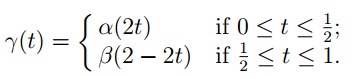
Then [γ] ∈ p#(π1(X˜, x˜0)). It follows from Corollary 1.3 that there exists a loop γ˜ in X˜ based at x˜0 such that p ◦ γ˜ = γ. Let αˆ: [0, 1] → X˜ and Let βˆ: [0, 1] → X˜ be the paths in X˜ defined such that αˆ (t) = γ˜ (1/2t) and βˆ(t) = γ˜ (1 −1/2t) for all t ∈ [0, 1]. Then
α˜(0) = αˆ (0) = β˜(0) = βˆ(0) = x˜0, p ◦ αˆ = α = p ◦ α˜ and p ◦ βˆ = β = p ◦ β˜.
But Proposition (Let p: X˜ → X be a covering map, let Z be a connected topological space, and let g:Z → X˜ and h:Z → X˜ be continuous maps. Suppose that p ◦ g = p ◦ h and that g(z) = h(z) for some z ∈ Z. Then g = h.) ensures that the lift to X˜ of any path in X is uniquely determined by its starting point.
Therefore α˜ = α ˆand β˜ = βˆ. It follows that
α˜(1) = α(1ˆ) = γ˜ (1/2) = βˆ(1) = β˜(1),
as required.
Theorem 1.6 Let p: X˜ → X be a covering map over a topological space X.
Suppose that X˜ is path-connected and that X is simply-connected. Then the covering map p: X˜ → X is a homeomorphism.
Proof We show that the map p: X˜ → X is a bijection. This map is surjective (since covering maps are by definition surjective). We must show that it is injective. Let w0 and w1 be points of X˜ with the property that p(w0) = p(w1). Then there exists a path α: [0, 1] → X˜ with α(0) = w0 and α(1) = w1, since X˜ is path-connected. Then p ◦ α is a loop in X based at the point x0, where x0 = p(w0). However π1 (X,p(w0)) is the trivial group, since X is simply- connected. It follows from Corollary 1.4 that the path α is a loop in X˜ based at w0, and therefore w0 = w1. This shows that the the covering map p: X˜ → X is injective. Thus the map p: X˜ → X is a bijection, and thus has a well-defined inverse p−1: X → X˜. It now follows from Lemma (Let p: X~ → X be a covering map. Then p(V ) is open in X for every open set V in X~. In particular, a covering map p: X~ → X is a homeomorphism if and only if it is a bijection.) that p: X˜ → X is a homeomorphism, as required.
Let p: X˜ → X be a covering map over some topological space X, and let x0 be some chosen basepoint of X. We shall investigate the dependence of the subgroup p#(π1(X˜, x˜)) of π1(X, x0) on the choice of the point x˜ in X˜, where x˜ is chosen such that p(x˜) = x0. We first introduce some concepts from group theory.
Let G be a group, and let H be a subgroup of G. Given any g ∈ G, let gHg−1 denote the subset of G defined by
gHg−1 = {g0 ∈ G : g0 = ghg−1 for some h ∈ H}.
It is easy to verify that gHg−1 is a subgroup of G.
Definition Let G be a group, and let H and H0 be subgroups of G. We say that H and H0 are conjugate if and only if there exists some g ∈ G for which H0 = gHg−1 Note that if H0 = gHg−1 then H = g−1H0g. The relation of conjugacy is an equivalence relation on the set of all subgroups of the group G. Moreover conjugate subgroups of G are isomorphic, since the homomorphism sending h ∈ H to ghg−1 is an isomorphism from H to gHg−1 whose inverse is the homorphism sending h 0 ∈ gHg−1 to g−1h0g.
A subgroup H of a group G is said to be a normal subgroup of G if ghg−1 ∈ H for all h ∈ H and g ∈ G. If H is a normal subgroup of G then gHg−1 ⊂ H for all g ∈ G. But then g−1Hg ⊂ H and H = g(g−1Hg)g−1 for all g ∈ G, and therefore H ⊂ gHg−1 for all g ∈ G. It follows from this that a subgroup H of G is a normal subgroup if and only if gHg−1 = H for all g ∈ G. Thus a subgroup H of G is a normal subgroup if and only if there is no other subgroup of G conjugate to H.
Lemma 1.7 Let p: X˜ → X be a covering map over a topological space X.
Let x0 be a point of X, and let w0 and w1 be points of X˜ for which p(w0) = x0 = p(w1). Let H0 and H1 be the subgroups of π1(X, x0) defined by
H0 = p#(π1(X, w˜0)), H1 = p#(π1(X, w˜1)).
Suppose that the covering space X˜ is path-connected. Then the subgroups H0 and H1 of π1(X, x0) are conjugate. Moreover if H is any subgroup of π1(X, x0) which is conjugate to H0 then there exists an element w of X˜ for which p(w) = x and p#(π1(X, w˜ )) = H.
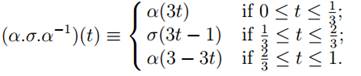
Proof Let α: [0, 1] → X˜ be a path in X˜ for which α(0) = w0 and α(1) = w1. (Such a path exists since X˜ is path-connected.) Then each loop σ in X˜ based at w1 determines a corresponding loop α.σ.α−1 in X˜ based at w0, where
(This loop traverses the path α from w0 to w1, then continues round the loop σ, and traverses the path α in the reverse direction in order to return from w1 to w0.) Let η: [0, 1] → X be the loop in X based at the point x0 given by η = p ◦ α, and let ϕ: π1(X, x0) → π1(X, x0) be the automorphism of the group π1(X, x0) defined such that ϕ([γ]) = [η][γ][η] −1 for all loops γ in X based at the point x0. Then p ◦ (α.σ.α−1) = η.(p ◦ σ).η−1, and therefore p#([α.σ.α−1]) = [η]p#([σ])[η]−1 = ϕ(p#([σ])) in π1(X, x0). It follows that ϕ(H1) ⊂ H0. Similarly ϕ−1 (H0) ⊂ H1, where ϕ−1 ([γ]) = [η]−1 [γ][η] for all loops γ in X based at the point x0. It follows that ϕ(H1) = H0, and thus the subgroups H0 and H1 are conjugate Now let H be a subgroup of π1(X, x0) which is conjugate to H0. Then H0 = [η]H[η]−1 for some loop η in X based at the point x0. It follows from the Path Lifting Theorem for covering maps (Theorem (Path Lifting Theorem) that there exists a path α: [0, 1] → X˜ in X˜ for which α(0) = w0 and p ◦ α = η. Let w = α(1).
Then p#(π1(X, w˜ )) = [η]−1H0[η] = H, as required.








