Definition 1.1. A function is an ordered triple 〈f,A, B〉 such that
1. A and B are sets, and f ⊆ A × B,
2. For every x ∈ A there is some y ∈ B such that 〈x ,y〉 ∈ f
3. If 〈x ,y〉 ∈ f and 〈x ,z〉 ∈ f, then y = z; in other words, the assignment is unique in the sense that an x ∈ A is assigned at most one element of B.
A is called the domain of f, and B its codomain.
It is customary to write the function 〈f,A, B〉 as f : A → B. Also, if 〈x ,y〉 ∈ f, then we will usually write y = f(x), and call y the image of x under f.
The set {y ∈ B : There is an x ∈ A such that y = f(x)} is called the range of f.
Observe that the range of f is always a subset of the codomain. Observe carefully the distinction between f(x) and f: Whereas f(x) is an element of the codomain, f is the rule of assignment, conveniently expressed as a subset of A × B.
Suppose that f : A → B and g : C → D are functions. It follows from the definition of a function that they are equal if and only if
1. A = C,
2. B = D,
3. f = g.
If for a function f : A → B it is clear what A and B are, we sometimes call the function simply f, but we must keep in mind that a function is only properly defined if we also give a domain and a codomain!
Usually, after having agreed on a domain and a codomain, f is given by a rule,
e.g. f(x) = x2 , f(t) = sin t,f(n) = n + 1. As in the previous section
with relations, we sometimes use a diagram to describe a function; for example, the diagram of Figure 1.1 describes the function f : A → B, where A = {1, −1, 0, −2} is the domain of f,B = {1, 0, 2, 4, } is its codomain, and f = {〈1, 1〉,〈−1, 1〉,〈0, 0〉,〈−2, 4〉}.
Figure 1.1: Function arrow diagram
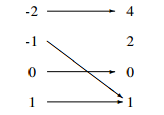
Observe that for all x ∈ A, f(x) = x2 . This can also be indicated by writing x → x2 .
The definition of a function implies that each element of A is the origin of exactly one arrow; it does not imply that at each element of B is the target of an arrow, or that only one arrow from A points to a single element of B. Functions with these properties have special names, and we shall look at them in a later section.
Definition 1.2. Let f : A → B be a function.
1. If A = B and f(x) = x for all x ∈ A, the f is called the identity function on A, and it is denoted by idA.
2. If A ⊆ B and f(x) = x for all x ∈ A, then f is called the inclusion function from A to B, or, if no confusion can arise, simply the inclusion. Observe that, if A = B and f is the inclusion, then f is in fact the identity on A.
3. If f(x) = x for some x ∈ A, then x is called a fixed point of f.
4. If f(x) = b for all x ∈ A, then f is called a constant function.
5. If g : C → D is a function such that A ⊆ C, B ⊆ D, and f ⊆ g, then g is
called an extension of f over C, and f is called the restriction of g to A.
While a function may have many different extension, it can only have one restriction to a subset of its domain. The following diagrams shall illustrate these situations:
Consider the assignment h(x) = (sin x)2 , and suppose that dom h = codom h = R. To find h(x) for a given x, we do two things:
1. First find sin x and set y = sin x;
2. Then find y2.
If we look close enough, we find that we have actually used two functions to find h(x):
1. f : R → R, f(x) = sin x,
2. g : R → R, g(y) = y2,
This shows that h(x) = g(f(x)): We have first applied f to x, found that f(x) is an element of dom g, and then applied g to f(x). This brings us to
Definition 1.3. Let f : A → B and g : C → D be functions such that ran f ⊆ dom g. Then the function g ◦ f : A → C defined by (g ◦ f)(x) = g(f(x)) is called the (functional) composition of f and g.
the reason for using a different interpretation of composition for functions is historical, and we shall not go into details.
Lemma 1.1. If f and g are functions such that ran f ⊆ dom g, then dom(g ◦ f) = dom f, and codom(g ◦ f) = codom g.
Proof. This follows immediately from the definition of composite functions.
One the most useful properties of functional composition is the following:
Lemma .1.2. Let f : A → B, g : B → C, h : C → D be functions. Then, h ◦ (g ◦ f) = (h ◦ g) ◦ f, i.e. the composition of functions is associative.
Proof. Let p = h ◦ (g ◦ f), and q = (h ◦ g) ◦ f; to show that two functions are equal we use the remarks following to find their domains and co-domains.
Looking first at p, we see that p is the composite of the functions g ◦ f and h, so, we will have to look at g ◦ f first. Now, dom(g ◦ f) = dom f = A by Lemma
1.1, thus, dom p = dom h ◦ (g ◦ f) = A. Next,
codom p = codom h ◦ (g ◦ f) = codom h = D, also by Lemma 1.1.
Looking at q, we see by a similar reasoning that dom q = A and that codom q = codom(h ◦ g). Since codom(h ◦ g) = codom h, we have codom h = D; thus, we find that dom p = dom q, and codom p = codom q.
All that is left to show is that p = q, i.e. that p(x) = q(x) for all x ∈ A. Let x ∈ A;
then,
p(x) = (h ◦ (g ◦ f))(x)
= h((g ◦ f)(x))
= h(g(f(x)))
= (h ◦ g)(f(x))
= ((h ◦ g) ◦ f)(x)
= q(x).
Thus, (p,A, D) = (q, A, D)








