Thus far, we have not paid much attention to the structure a relation imposes on a set; in this section we shall define several ordering relations. As a first example, let A = N and let R be the relation defined by hx,yi ∈ R iff x ≤ y; we note that ≤ (or R) has the properties that for all x,y, z ∈ N,
1. x ≤ x,
2. If x ≤ y and y ≤ x then x = y,
3. If x ≤ y and y ≤ z then x ≤ z,
4. x ≤ y or y ≤ x, i.e. any two elements of N are comparable with respect to ≤.
We shall use the first three properties to define our first type of ordering relation:
Definition 1.1. Let R be a relation on A.
1. R is reflexive if 〈x,x〉 ∈ R for all x ∈ A.
2. R is antisymmetric if for all x,y ∈ A, 〈x,y〉 ∈ R and 〈y,x〉 ∈ R implies x = y.
3. R is transitive if for all x,y,z ∈ A, 〈x,y〉 ∈ R and 〈y,z〉 ∈ R implies 〈x,z〉 ∈ R.
4. R is a partial order on A, if R is reflexive, antisymmetric, and transitive.
Sometimes we will call a partial order on A just an order on A, or an ordering of A.
5. R is a linear order on A if R is a partial order, and xRy or yRx for all x,y ∈ A, i.e. if any two elements of A are comparable with respect to R.
If R is an ordering relation on A, then we usually write ≤ (or a similar symbol) for R, i.e. x ≤ y iff xRy. If ≤ is a partial order on A, then we call the pair hA, ≤i a partially ordered set, or just an ordered set. If ≤ furthermore is a linear order, then hA, ≤i is called a linearly ordered set or a chain.
For a finite partially ordered set 〈A, ≤〉 we can draw an order diagram by the following rules: If a ≤ b and a ≠b, then put b above a. b need not be directly
above a, but also may be shifted to one side or the other. If there is no element between a and b, you connect them by a line.
Example .1. 1. Let A = {0, 1,a, b,c}, and define
by the diagram given in Fig. 1.1
Figure 1.1: The diamond
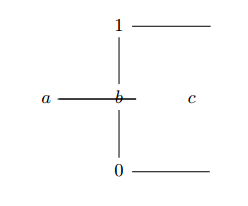
This diagram represents the following relation on A:
0 ≤ 0, 0 ≤ a, 0 ≤ b, 0 ≤ c, 0 ≤ 1, a ≤ a, a ≤ 1, b ≤ b, b ≤ 1, c ≤ c, c ≤ 1, 1 ≤ 1.
It is not hard to see that this is indeed a partial order on A.
2. Let A = {2, 3, 4, 5, 6}, and define R by the usual ≤ relation on N, i.e. aRb iff a ≤ b. Then R is a linear order on A.
3. Let us define another relation on N by
(1.1) a/b iff a divides b.
To show that / is a partial order we have to show the three defining properties of a partial order relation:
Reflexive: Since every natural number is a divisor of itself, we have a/a for all a ∈ A.
Antisymmetric: If a divides b then we have either a = b or  in the
usual ordering of N; similarly, if b divides a, then b = a or b
a. Since  is not possible, a/b and b/a implies a = b.
Transitive: If a divides b and b divides c then a also divides c.
Thus, / is a partial order on N.
4. Let A = {x,y} and define ≤ on the power set P(A) by s ≤ t iff s is a subset of t
This gives us the following relation:
∅ ≤ ∅, ∅ ≤ {x}, ∅ ≤ {y}, ∅ ≤ {x,y} = A, {x} ≤ {x}, {x} ≤ {x,y}
{y} ≤ {y}, {y} ≤ {x,y} {x,y} ≤ {x,y}.








