Definition : A topological space X is said to be connected if the empty set ∅ and the whole space X are the only subsets of X that are both open and closed.
Lemma 1.1 A topological space X is connected if and only if it has the following property: if U and V are non-empty open sets in X such that X = U ∪ V , then U ∩ V is nonempty.
Proof If U is a subset of X that is both open and closed, and if V = X U, then U and V are both open, U ∪ V = X and U ∩ V = ∅. Conversely if U and V are open subsets of X satisfying U ∪ V = X and U ∩ V = ∅, then U = X V , and hence U is both open and closed. Thus a topological space X is connected if and only if there do not exist non-empty open sets U and V such that U ∪ V = X and U ∩ V = ∅. The result follows.
Let Z be the set of integers with the usual topology (i.e., the subspace topology on Z induced by the usual topology on R). Then {n} is open for all n ∈ Z, since
{n} = Z ∩ {t ∈ R : |t − n| <1/2}.
It follows that every subset of Z is open (since it is a union of sets consisting of a single element, and any union of open sets is open). It follows that a function f: X → Z on a topological space X is continuous if and only if f−1 (V ) is open in X for any subset V of Z. We use this fact in the proof of the next theorem.
Proposition 1.2 A topological space X is connected if and only if every continuous function f: X → Z from X to the set Z of integers is constant.
Proof Suppose that X is connected. Let f: X → Z be a continuous function.
Choose n ∈ f(X), and let
U = {x ∈ X : f(x) = n}, V = {x ∈ X : f(x) ≠n}.
Then U and V are the preimages of the open subsets {n} and Z {n} of Z, and therefore both U and V are open in X. Moreover U ∩ V = ∅, and X = U ∪ V . It follows that V = X U, and thus U is both open and closed. Moreover U is non-empty, since n ∈ f(X). It follows from the connectedness of X that U = X, so that f: X → Z is constant, with value n.
Conversely suppose that every continuous function f: X → Z is constant.
Let S be a subset of X which is both open and closed. Let f: X → Z be defined by
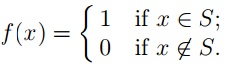
Now the preimage of any subset of Z under f is one of the open sets ∅, S, X S and X. Therefore the function f is continuous. But then the function f is constant, so that either S = ∅ or S = X. This shows that X is connected.
Lemma 1.3 The closed interval [a, b] is connected, for all real numbers a and b satisfying a ≤ b.
Proof Let f: [a, b] → Z be a continuous integer-valued function on [a, b]. We show that f is constant on [a, b]. Indeed suppose that f were not constant. Then f(τ ) ≠f(a) for some τ ∈ [a, b]. But the Intermediate Value Theorem would then ensure that, given any real number c between f(a) and f(τ ), there would exist some t ∈ [a, τ ] for which f(t) = c, and this is clearly impossible, since f is integer-valued. Thus f must be constant on [a, b]. We now deduce from Proposition 1.2 that [a, b] is connected.
Example: Let X = {(x, y) ∈ R2: x ≠0}. The topological space X is not connected. Indeed if f: X → Z is defined by
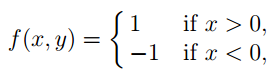
then f is continuous on X but is not constant.
A concept closely related to that of connectedness is path-connectedness.
Let x0 and x1 be points in a topological space X. A path in X from x0 to x1 is defined to be a continuous function γ: [0, 1] → X such that γ(0) = x0 and γ(1) = x1. A topological space X is said to be path-connected if and only if, given any two points x0 and x1 of X, there exists a path in X from x0 to x1.
Proposition 1.4 Every path-connected topological space is connected.
Proof Let X be a path-connected topological space, and let f: X → Z be a continuous integer-valued function on X. If x0 and x1 are any two points of X then there exists a path γ: [0, 1] → X such that γ(0) = x0 and γ(1) = x1. But then f ◦ γ: [0, 1] → Z is a continuous integer-valued function on [0, 1]. But [0, 1] is connected (Lemma 1.3), therefore f◦γ is constant (Proposition 1.2). It follows that f(x0) = f(x1). Thus every continuous integer-valued function on X is constant. Therefore X is connected, by Proposition 1.30.
The topological spaces R, C and Rn are all path-connected. Indeed, given any two points of one of these spaces, the straight line segment joining these two points is a continuous path from one point to the other. Also the n-sphere Sn is path-connected for all n > 0. We conclude that these topological spaces are connected.
Let A be a subset of a topological space X. Using Lemma 1.1 and the definition of the subspace topology, we see that A is connected if and only if the following condition is satisfied:
• if U and V are open sets in X such that A∩U and A∩V are non-empty and A ⊂ U ∪ V then A ∩ U ∩ V is also non-empty.
Lemma 1.5 Let X be a topological space and let A be a connected subset of X. Then the closure Ᾱ of A is connected.
Proof It follows from the definition of the closure of A that Ᾱ ⊂ F for any closed subset F of X for which A ⊂ F. On taking F to be the complement of some open set U, we deduce that Ᾱ∩ U = ∅ for any open set U for which A ∩ U = ∅. Thus if U is an open set in X and if Ᾱ ∩ U is non-empty then A ∩ U must also be non-empty.
Now let U and V be open sets in X such that Ᾱ ∩ U and Ᾱ∩ V are non-empty and Ᾱ ⊂ U ∪ V . Then A ∩ U and A ∩ V are non-empty, and A⊂ U ∪ V . But A is connected. Therefore A ∩ U ∩ V is non-empty, and thus Ᾱ ∩ U ∩ V is non-empty. This shows that Ᾱ is connected.
Lemma 1.6 Let f:X → Y be a continuous function between topological spaces X and Y , and let A be a connected subset of X. Then f(A) is connected.
Proof Let g: f(A) → Z be any continuous integer-valued function on f(A).
Then g ◦ f: A → Z is a continuous integer-valued function on A. It follows from Proposition 1.30 that g ◦ f is constant on A. Therefore g is constant on f(A). We deduce from Proposition 1.30 that f(A) is connected.
Lemma 1.7 The Cartesian product X × Y of connected topological spaces X and Y is itself connected.
Proof Let f: X×Y → Z be a continuous integer-valued function from X×Y to Z. Choose x0 ∈ X and y0 ∈ Y . The function x → f(x, y0) is continuous on X, and is thus constant. Therefore f(x, y0) = f(x0, y0) for all x ∈ X. Now fix x. The function y → f(x, y) is continuous on Y , and is thus constant.
Therefore
f(x, y) = f(x, y0) = f(x0, y0)
for all x ∈ X and y ∈ Y . We deduce from Proposition 1.30 that X × Y is connected.
We deduce immediately that a Finite Cartesian product of connected topological spaces is connected.
Proposition 1.8 Let X be a topological space. For each x ∈ X, let Sx be the union of all connected subsets of X that contain x. Then
(i) Sx is connected,
(ii) Sx is closed,
(iii) if x, y ∈ X, then either Sx = Sy, or else Sx ∩ Sy = ∅.
Proof Let f: Sx→ Z be a continuous integer-valued function on Sx, for some x ∈ X. Let y be any point of Sx. Then, by definition of Sx, there exists some connected set A containing both x and y. But then f is constant on A, and thus f(x) = f(y). This shows that the function f is constant on Sx. We deduce that Sx is connected. This proves (i). Moreover the closure  is connected, by Lemma 1.33. Therefore v
  ⊂ Sx. This shows that Sx is closed, proving (ii).
Finally, suppose that x and y are points of X for which Sx ∩ Sy ≠∅. Let f: Sx ∪ Sy → Z be any continuous integer-valued function on Sx ∪ Sy. Then f is constant on both Sx and Sy. Moreover the value of f on Sx must agree with that on Sy, since Sx ∩ Sy is non-empty. We deduce that f is constanton Sx ∪ Sy. Thus Sx ∪ Sy is a connected set containing both x and y, and thus Sx ∪Sy ⊂ Sx and Sx ∪Sy ⊂ Sy, by definition of Sx and Sy. We conclude that Sx = Sy. This proves (iii).
Given any topological space X, the connected subsets Sx of X defined as n the statement of Proposition 1.8 are referred to as the connected components of X. We see from Proposition 1.8, part (iii) that the topological space X is the disjoint union of its connected components.
Example : The connected components of
{(x, y) ∈ R2: x ≠ 0} are{(x, y) ∈ R2: x > 0} and {(x, y) ∈ R2: x < 0}
Example : The connected components of
{t ∈ R : |t − n| <1/2for some integer n}.
are the sets Jn for all n ∈ Z, where Jn = (n −1/2, n +1/2).








