Thermal Expansion and Heat Capacity
a) Find the temperature dependence of the thermal expansion coefficient if the interaction between atoms is described by a potential
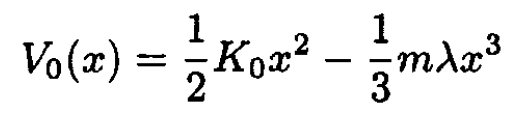
where λ is a small parameter.
b) Derive the anharmonic corrections to the Dulong–Petit law for a potential
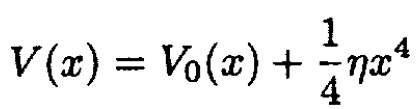
where η is a small parameter.
SOLUTION
a) First solution: We can calculate the average displacement of an oscillator:
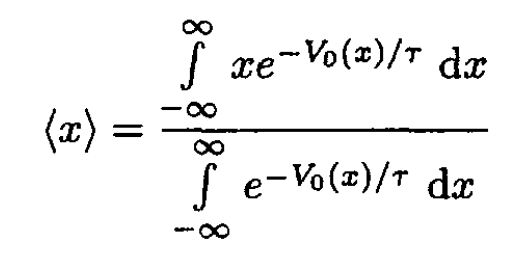 (1)
(1)
Since the anharmonic term is small, mλx3/3 << τ, we can expand the exponent in the integral:
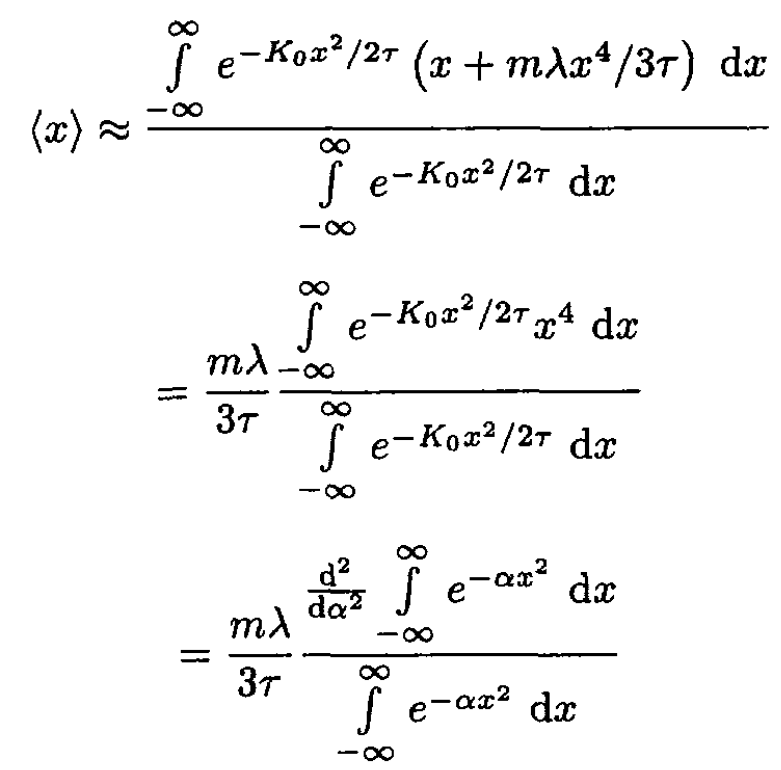 (2)
(2)
where we set α ≡ K0/2τ. So,
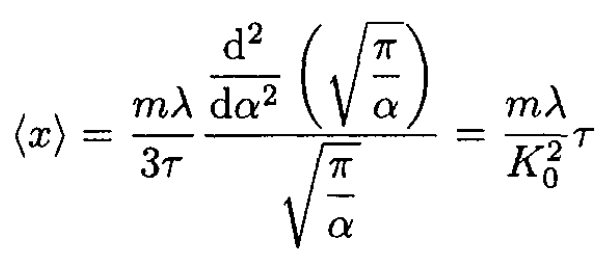 (3)
(3)
Note that, in this approximation, the next term in the potential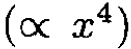 would not have introduced any additional shift (only antisymmetric terms do).
Second solution: We can solve the equation of motion for the nonlinear harmonic oscillator corresponding to the potential V0(x):
 (4)
(4)
where  is the principal frequency. The solution gives
 (5)
(5)
where A' is defined from the initial conditions and A is the amplitude of oscillations of the linear equation. The average ⟨x⟩ over a period T = 2π/ω0 is
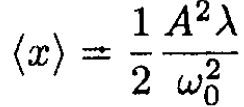 (6)
(6)
We need to calculate the thermodynamic average of ⟨x⟩:
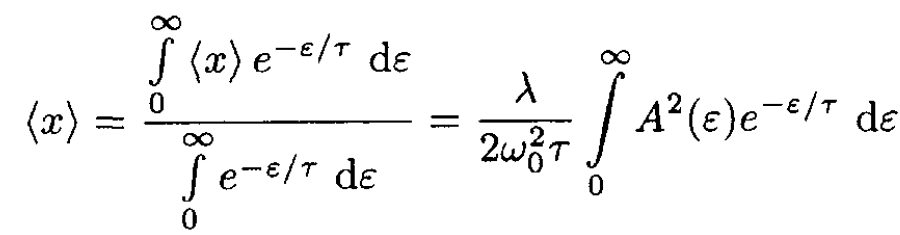 (7)
(7)
Substituting A2(ε) =2ε/K0, we obtain
 (8)
(8)
the same as before.
b) The partition function of a single oscillator associated with this potential energy is
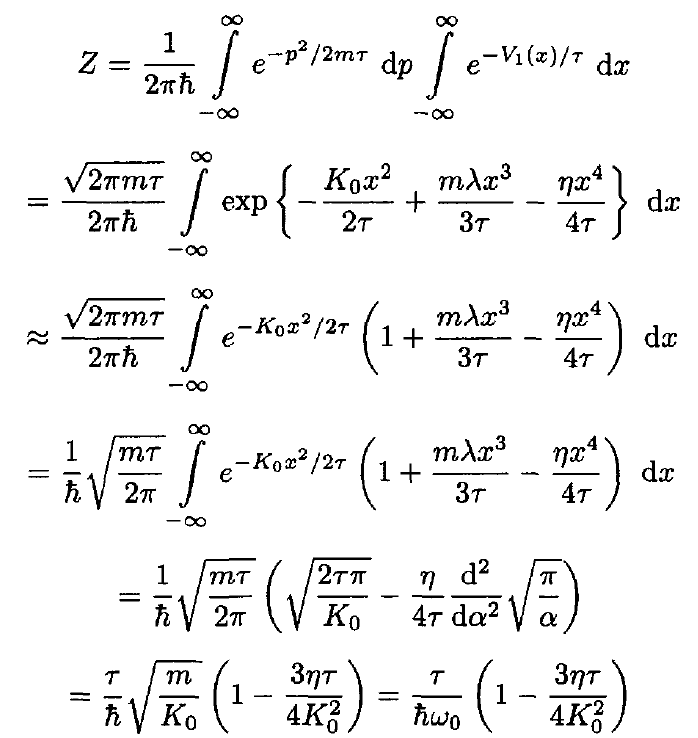 (9)
(9)
So, the free energy F per oscillator is given by
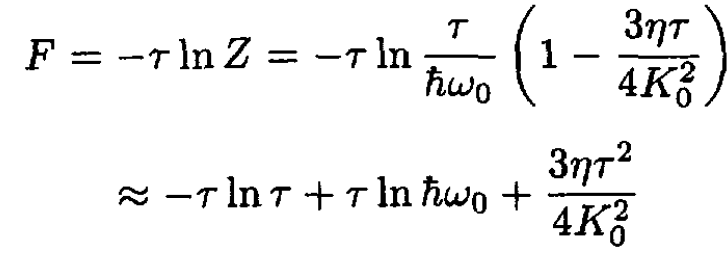 (10)
(10)
where we approximated ln (1 – x) ≈ - x. The energy per oscillator may be found from
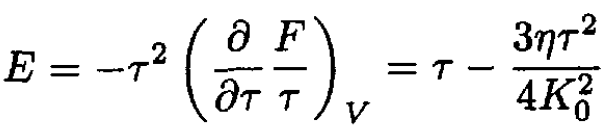 (11)
(11)
The heat capacity is then
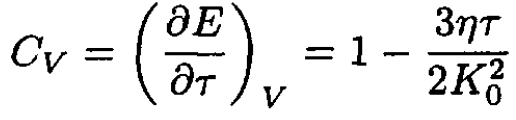 (12)
(12)
The anharmonic correction to the heat capacity is negative.








