Shallow Square Well I
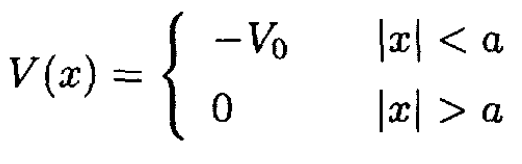
A particle of mass m moving in one dimension has a potential V(x) which is a shallow square well near the origin:
 (1)
(1)
where V0 is a positive constant. Derive the eigenvalue equation for the state of lowest energy, which is a bound state (see Figure 1.1).
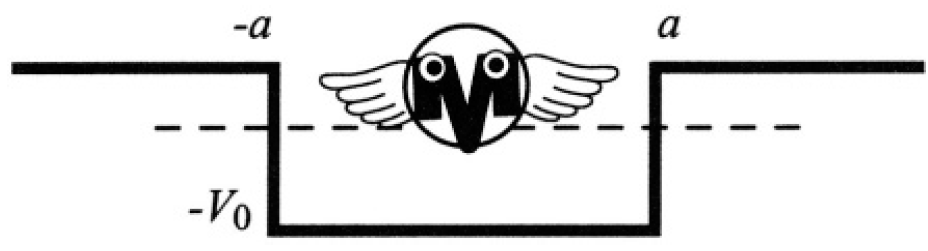
Figure 1.1
SOLUTION
The ground state energy E must be less than zero and greater than the bottom of the well, 0 > E > -V0. From the expression
 (1)
(1)
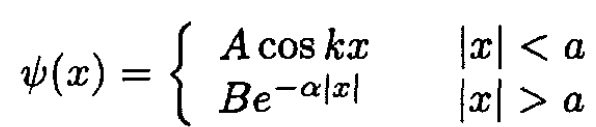
one can deduce the form for the eigenfunction. Denote the ground state energy E = -h2α2/2m, where α is to be determined. The eigenfunction outside the well (V = 0) has the form exp(-α|x|). Inside the well, define k2 = k20 – α2, where k20 = 2mV0/h2. One can show that k2 is positive since E + V0 > 0. Inside the well, the eigenfunction has the form A cos kx, so
 (2)
(2)
Matching ѱ(x) and its derivative at x = a gives two expressions:
 (3)
(3)
 (4)
(4)
Dividing these two equations produces the eigenvalue equation
 (5)
(5)
The equation given by the rightmost equals sign is an equation for the unknown k. Solving it gives the eigenvalue E.








