Keq and ΔG0 Are Measures of a Reaction’s Tendency to Proceed Spontaneously
The tendency of a chemical reaction to go to completion can be expressed as an equilibrium constant.
aA + bB → cC + dD
For the reaction the equilibrium constant, Keq, is given by
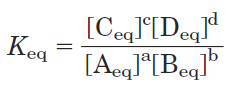
where [Aeq] is the concentration of A, [Beq] the concentration of B, and so on, when the system has reached equilibrium. A large value of Keq means the reaction tends to proceed until the reactants have been almost completely converted into the products.
Gibbs showed that ΔG for any chemical reaction is a function of the standard free-energy change, ΔG0— a constant that is characteristic of each specific reaction—and a term that expresses the initial concentrations of reactants and products:

where [Ai] is the initial concentration of A, and so forth; R is the gas constant; and T is the absolute temperature. When a reaction has reached equilibrium, no driving force remains and it can do no work: ΔG = 0. For this special case, [Ai] = [Aeq], and so on, for all reactants and products, and

Substituting 0 for ΔG and Keq for [Ci]c[Di]d/[Ai]a[Bi]b in Equation 1–1, we obtain the relationship
ΔG0 = -RT ln Keq
from which we see that ΔG0 is simply a second way (besides Keq) of expressing the driving force on a reaction. Because Keq is experimentally measurable, we have a way of determining ΔG0, the thermodynamic constant characteristic of each reaction. The units of ΔG0 and ΔG are joules per mole (or calories per mole). When Keq >> 1, ΔG0 is large and negative; when Keq << 1, ΔG0 is large and positive. From a table of experimentally determined values of either Keq or ΔG0, we can see at a glance which reactions tend to go to completion and which do not. One caution about the interpretation of ΔG0: thermodynamic constants such as this show where the final equilibrium for a reaction lies but tell us nothing about how fast that equilibrium will be achieved. .








