X IS LIKE Y: The emergence of similarity mappings in children’s early speech and gesture
Developmental changes in children’s production of ‘X IS LIKE Y’ construction in their speech
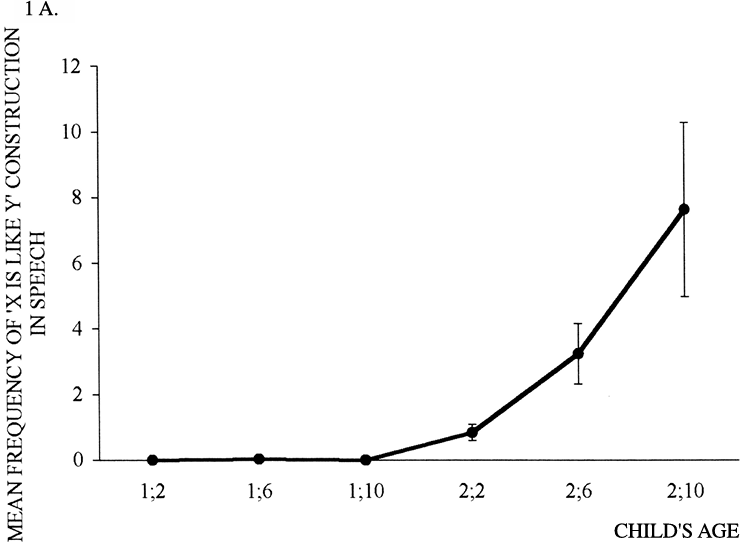
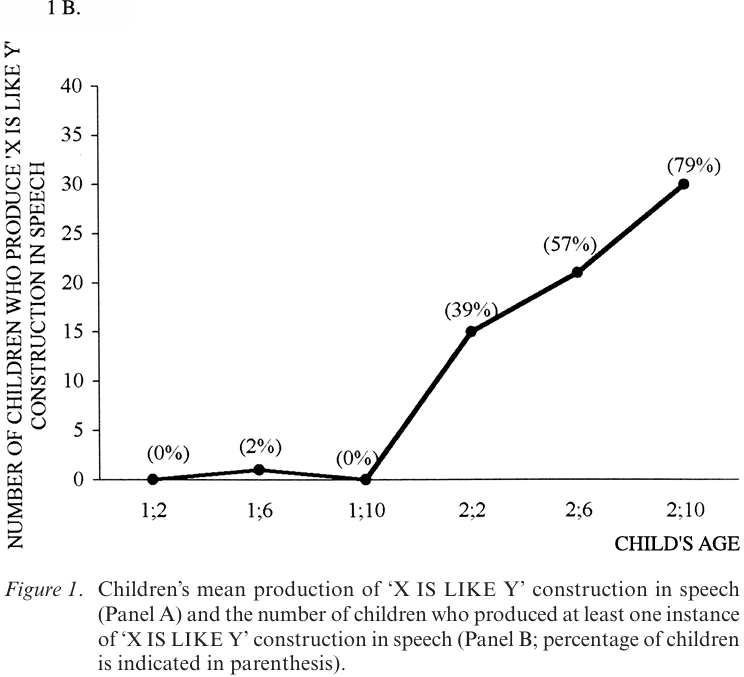
We focus our analysis on the ‘X IS LIKE Y’ constructions because the word like2 is one of the earliest signs of similarity mapping ability in young children. Figure 1A shows children’s mean production of ‘X IS LIKE Y’ constructions in speech, and Figure 1B shows the number of children who produced this construction in speech at least once over the six time periods. As the figures illustrate, children did not routinely produce the ‘X IS LIKE Y’ construction in speech until age 2;2.3 At 2;2, there were 15 children who produced the construction at a mean frequency of 0.84. Children significantly increased their production of the construction over time (F(5, 170)=6.9, p<0.001), showing a reliable increase from age 2;2 (M=3.24) to age 2;10 (M=7.63; p<0.005, Schéffe). The number of children who produced the construction also increased with age. At age 2;2, about 40% of the children used the construction in their speech, but by age 2;10, almost 80% of the children produced at least one instance of the construction in their speech.
The construction ‘X IS LIKE Y’ involves both a source (Y, e.g., rainbow in Butterfly is like a rainbow) and a target domain (X, e.g., butterfly in Butterfly is like a rainbow). Initially children’s uses of the construction did not contain both domains. They expressed only one domain (typically the source) and the other (typically the target) could be inferred from context (examples 1–3).
(1) Look like a house + CHILD IS LOOKING AT A CHURCH PAINTING [2;2]4
‘Church painting looks like a house’
(2) Just like potato-head + CHILD IS PLAYING A COMPUTER GAME SIMILAR TO POTATO-HEAD
[2;6]
‘Computer game is like potato-head’
(3) Like a mean monster + CHILD HAS BEEN TALKING ABOUT TORNADOS [2;10]
‘Tornado is like a mean monster’
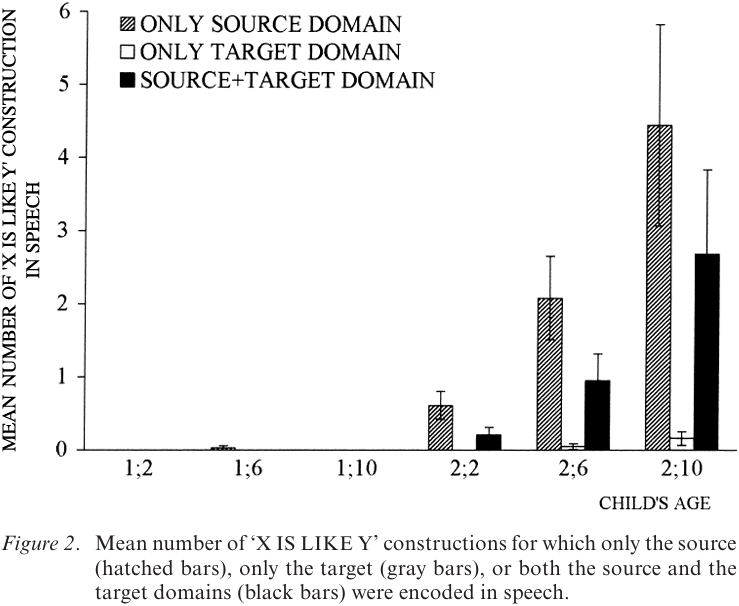
Thus, children’s initial uses of the construction showed an effect of domain type (F(2, 68)=16.17, p<0.0001). As Figure 2 illustrates, once children began producing the ‘X IS LIKE Y’ construction, they were significantly more likely to express the source domain on its own than either the target domain on its own (p<0.0001, Schéffe) or the source and target domains together (p<0.03, Schéffe).
There was also an effect of age in the children’s expression of source and target domains (F(5, 170)=6.77, p<0.0001), which interacted with domain type (F(10, 340)=6.88, p<0.0001). Children increased the number of ‘X IS LIKE Y’ constructions they produced containing the source domain on its own over time (F(5, 170) = 8.25, p<0.0001) and the source and target domains together (F(5, 170) = 4.66, p<0.001), with significant changes from age 2;2 to age 2;10 for both (p’s<0.05, Schéffe). However, no such developmental trend was observed for the target domain on its own– whenever the children expressed the target domain of a similarity mapping, they also expressed the source domain (see examples 4–6).
(4) That one like this one + CHILD IS HOLDING AN ORNAMENT AND LOOKING AT ANOTHER ORNAMENT IN HER MOTHER’S HAND [2;2]
‘Child’s ornament is like mother’s ornament’
(5) Bunny looks like me + CHILD IS TALKING ABOUT A BUNNY CHARACTER ON TV [2;6] ‘Bunny looks like child’
(6) The cow is like that cow there + CHILD IS TALKING ABOUT THE TWO COWS IN THE TWO PUZZLES HE IS PLAYING WITH [2;10]
‘The cow in one puzzle is like the cow in the other puzzle’
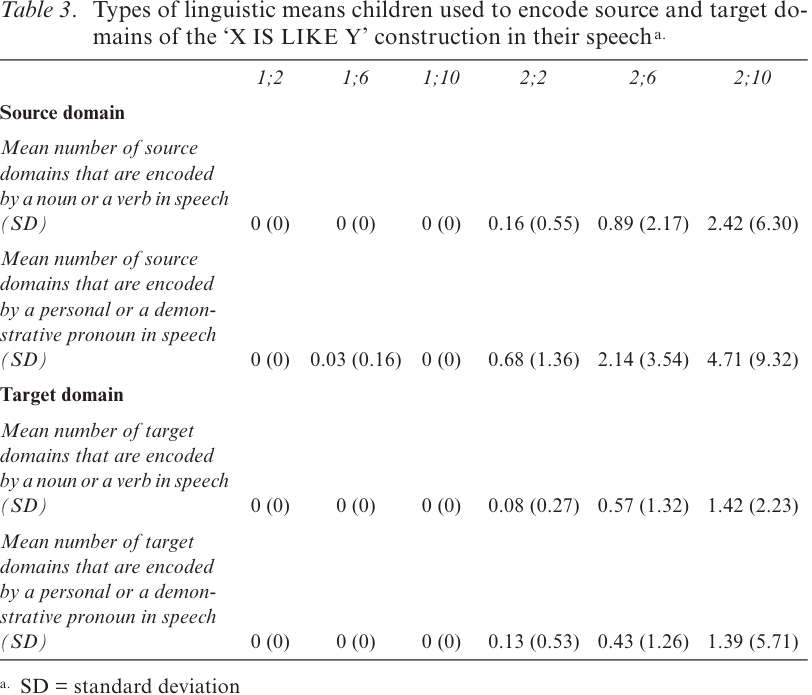
Children also showed developmental changes in the linguistic means they used to express the source and target domains of the ‘X IS LIKE Y’ construction. As can be seen in Table 3, they predominantly relied on demonstrative (this, that, these, those) and personal (it, he, she, me) pronouns to express the source domain and reliably increased their use of pronominal references over time (F(5, 170)=7.95, p<0.0001, M=0.68 at age 2;2 vs. M=4.71 at age 2;10). They used explicit nouns (e.g., baby, spider) or verbs (e.g., climb, eat) to express the source domain far less often. Nevertheless, their use of nominal devices also increased reliably
with age (F(5, 170)=4.81, p<0.001, M=0.16 at age 2;2 vs. M=2.42 at age 2;10) (see examples 7–9).
(7) Looks like it + CHILD IS COMPARING BINGBONG IN BOOK TO SQUIRREL OUTSIDE [2;2]
‘Bingbong looks like squirrel’
(8) Just like Dori + CHILD IS COMPARING HER VOICE TO THAT OF DORI IN MOVIE [2;6]
‘Child’s voice like Dori’s voice’
(9) Look like a whale + CHILD IS LOOKING AT A WHALE PICTURE IN ALBUM [2;10]
‘Whale picture looks like a whale’
The pattern was slightly different for the target domain. Children used both linguistic devices (pronominal and nominal) at roughly equal rates at each age. Their use of nouns and verbs to express the target domain increased reliably over time (F(5, 170)=11.56, p<0.0001; M=0.08 at age 2;2 vs. M=1.42 at age 2;10), but their use of pronominal reference to express the target domain did not (F(5, 170)=1.97, ns; M=0.13 at age 2;2 vs. M=1.39 at age 2;10) (see examples 10–12).
(10) Do you close it like this? + CHILD CLOSES DOOR BY PUSHING IT WITH FOOT [2;6]
‘Do you close door like you close it by pushing it with foot?’
(11) Baby like the one at grandma’s + CHILD IS PLAYING WITH A BABY DOLL [2;2]
‘Baby doll is like the baby doll at grandmother’s house’
(12) Dad is like D and dog + CHILD IS LEARNING HOW TO SPELL LETTER D [2;10]
‘D in dad is like D in dog’
In summary, children began to use the ‘X IS LIKE Y’ construction in their spontaneous speech by age 2;2, a time period much earlier than what has been reported in earlier experimental studies and anecdotal reports. Although their initial uses of the construction typically encoded only the source domain, they showed an increasing tendency to encode both the source and the target domains over time.
2. The word like in children’s speech became polysemous at age 2;2, functioning as a verb in some instances (e.g., I like ice-cream) and as a comparative marker in others (e.g., ice-cream cone is like mushroom). Beginning at age 2;6, a few children occasionally used like as a discourse marker. Here, we focus exclusively on the uses of like as a comparative marker.
3. The only exception was one child who produced one instance of such a construction at age 1;6.
4. Speech is provided in italics and any nonverbal information (e.g., gesture, communicative context) is given in small caps; the age of each child is indicated in brackets. Each example is followed by a gloss that approximates what the child is intending to convey in his/her communication.








