X IS LIKE Y: The emergence of similarity mappings in children’s early speech and gesture
Developmental changes in children’s overall production of speech and gesture
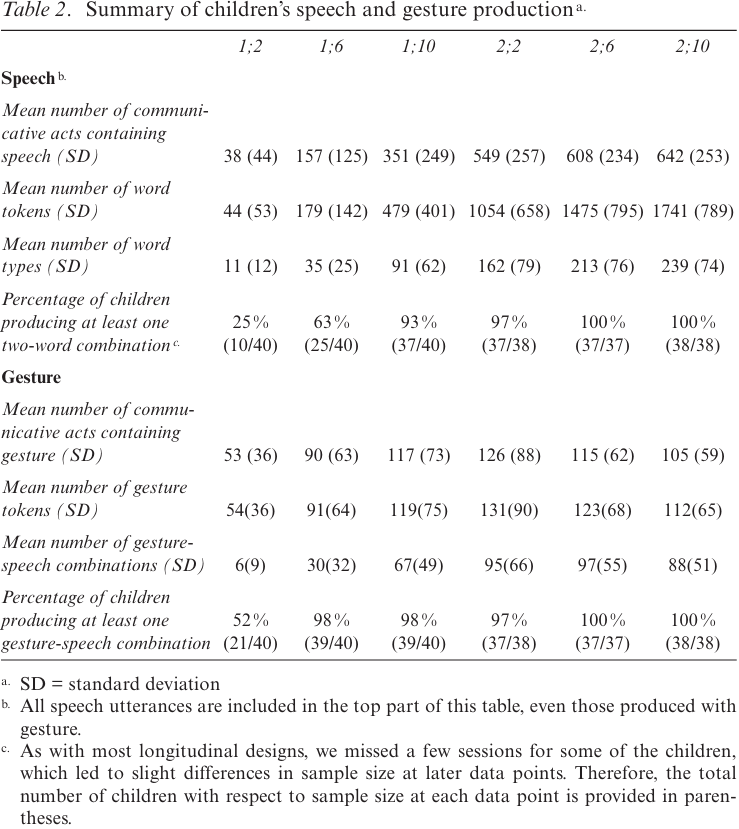
A broad look at the children’s speech showed that they steadily increased their speech production over time. As can be seen in Table 2, children produced more communicative acts containing speech (F(5,170)=84.09, p<0.001), more different word types (F(5,170)=174.74, p<0.001), and more words overall (i.e., tokens, F(5,170)=95.32, p<0.001) with increasing age. There was a significant increase in the number of communicative acts containing speech and word types between ages 1;6 and 1;10 (p’s<0.001, Schéffe), and significant increases in all three measures from age 1;10 to 2;2 (p’s<0.001, Schéffe). In addition, children continued to increase their word tokens and word types from age 2;2 to 2;6 (p’s<0.01, Schéffe). Children’s verbal lexicons showed a steep increase from 11 word types and 44 word tokens at age 1;2 to 239 word types and 1741 word tokens at age 2;10, and the majority of the children (37/40) were producing multi-word combinations by age 1;10.
Children also increased their gesture production over time. They produced more communicative acts with gesture (F(5,170)=10.22, p<0.001), more gesture tokens (F(5,170)=10.82, p<0.001), and more gesture-speech combinations (F(5,170)=34.29, p<0.001) with increasing age. There were significant increases in the mean number of communicative acts with gesture and in gesture tokens between ages 1;2 and 1;6 (p’s<0.05, Schéffe), and a significant increase in the mean number of gesture-speech combi nations between ages 1;6 and 1;10 (p<0.01, Schéffe). By 1;2, only half of the children (21/40) were producing gesture-speech combinations, but by 1;6, all but one child were combining gesture with speech. Thus, overall children showed steady increases in their speech and gesture production over time.