The complex sentence
The highest grammatical unit is traditionally called the sentence. Three possible types are usually distinguished:
• The simple sentence consists minimally of one independent clause, as in Sam bought the tickets.
• The compound sentence consists basically of two independent clauses, linked in a relationship of coordination, as in Sam bought the tickets and Sue parked the car.
• The complex sentence consists minimally of one independent clause and one dependent clause, linked in a relationship of dependency, as in Sam bought the tickets while Sue parked the car.
In connected discourse, however, the combinations may be more complex and variable than this simple outline suggests. Coordination and subordination of clauses do not occur unrelatedly, each in combination with a main clause. More often they interrelate. Numerous combinations are possible. Here are two examples. In these examples the + sign indicates coordination, the x sign subordination. Example 1, based on a news item, has one main clause with two dependent clauses successively subordinated as adjuncts:
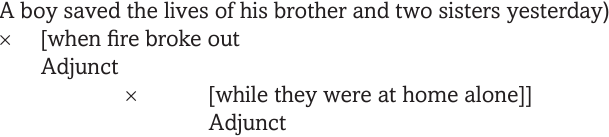
1 A boy of six saved the lives of his brother and two sisters yesterday (1) when fire broke out (2) while they were at home alone (3).
[AHX]
The three clauses are organized in a hierarchical relationship. The independent clause encodes the main content – A boy saved the lives of his brother and two sisters yesterday. The two subordinate clauses encode the circumstances of time and place. The first functions as adjunct in the main clause, the second as adjunct in the previous subordinate clause. This is a case of double, or ‘layered’ subordination:
Example 2 warns of the dangers of walking on hills:
2 (However,) hillwalking is largely safe (1) but there are risks (2) and we have to educate people about these risks (3) if we are going to improve safety (4).
Leaving aside the connective adjunct however, two coordinated clauses (1 and 2) are followed by a unit consisting of a third coordinated clause (3) in which a conditional clause is subordinated as adjunct.
(hillwalking is largely safe) + (but there are risks) + (and we have to educate people about these risks) × (if we are going to improve safety) Adjunct
Adopting a broader application of the term, we will say that a complex sentence can consist of any number of clauses of different types and in different combinations.








