Lexical entries
Linguists use the term LEXICON to refer to the collection of all the words (or meaningful elements) in the language; we often think of it as the speaker’s “mental dictionary.” Each individual word is referred to as a lexical item. For each LEXICAL ITEM, the lexicon must specify how it is pronounced, what it means, and how it patterns in the grammar.
All of the phonological, semantic, and grammatical information which is specific to a particular word is included in its lexical entry. This LEXICAL ENTRY is somewhat analogous to an entry in a normal printed dictionary, which provides information about pronunciation, meaning, and part of speech. However, the grammatical information contained in a lexical entry may go far beyond the word’s part of speech (syntactic category). For example, we noted that one of the diagnostic features for nouns in English is that they can be inflected for number. There is, however, a large sub-class of nouns that cannot (in their most basic meanings) be pluralized. Nouns of this type are often called MASS NOUNS, while nouns which can be pluralized are called COUNT NOUNS. The contrast is illustrated in (1).
(1) a MASS NOUNS: this rice/salt/mud/money
COUNT NOUNS: this dog/house/tree/car
b MASS NOUNS: *these rices/salts/muds/moneys
COUNT NOUNs: these dogs/houses/trees/cars
Mass and count nouns exhibit other grammatical differences as well. Mass nouns cannot be modified by determiners such as a, many, few, three, eight, etc. (2a). Count nouns, on the other hand, cannot be used in their singular form with the determiner some (2b), or without any determiner (2c).
(2) a *a rice/salt/mud/money
a dog/house/tree/car
b Please give me some rice/salt/mud/money
Please give me some? dog/*house/*tree/*car
c Ilike rice/mud/?dog/*tree/*car.1
These differences in grammatical patterning can be used to separate the words that belong to the category Noun in to two sub-classes (or SUBCATEGORIES), count vs. mass nouns. Which sub-class a particular noun belongs to must be indicated in its lexical entry. In cases like this, where there is a simple two-way distinction to be made, linguists often think in terms of binary FEATURES.2 Features are used to represent a property that a given linguistic unit may or may not have. To distinguish between count vs. mass nouns, we could require the lexical entry of every noun to contain either the feature [+ count] (for count nouns) or [– count] (for mass nouns). Similarly, the subclass of AUXILIARY verbs, which have a number of special grammatical properties, could be distinguished from regular verbs by a feature [+ aux].
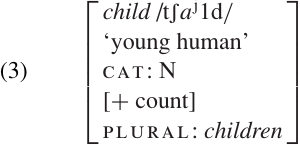
To summarize, then, the lexical entry for each word must specify at least the following information:
a phonological shape
b meaning (semantic properties)
c syntactic category (part of speech)
d other grammatical information
e irregular forms or patterns associated with that specific word
A lexical entry for the English noun child might look something like (3).
1. The word dog is possible in (2b, c) only when interpreted as a mass noun, i.e. a kind of meat.
2. This device is used more extensively in phonology.








