Regular and irregular English past tense verb forms
Jaeger et al. (1996) conducted a study using positron emission tomography (PET). Positron emission tomography is a brain imaging technique that takes advantage of the fact that the brain is extremely hungry for glucose and oxygen, both of which are transported by the blood. Radioactive isotopes and glucose are injected into the arteries before subjects engage in specific cognitive activities. The radioactive glucose allows maps of brain activity based on blood flow to be produced. Jaeger et al. were interested in the brain activity associated with the processing of regular and irregular past tense verb forms in English. Should regular and irregular verbs be treated as one and the same by linguistic theories and processing models of language, or are they intrinsically different?
Early generative theories hypothesized that all past tense verbs, whether regular or irregular, are generated by rule (Chomsky and Halle 1968). This approach is also found in some later work (for example, Halle and Mohanan 1985). A problem with it, however, is that the rules needed to generate the wealth of possible forms in English can result in very abstract underlying representations and few constraints on the actual rules themselves. Aronoff (1976) and Hooper (1976) argued that only rules formed by productive processes belong in the morphological component. Irregular words and words formed by unproductive processes are stored in the lexicon. When multiple words formed by unproductive processes exist, speakers are able to see the patterns that relate them, but this does not mean that the rule is active in the mental grammar. Although none of these theories claimed to be processing models, all of them were based on beliefs about the workings of the human mind. Rule-based approaches to irregular and regular verb morphology assume that storage space for memorized forms in the brain is at a premium. Words are therefore argued to be stored in as economical a form as possible, with redundant properties eliminated. The second type of approach assumes that the brain is capable of memorizing enormous numbers of words and also that it is more efficient or economical to retrieve memorized lexical forms than to create them anew via a plethora of different rules (which, in the first approach, must also be stored).
Processing models fall into the same two general types. Some treat regular and irregular past tense verb forms as being processed by the same system. Some treat them as being processed differently from each other. More discussion can be found in Jaeger et al. (1996).
Jaeger et al. set out to shed light on these competing types of models, which they call single-system theories and dual-system theories (see single-route and dual-route models). Nine subjects viewed five lists of words or nonce forms. They were required to give a spoken response to each form, one at a time. The five lists were as follows:
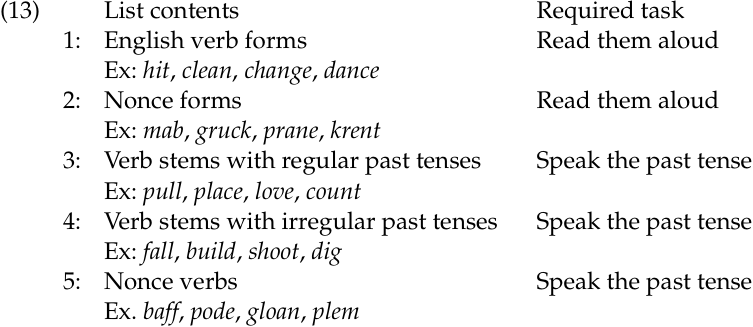
The researchers collected data on the regions and levels of brain activity, the subjects’ responses, and their reaction time. The idea was that patterns of brain activity recorded in the PET scan would be similar for all lists if regular and irregular past tense forms are created by the same process. If, however, they are generated by different processes, the results of the PET scan would be different for the regular and irregular past tense formations.
When the study was completed, Jaeger and the others found that subjects spoke aloud the past tense forms of regular verbs significantly faster than irregular verbs. Response times for the past tense of nonce forms were closest to those of regular verbs. When subjects were asked to give the past tense of irregular verb forms, their brains showed larger areas of brain activity. Finally, while there was overlap in the areas of the brain activated by each activity, it was also the case that the regular verb task and the irregular verb task each activated different areas of the brain, as well. These results support dual-system theories that claim that regular and irregular past tense verb forms are generated by different mechanisms.
Seidenberg and Hoeffner (1998) criticize Jaeger and her colleagues for presenting regular verb forms and irregular verb forms in completely separate lists. Since the regular verb forms all work the same way, it could be that the subjects predicted the process they had to apply and therefore computed them faster than the irregular verbs, which fell into no such pattern. Jaeger et al. (1998) disagree with the criticism. This contention, however, highlights the care with which experiments must be designed. Researchers must try to identify flaws in their experimental design and correct them prior to executing the study. It also underscores the need for multiple studies before we draw hard conclusions about the mechanisms of morphological productivity. Any given study can advance our understanding of morphological productivity without being the last word on the subject. There is a great deal of value in studies that ask new questions or try out new ways of testing hypotheses. Design errors may or may not influence a given set of results. When they do, they can often be corrected in follow-up studies, which are just as essential to advancing our knowledge.








