Grammar
Tenses
Present

Present Simple
Present Continuous
Present Perfect
Present Perfect Continuous
Past
Past Simple
Past Continuous
Past Perfect
Past Perfect Continuous
Future
Future Simple
Future Continuous
Future Perfect
Future Perfect Continuous
Parts Of Speech
Nouns
Countable and uncountable nouns
Verbal nouns
Singular and Plural nouns
Proper nouns
Nouns gender
Nouns definition
Concrete nouns
Abstract nouns
Common nouns
Collective nouns
Definition Of Nouns
Animate and Inanimate nouns
Nouns
Verbs
Stative and dynamic verbs
Finite and nonfinite verbs
To be verbs
Transitive and intransitive verbs
Auxiliary verbs
Modal verbs
Regular and irregular verbs
Action verbs
Verbs
Adverbs
Relative adverbs
Interrogative adverbs
Adverbs of time
Adverbs of place
Adverbs of reason
Adverbs of quantity
Adverbs of manner
Adverbs of frequency
Adverbs of affirmation
Adverbs
Adjectives
Quantitative adjective
Proper adjective
Possessive adjective
Numeral adjective
Interrogative adjective
Distributive adjective
Descriptive adjective
Demonstrative adjective
Pronouns
Subject pronoun
Relative pronoun
Reflexive pronoun
Reciprocal pronoun
Possessive pronoun
Personal pronoun
Interrogative pronoun
Indefinite pronoun
Emphatic pronoun
Distributive pronoun
Demonstrative pronoun
Pronouns
Pre Position
Preposition by function
Time preposition
Reason preposition
Possession preposition
Place preposition
Phrases preposition
Origin preposition
Measure preposition
Direction preposition
Contrast preposition
Agent preposition
Preposition by construction
Simple preposition
Phrase preposition
Double preposition
Compound preposition
prepositions
Conjunctions
Subordinating conjunction
Correlative conjunction
Coordinating conjunction
Conjunctive adverbs
conjunctions
Interjections
Express calling interjection
Phrases
Sentences
Clauses
Part of Speech
Grammar Rules
Passive and Active
Preference
Requests and offers
wishes
Be used to
Some and any
Could have done
Describing people
Giving advices
Possession
Comparative and superlative
Giving Reason
Making Suggestions
Apologizing
Forming questions
Since and for
Directions
Obligation
Adverbials
invitation
Articles
Imaginary condition
Zero conditional
First conditional
Second conditional
Third conditional
Reported speech
Demonstratives
Determiners
Direct and Indirect speech
Linguistics
Phonetics
Phonology
Linguistics fields
Syntax
Morphology
Semantics
pragmatics
History
Writing
Grammar
Phonetics and Phonology
Semiotics
Reading Comprehension
Elementary
Intermediate
Advanced
Teaching Methods
Teaching Strategies
Assessment

What is recursion? A definition
 المؤلف:
Bernd Heine and Tania Kuteva
المؤلف:
Bernd Heine and Tania Kuteva
 المصدر:
The Genesis of Grammar
المصدر:
The Genesis of Grammar
 الجزء والصفحة:
P264-C6
الجزء والصفحة:
P264-C6
 2026-03-20
 19
19




+
-
20
What is recursion?
A definition
The linguistic term recursion has been adopted from mathematics and computer sciences, where it stands for the act of defining an object in terms of that object itself—in short: a definition that uses itself as part of itself.1 As a notion used in some schools of linguistics, it is used to refer to a set of phrase structure rules that allows a category to embed a category of the same type. There are structural definitions of recursion, based on phrase structure geometry, and computational definitions, based on processing mechanisms that assign structures (Dougherty 2004).
In its most general form, recursion can be said to be present when some constituent occurs within another constituent of the same type. For instance, a noun phrase can appear within another noun phrase (John’s wife, or the book on the table) or a clause within another clause (Jane is the woman that John loves). It can be represented with a rule like (1a), which contains the same symbol on both sides of the arrow and thereby produces an environment for its own reapplication.
Following other linguistic treatments, we will be concerned primarily with only one type of recursion—one that is widely held to be the prototypical one, which we refer to as embedding recursion and, unless otherwise stated, we will henceforth use ‘‘recursion’’ as a shorthand for embedding recursion (see “Embedding, iteration, and succession”). This type can be described thus: [A [B]] is a construction that—in some sense—is structurally derived from another construction [A] which is of the same type, where B is embedded in A, cf. (1b). Recursion can but need not be productive, in that the output (to the right of the arrow) can form the input of another application of the same rule, as in (1c).

Recursion is not a property of language but rather the product of a given theory designed to describe or account for language structure;2 given an appropriate theory, one might argue that language is no more recursive than, say, biological reproduction, or some other natural phenomenon. Accordingly, when using this term we are not maintaining that language, or language structure, has recursion but rather that there are certain properties to be observed in language that can appropriately be described in terms of a construct of the form proposed in (1); as we will see below (“Treatment of recursion in linguistic description”), there are theories that do without ‘‘recursion.’’
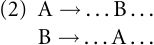
We are restricted to what may be called direct recursion to distinguish it from other kinds of recursion, such as indirect recursion, where there is not one recursive rule but a recursive ‘‘loop’’, in that two (or more) rules jointly produce recursion, as in the set of rules of (2).3 Indirect recursion raises a number of issues that would be beyond the scope of the present treatment; hence, we will have nothing to say about it and its implications for language evolution.
Embedding recursion (1b) entails hierarchy, or phrase structure—be that conceptual or syntactic hierarchy; but not all hierarchy or phrase structure is necessarily recursive: Instances of hierarchy are only recursive when they are in accordance with (1b), that is when the same category occurs both to the left and to the right of the arrow. In dealing with embedding recursion, a number of additional distinctions have been made (see Chomsky 1957; Christiansen and Chater 1999). First, there is a basic distinction between tail and nested (or center-embedded) recursion. In linguistics, tail recursion involves embedding at the edge of a phrase, or invokes another instance of itself as a final step, while nested recursion (or ‘‘true’’ recursion) involves embedding in the center, leaving material on both sides of the embedded component. Second, there is a distinction between counting and mirror recursion. In order to parse strings from left to right it is necessary to count the number of As and note whether it equals the number of Bs, as, for example, in AAABBB. Counting recursion corresponds to sentence constructions such as ‘‘if S1, then S2’’ and ‘‘either S1, or S2’’, which can be nested arbitrarily deeply, for example, ‘‘if if if S1, then S2, then S3, then S4’’. In mirror recursion (which corresponds to center embedding), the first A is matched with the last A: A[BB]A, as in the English example The boy girls like ran away. And crossed embedding (identity recursion, cross-dependency) involves dependencies where A–A are crossed by B–B, that is {A [A B} B].
1 In mathematics, it is used for example for an expression each term of which is determined by application of a formula to preceding terms, or an expression such that each term is generated by repeating a particular mathematical operation.
2 Fritz Newmeyer (p.c.) rightly draws attention to the fact that this applies not only to recursion but to most constructs in linguistics.
3 In some traditions of generative grammar, a common kind of indirect recursion is found in the following set of rules (where there is an intervening generating operation): S → NP VP; VP → V(S).
 الاكثر قراءة في Linguistics fields
 اخر الاخبار
اخبار العتبة العباسية المقدسة

الآخبار الصحية


مواضيع ذات صلة
 قسم الشؤون الفكرية يصدر كتاباً يوثق تاريخ السدانة في العتبة العباسية المقدسة
 "المهمة".. إصدار قصصي يوثّق القصص الفائزة في مسابقة فتوى الدفاع المقدسة للقصة القصيرة
 (نوافذ).. إصدار أدبي يوثق القصص الفائزة في مسابقة الإمام العسكري (عليه السلام)