Reflexives and reciprocals
We noted that English, like many other languages, has a set of REFLEXIVE pronouns that are used in certain restricted contexts. Grammatically, reflexive pronouns are special in that they can (and frequently must) take an argument of their immediate clause as their antecedent. This pattern is illustrated in the following sentences, repeated from earlier:
(11) a John has bought himself a new Mercedes.
b I surprised myself by winning the dancing competition.
c Mary tried to control herself, but could not resist tickling the Governor.
Reflexives are also special in terms of their semantic function. Reflexives are used when a single individual plays more than one role within a given situation. A reflexive pronoun is used to indicate that John is both agent and beneficiary in (11a); that the speaker is both agent and experiencer in (11b); and that Mary is both agent and patient in (11c).
Another type of pronominal element that can take an antecedent within its immediate clause is the RECIPROCAL. This is illustrated in (12):
(12) a John and Mary bought each other new bicycles for Christmas.
b My wife and I blame each other for the collapse of our business.
c Fred and Martha seem to love each other, in a strange sort of way.
There are two important differences between reflexives and reciprocals. First, the antecedent of a reciprocal must name a group which contains two or more individuals, whereas the antecedent of a reflexive may be a single individual. Second, a reflexive is used to describe a relationship between an individual and himself (e.g. X does something to X). A reciprocal is used to describe a relationship between two or more people which is viewed as being mutual and symmetric (e.g. X does something to Y and Y does that same thing to X).
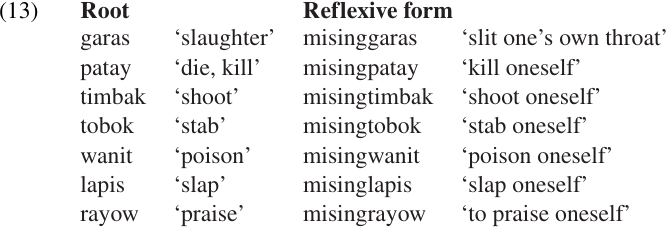
In some languages, these types of relationships are expressed using verbal affixation rather than special types of pronouns. For example, in Kimaragang Dusun (Malayo-Polynesian, northeast Borneo) the prefix pising- is used to form reflexive verbs. Typically, the prefix is added to transitive verb roots, as in example (13). (The reflexive verbs are shown in the normal Active Voice form, which changes the initial p- to m-.) The derived reflexive is intransitive, taking only a single argument, because the same participant f ills both the agent and patient roles. Thus, morphological reflexivization is a detransitivizing, or valence-decreasing, process.
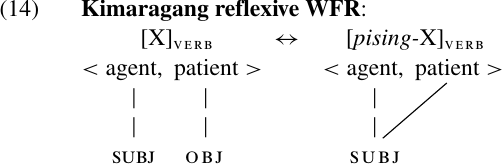
We might represent the effect of this prefix as in (14). The right side of the rule in (14) indicates that the reflexive verb assigns two semantic roles to the same participant. That participant bears only one Grammatical Relation (SUBJ), and so must be expressed by a single NP. This rule expresses the fact that reflexivization changes transitive verbs into intransitives.
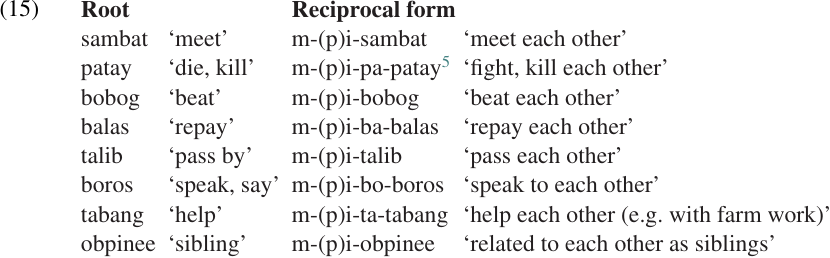
Kimaragang also has a reciprocal prefix, pi-. This is illustrated in (15), again using the active voice form.
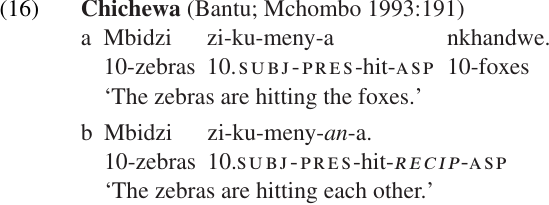
Chichewa is another language which has a reciprocal affix. As (16) illustrates, the suffix–an changes a transitive verb stem into an intransitive reciprocal verb. So reciprocal formation, like reflexivization, is a valence decreasing process.6
The argument structure configuration for a reciprocal verb like that in (16b) would look essentially the same as the reflexive structure shown on the right side of (14). The difference in meaning between reflexives and reciprocals would need to be spelled out as part of the semantic representation, which we will not discuss here.
5. With some roots it is more natural to REDUPLICATE the reciprocal form; see Non-linear morphology.
6. Mchombo (1993, 1998) shows that the reciprocal suffix is part of the verb stem and functions as a derivational affix, reducing the syntactic valence of the verb. The Chichewa reflexive prefix, in contrast, is not part of the verb stem and functions as an incorporated pronoun, like the other object-agreement prefixes. It does not reduce syntactic valence.








