Grammar
Tenses
Present

Present Simple
Present Continuous
Present Perfect
Present Perfect Continuous
Past
Past Simple
Past Continuous
Past Perfect
Past Perfect Continuous
Future
Future Simple
Future Continuous
Future Perfect
Future Perfect Continuous
Parts Of Speech
Nouns
Countable and uncountable nouns
Verbal nouns
Singular and Plural nouns
Proper nouns
Nouns gender
Nouns definition
Concrete nouns
Abstract nouns
Common nouns
Collective nouns
Definition Of Nouns
Animate and Inanimate nouns
Nouns
Verbs
Stative and dynamic verbs
Finite and nonfinite verbs
To be verbs
Transitive and intransitive verbs
Auxiliary verbs
Modal verbs
Regular and irregular verbs
Action verbs
Verbs
Adverbs
Relative adverbs
Interrogative adverbs
Adverbs of time
Adverbs of place
Adverbs of reason
Adverbs of quantity
Adverbs of manner
Adverbs of frequency
Adverbs of affirmation
Adverbs
Adjectives
Quantitative adjective
Proper adjective
Possessive adjective
Numeral adjective
Interrogative adjective
Distributive adjective
Descriptive adjective
Demonstrative adjective
Pronouns
Subject pronoun
Relative pronoun
Reflexive pronoun
Reciprocal pronoun
Possessive pronoun
Personal pronoun
Interrogative pronoun
Indefinite pronoun
Emphatic pronoun
Distributive pronoun
Demonstrative pronoun
Pronouns
Pre Position
Preposition by function
Time preposition
Reason preposition
Possession preposition
Place preposition
Phrases preposition
Origin preposition
Measure preposition
Direction preposition
Contrast preposition
Agent preposition
Preposition by construction
Simple preposition
Phrase preposition
Double preposition
Compound preposition
prepositions
Conjunctions
Subordinating conjunction
Correlative conjunction
Coordinating conjunction
Conjunctive adverbs
conjunctions
Interjections
Express calling interjection
Phrases
Sentences
Clauses
Part of Speech
Grammar Rules
Passive and Active
Preference
Requests and offers
wishes
Be used to
Some and any
Could have done
Describing people
Giving advices
Possession
Comparative and superlative
Giving Reason
Making Suggestions
Apologizing
Forming questions
Since and for
Directions
Obligation
Adverbials
invitation
Articles
Imaginary condition
Zero conditional
First conditional
Second conditional
Third conditional
Reported speech
Demonstratives
Determiners
Direct and Indirect speech
Linguistics
Phonetics
Phonology
Linguistics fields
Syntax
Morphology
Semantics
pragmatics
History
Writing
Grammar
Phonetics and Phonology
Semiotics
Reading Comprehension
Elementary
Intermediate
Advanced
Teaching Methods
Teaching Strategies
Assessment

CURRENT POSITION OF ADULTS WITH LEARNING DISABILITIES
 المؤلف:
DEBRA FEARNS
المؤلف:
DEBRA FEARNS
 المصدر:
Caring for People with Learning Disabilities
المصدر:
Caring for People with Learning Disabilities
 الجزء والصفحة:
P56-C4
الجزء والصفحة:
P56-C4
 2025-10-09
 314
314




+
-
20
CURRENT POSITION OF ADULTS WITH LEARNING DISABILITIES
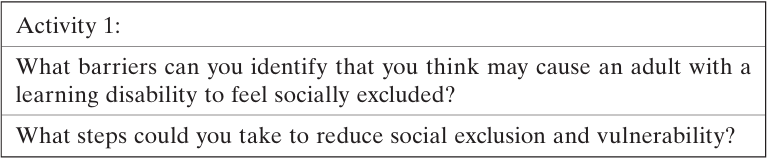
The reality for many adults with learning disabilities is a life with limited choice, rights, independence or inclusion – the four key principles at the heart of Valuing People (Department of Health 2001b). This state of affairs puts many adults with learning disabilities in a vulnerable position, as they are dependent on family, carers and professionals to help them live their lives. This can lead to potential vulnerability, as an adult with a learning disability is reliant on the honesty, integrity and professionalism of those caring for him/her. Alongside this is the difficulty that adults with learning disabilities may have in making their needs and wishes known, and in being heard, listened to and understood by families, carers and professionals (Department of Health 2001b):
‘People with learning disabilities are amongst the most socially excluded and vulnerable groups in Britain today. Very few have jobs, live in their own homes or have real choice over who cares for them. Many have few friends outside their families and those paid to care for them. Their voices are rarely heard in public. This needs to change.’
(Department of Health 2001b, p. 14)
Whilst there may have been key changes made in the delivery and provision of some services that support adults with learning disabilities, the reality is that this has had little impact on overcoming obstacles that relate to social exclusion and access to services, facilities, housing and employment. This continued exclusion adds to the vulnerable position that many adults with learning disabilities find themselves in.
Emerson and Malam (2005) carried out a national survey of adults with learning disabilities and their families, in England. This survey highlights that adults with learning disabilities are often socially excluded. 43 per cent stated that they had been bullied at school; 32 per cent stated that they did not feel safe in either their homes, their locality, or whilst using public transport; and 32 per cent also stated that someone had been rude or offensive to them in the last year, because they had a learning disability. Worryingly, 9 per cent stated that they had been the victim of crime in the preceding year.
 الاكثر قراءة في Teaching Strategies
 اخر الاخبار
اخبار العتبة العباسية المقدسة

الآخبار الصحية


مواضيع ذات صلة
 قسم الشؤون الفكرية يصدر كتاباً يوثق تاريخ السدانة في العتبة العباسية المقدسة
 "المهمة".. إصدار قصصي يوثّق القصص الفائزة في مسابقة فتوى الدفاع المقدسة للقصة القصيرة
 (نوافذ).. إصدار أدبي يوثق القصص الفائزة في مسابقة الإمام العسكري (عليه السلام)