Grammar
Tenses
Present

Present Simple
Present Continuous
Present Perfect
Present Perfect Continuous
Past
Past Simple
Past Continuous
Past Perfect
Past Perfect Continuous
Future
Future Simple
Future Continuous
Future Perfect
Future Perfect Continuous
Parts Of Speech
Nouns
Countable and uncountable nouns
Verbal nouns
Singular and Plural nouns
Proper nouns
Nouns gender
Nouns definition
Concrete nouns
Abstract nouns
Common nouns
Collective nouns
Definition Of Nouns
Animate and Inanimate nouns
Nouns
Verbs
Stative and dynamic verbs
Finite and nonfinite verbs
To be verbs
Transitive and intransitive verbs
Auxiliary verbs
Modal verbs
Regular and irregular verbs
Action verbs
Verbs
Adverbs
Relative adverbs
Interrogative adverbs
Adverbs of time
Adverbs of place
Adverbs of reason
Adverbs of quantity
Adverbs of manner
Adverbs of frequency
Adverbs of affirmation
Adverbs
Adjectives
Quantitative adjective
Proper adjective
Possessive adjective
Numeral adjective
Interrogative adjective
Distributive adjective
Descriptive adjective
Demonstrative adjective
Pronouns
Subject pronoun
Relative pronoun
Reflexive pronoun
Reciprocal pronoun
Possessive pronoun
Personal pronoun
Interrogative pronoun
Indefinite pronoun
Emphatic pronoun
Distributive pronoun
Demonstrative pronoun
Pronouns
Pre Position
Preposition by function
Time preposition
Reason preposition
Possession preposition
Place preposition
Phrases preposition
Origin preposition
Measure preposition
Direction preposition
Contrast preposition
Agent preposition
Preposition by construction
Simple preposition
Phrase preposition
Double preposition
Compound preposition
prepositions
Conjunctions
Subordinating conjunction
Correlative conjunction
Coordinating conjunction
Conjunctive adverbs
conjunctions
Interjections
Express calling interjection
Phrases
Sentences
Clauses
Part of Speech
Grammar Rules
Passive and Active
Preference
Requests and offers
wishes
Be used to
Some and any
Could have done
Describing people
Giving advices
Possession
Comparative and superlative
Giving Reason
Making Suggestions
Apologizing
Forming questions
Since and for
Directions
Obligation
Adverbials
invitation
Articles
Imaginary condition
Zero conditional
First conditional
Second conditional
Third conditional
Reported speech
Demonstratives
Determiners
Direct and Indirect speech
Linguistics
Phonetics
Phonology
Linguistics fields
Syntax
Morphology
Semantics
pragmatics
History
Writing
Grammar
Phonetics and Phonology
Semiotics
Reading Comprehension
Elementary
Intermediate
Advanced
Teaching Methods
Teaching Strategies
Assessment

UNDERSTANDING CHALLENGING BEHAVIOR
 المؤلف:
COSTAS JOANNIDES
المؤلف:
COSTAS JOANNIDES
 المصدر:
Caring for People with Learning Disabilities
المصدر:
Caring for People with Learning Disabilities
 الجزء والصفحة:
P49-C3
الجزء والصفحة:
P49-C3
 2025-10-08
 274
274




+
-
20
UNDERSTANDING CHALLENGING BEHAVIOR
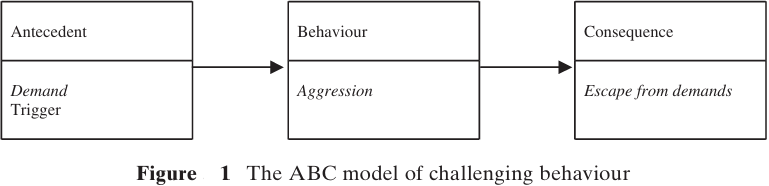
Frameworks for understanding challenging behavior have become more sophisticated over time, with important implications for assessment and intervention practices. These frameworks will be illustrated and their implications considered. An example of the assessment and intervention planning process will be illustrated. It is well recognized that ‘demands’ often set off challenging behavior. If an adult with a learning disability is asked to wash the floor, s/he may become aggressive. This often results in action to calm the person down or prevent injury to him/herself or others. The adult with a learning disability may be moved to another room or restrained, or prescribed medication and so on. In any event, s/he ends up not washing the floor. One of the earliest sensible conceptions of challenging behavior depicted exactly this pattern (see Figure 1).
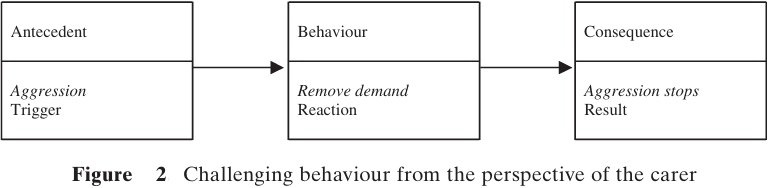
The demand ‘sets off’ aggression, which results in escape from the demand. From the perspective of the carer (Figure 2), the person’s aggression ‘sets off’ their removing the demand and the aggression stops (with some luck)!
The outcome of this process can be readily seen. The adult with a learning disability is more likely to become aggressive when presented with demands and the carer is more likely to remove demands when s/he becomes aggressive.
Whatever the exact nature of the ‘thought’, s/he is likely to be feeling distressed and wanting to get rid of his/her distress. Aggressive behavior may then succeed in removing both the demand and (eventually) his/her own distress, as shown in Figure 3.
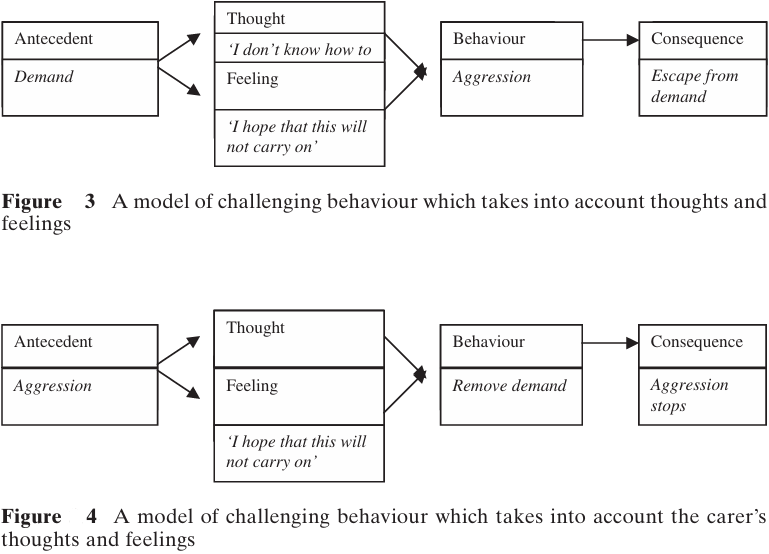
The carer may well have similar thoughts and feelings, s/he may be thinking (negatively) that sh/e does not know how to cope with the person’s behavior and s/he is almost certainly feeling distressed and frightened (see Figure 4).
This extension of these models helps us to feel that we can understand the motivation of the two parties better, and shows how negative thoughts and feelings may have maladaptive consequences. Given this depiction, it would not be surprising to find that both parties developed failure sets about these kinds of interactions (and therefore avoided them if at all possible), and both parties learned to handle their distress by seeking to escape from the distressing situation.
Expanded models may develop from the above, bearing in mind that four kinds of background factors are included: temporary personal (such as feeling tired), persistent personal (such as difficulty in understanding speech), temporary environmental (such as a lot of noise) and persistent environmental (such as a climate of social control).
The aim of any intervention is to interrupt the sequence leading to the adults with learning disabilities exhibiting challenging behavior as early as possible, so that difficulties are prevented, not just reacted to, and to develop skills to cope better with the difficulties being faced. The intervention includes:
1. Making realistic demands based on information of skill.
2. Anticipating difficulties.
3. Developing skills (coping strategies for dealing with problems, training in recognizing and dealing with distress).
4. Support for carers (guidance for preventing and managing difficulties and also joint approaches).
 الاكثر قراءة في Teaching Strategies
 اخر الاخبار
اخبار العتبة العباسية المقدسة

الآخبار الصحية


مواضيع ذات صلة
 قسم الشؤون الفكرية يصدر كتاباً يوثق تاريخ السدانة في العتبة العباسية المقدسة
 "المهمة".. إصدار قصصي يوثّق القصص الفائزة في مسابقة فتوى الدفاع المقدسة للقصة القصيرة
 (نوافذ).. إصدار أدبي يوثق القصص الفائزة في مسابقة الإمام العسكري (عليه السلام)