









Grammar
Tenses
Present

Present Simple
Present Continuous
Present Perfect
Present Perfect Continuous
Past
Past Simple
Past Continuous
Past Perfect
Past Perfect Continuous
Future
Future Simple
Future Continuous
Future Perfect
Future Perfect Continuous
Parts Of Speech
Nouns
Countable and uncountable nouns
Verbal nouns
Singular and Plural nouns
Proper nouns
Nouns gender
Nouns definition
Concrete nouns
Abstract nouns
Common nouns
Collective nouns
Definition Of Nouns
Animate and Inanimate nouns
Nouns
Verbs
Stative and dynamic verbs
Finite and nonfinite verbs
To be verbs
Transitive and intransitive verbs
Auxiliary verbs
Modal verbs
Regular and irregular verbs
Action verbs
Verbs
Adverbs
Relative adverbs
Interrogative adverbs
Adverbs of time
Adverbs of place
Adverbs of reason
Adverbs of quantity
Adverbs of manner
Adverbs of frequency
Adverbs of affirmation
Adverbs
Adjectives
Quantitative adjective
Proper adjective
Possessive adjective
Numeral adjective
Interrogative adjective
Distributive adjective
Descriptive adjective
Demonstrative adjective
Pronouns
Subject pronoun
Relative pronoun
Reflexive pronoun
Reciprocal pronoun
Possessive pronoun
Personal pronoun
Interrogative pronoun
Indefinite pronoun
Emphatic pronoun
Distributive pronoun
Demonstrative pronoun
Pronouns
Pre Position
Preposition by function
Time preposition
Reason preposition
Possession preposition
Place preposition
Phrases preposition
Origin preposition
Measure preposition
Direction preposition
Contrast preposition
Agent preposition
Preposition by construction
Simple preposition
Phrase preposition
Double preposition
Compound preposition
prepositions
Conjunctions
Subordinating conjunction
Correlative conjunction
Coordinating conjunction
Conjunctive adverbs
conjunctions
Interjections
Express calling interjection
Phrases
Sentences
Clauses
Part of Speech
Grammar Rules
Passive and Active
Preference
Requests and offers
wishes
Be used to
Some and any
Could have done
Describing people
Giving advices
Possession
Comparative and superlative
Giving Reason
Making Suggestions
Apologizing
Forming questions
Since and for
Directions
Obligation
Adverbials
invitation
Articles
Imaginary condition
Zero conditional
First conditional
Second conditional
Third conditional
Reported speech
Demonstratives
Determiners
Direct and Indirect speech
Linguistics
Phonetics
Phonology
Linguistics fields
Syntax
Morphology
Semantics
pragmatics
History
Writing
Grammar
Phonetics and Phonology
Semiotics
Reading Comprehension
Elementary
Intermediate
Advanced
Teaching Methods
Teaching Strategies
Assessment

DEFINING CHALLENGING BEHAVIOR
 المؤلف:
COSTAS JOANNIDES
المؤلف:
COSTAS JOANNIDES
 المصدر:
Caring for People with Learning Disabilities
المصدر:
Caring for People with Learning Disabilities
 الجزء والصفحة:
P39-C3
الجزء والصفحة:
P39-C3
 2025-10-07
 432
432




+
-
20
DEFINING CHALLENGING BEHAVIOR
Prior to discussing any issues pertaining to challenging behavior, it is essential to refer to definitions of challenging behavior, in order to establish a framework to help carers who assist adults with challenging behavior, and to identify those who are labelled as having ‘challenging’ behaviors.
Challenging behavior, by definition, presents carers with difficult emotional and professional challenges. The term ‘challenging behavior’ has been defined as:
‘. . . culturally abnormal behavior(s) of such an intensity or duration that the physical safety of the person or others is likely to be placed in serious jeopardy, or behavior which is likely to seriously limit use of or result in the person being denied access to ordinary community facilities.’
(Emerson et al. 1988)
The Department of Health (1993) pointed out that any successful interventions rely on staff/carers having a broad knowledge base in relation to safe reactive strategies, psychological and behavioral approaches and long-term skills-teaching strategies. Skills and knowledge linked with behavior are central in managing challenging behavior and have been shown to be effecive (Lindsay 2001). It is useful to have an overview of a range of definitions; these are presented in Table 1.
Many carers refer to challenging behavior as a specific behavior or a group of behaviors which involve significant risks to people’s physical well-being, or which act to reduce access to community settings, or result in being denied access to ordinary community facilities. These may include, for example, exhibiting physical and verbal aggression and perhaps minor self-injury and stereotyping behaviors which may lead to significant levels of avoidance by members of the public. It should be noted that challenging behavior is not synonymous with mental health or psychiatric disorder, but appears to be a functional adaptive response to particular environments, people and objects, for example, rather than the manifestation of any underlying psychiatric pathological impairment. As Blunden and Allen (1987) point out, the term ‘challenging behavior’:
‘. . . emphasizes that such behavior represents challenges to services rather than problems with individuals with intellectual disabilities in some way carry around with them.’
(Blunden & Allen 1987, p. 14)
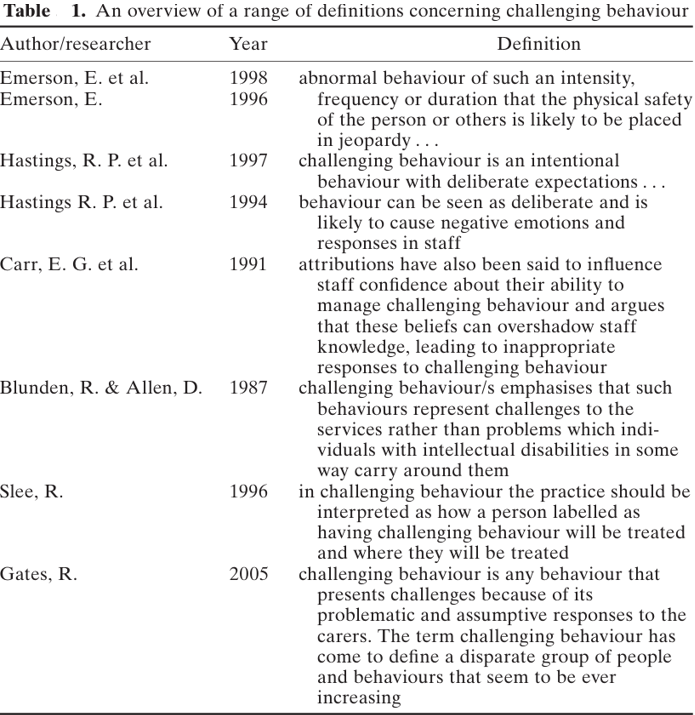
Many people are unaware of the implications of definition and therefore the label challenging behavior is often misused or misinterpreted. As Gates (1997) stated, it may well be that the term is used as a euphemism for, or an attempt to sanitize, what some regard as unacceptable behavior, implying that the ownership of such behavior therefore must reside with the individual displaying it.
In many senses, it is preferable to think about people’s behaviors in terms of the thoughts and feelings which generate them. However, ‘challenging behavior’ is the popular, universal term currently in use.
To construe a situation as a challenge rather than a problem encourages more constructive responses, although it would, of course, be mistaken to believe that minor changes in terminology are capable of bringing about major changes in practice.
The spectrum of challenging behavior as adapted from Nihira et al. (1993) is a portrayal of negative behaviors which often are used as definitions, such as:
• violence
• rebelliousness
• destructiveness
• stereotypical behavior
• unacceptable eccentric habits
• hyperactivity
• non-socially accepted behavior
• peculiar mannerisms and mimicries
• SIB (self-injurious behavior)
• untrustworthiness
• emotional/psychological disturbances.
 الاكثر قراءة في Teaching Strategies
 اخر الاخبار
اخبار العتبة العباسية المقدسة

الآخبار الصحية


مواضيع ذات صلة
 قسم الشؤون الفكرية يصدر كتاباً يوثق تاريخ السدانة في العتبة العباسية المقدسة
 "المهمة".. إصدار قصصي يوثّق القصص الفائزة في مسابقة فتوى الدفاع المقدسة للقصة القصيرة
 (نوافذ).. إصدار أدبي يوثق القصص الفائزة في مسابقة الإمام العسكري (عليه السلام)





