Grammar
Tenses
Present

Present Simple
Present Continuous
Present Perfect
Present Perfect Continuous
Past
Past Simple
Past Continuous
Past Perfect
Past Perfect Continuous
Future
Future Simple
Future Continuous
Future Perfect
Future Perfect Continuous
Parts Of Speech
Nouns
Countable and uncountable nouns
Verbal nouns
Singular and Plural nouns
Proper nouns
Nouns gender
Nouns definition
Concrete nouns
Abstract nouns
Common nouns
Collective nouns
Definition Of Nouns
Animate and Inanimate nouns
Nouns
Verbs
Stative and dynamic verbs
Finite and nonfinite verbs
To be verbs
Transitive and intransitive verbs
Auxiliary verbs
Modal verbs
Regular and irregular verbs
Action verbs
Verbs
Adverbs
Relative adverbs
Interrogative adverbs
Adverbs of time
Adverbs of place
Adverbs of reason
Adverbs of quantity
Adverbs of manner
Adverbs of frequency
Adverbs of affirmation
Adverbs
Adjectives
Quantitative adjective
Proper adjective
Possessive adjective
Numeral adjective
Interrogative adjective
Distributive adjective
Descriptive adjective
Demonstrative adjective
Pronouns
Subject pronoun
Relative pronoun
Reflexive pronoun
Reciprocal pronoun
Possessive pronoun
Personal pronoun
Interrogative pronoun
Indefinite pronoun
Emphatic pronoun
Distributive pronoun
Demonstrative pronoun
Pronouns
Pre Position
Preposition by function
Time preposition
Reason preposition
Possession preposition
Place preposition
Phrases preposition
Origin preposition
Measure preposition
Direction preposition
Contrast preposition
Agent preposition
Preposition by construction
Simple preposition
Phrase preposition
Double preposition
Compound preposition
prepositions
Conjunctions
Subordinating conjunction
Correlative conjunction
Coordinating conjunction
Conjunctive adverbs
conjunctions
Interjections
Express calling interjection
Phrases
Sentences
Clauses
Part of Speech
Grammar Rules
Passive and Active
Preference
Requests and offers
wishes
Be used to
Some and any
Could have done
Describing people
Giving advices
Possession
Comparative and superlative
Giving Reason
Making Suggestions
Apologizing
Forming questions
Since and for
Directions
Obligation
Adverbials
invitation
Articles
Imaginary condition
Zero conditional
First conditional
Second conditional
Third conditional
Reported speech
Demonstratives
Determiners
Direct and Indirect speech
Linguistics
Phonetics
Phonology
Linguistics fields
Syntax
Morphology
Semantics
pragmatics
History
Writing
Grammar
Phonetics and Phonology
Semiotics
Reading Comprehension
Elementary
Intermediate
Advanced
Teaching Methods
Teaching Strategies
Assessment

SUMMARIZING AND NOTE TAKING Classroom Recommendations
 المؤلف:
Jane D. Hill Kathleen M. Flynn
المؤلف:
Jane D. Hill Kathleen M. Flynn
 المصدر:
Classroom Instruction that works with English Language Learners
المصدر:
Classroom Instruction that works with English Language Learners
 الجزء والصفحة:
P63-C7
الجزء والصفحة:
P63-C7
 2025-09-10
 409
409




+
-
20
SUMMARIZING AND NOTE TAKING
Classroom Recommendations
Classroom Instruction That Works offers three recommendations for incorporating summarization into the classroom.
1. Teach students the rule-based summarizing strategy. A particular set of steps is followed to produce a summary (e.g., keeping, deleting, and substituting information). Students will need to see this strategy modeled again and again. Attaching a nonlinguistic representation to the rules will benefit early-stage ELLs.
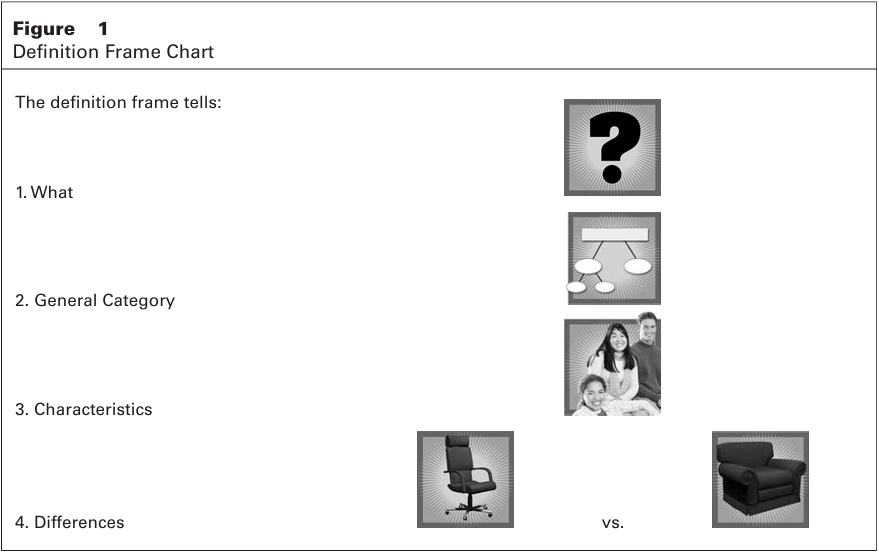
2. Use summary frames. There are six types of summary frames (see Appendix B): narrative, topic-restriction-illustration, argumentation, problem/solution, conversation, and definition (see below). All summary frames have a set of questions that extract important elements from the text. The answers to the questions are then used to summarize the text.
Each style of summary frame captures the basic structure of a different type of text. For example, let’s take a look at a definition frame. The purpose of a definition frame is to define a particular concept and identify other related concepts. There are four elements of a definition frame:
1. Term: the subject being defined
2. Set: the general category to which the term belongs
3. Gross characteristics: the characteristics that separate the term from other elements in the set
4. Minute differences: the different classes of objects that fall directly beneath the term
There are also four guiding questions for use when completing a definition frame:
1. What is being defined?
2. To which general category does the item belong?
3. What characteristics separate the item from the other items in the general category?
4. What are some types of classes of the item being defined?
Now let’s look at an example of how a definition frame can be used with ELLs at different stages of language acquisition. Students in Mr. Tate’s 3rd grade life science class are studying grasshoppers. Today, he is showing them a film. To guide their viewing, Mr. Tate presents the students with the four guiding definition frame questions listed above. For ELLs, he includes the chart depicted in Figure 1, with the frame questions accompanied by visuals.
Mr. Tate explains that answers to the frame questions can be found in the film. Students then watch the film with an eye toward answering the questions. When the film is over, Mr. Tate organizes the students into groups, where they compare their answers and construct a summary statement about grasshoppers.
3. Instruct students in reciprocal teaching as an aid to understanding expository text. Reciprocal teaching is a type of dialogue that students use to create meaning from text (Palincsar & Brown, 1984). When reviewing effective instructional programs for ELLs in elementary and middle schools, Fashola, Slavin, Calderón, and Durán (1997) reported that reciprocal teaching contributed to an improvement in reading comprehension. In the Classroom: A Toolkit for Effective Instruction of English Learners—available through the National Clearinghouse for English Language Acquisition (n.d.b)—offers sample lessons and activities for reciprocal teaching and emphasizes the importance of modeling each step with ELLs.
Reciprocal teaching involves four components: summarizing, questioning, clarifying, and predicting. For ELLs, it is critical to model each step and check for student understanding. Once the four components are learned, students can use them to monitor their reading for better comprehension.
The following is an adaptation involving the four components of reciprocal teaching that can be used as a whole-class activity or in small groups.
•Step 1: Summarizing. After students have silently or orally read a short section of a passage, a single student acting as teacher (i.e., the student leader) summarizes what has been read. Other students, with guidance from the student leader, may add to the summary. If students have difficulty summarizing, the teacher might point out clues (important items or obvious topic sentences) that aid in the construction of good summaries.
• Step 2: Questioning. The student leader asks some questions to which the class responds. The questions are designed to help students identify important information in the passage. For example, the student leader might look back over the selection and ask questions about specific pieces of information. The other students then try to answer these questions based on their recollection of the information.
• Step 3: Clarifying. The student leader tries to clarify confusing points in the passage. He might point these out or ask other students to point them out. For example, the student leader might say, “The part about why the dog ran into the car was confusing to me. Can anyone explain this?” Or the student leader might direct students to ask clarification questions. The group then attempts to clear up the confusing parts, which might involve rereading parts of the passage.
• Step 4: Predicting. The student leader asks for predictions about what will happen in the next segment of the text. The leader can write the predictions on the blackboard or on an overhead, or students can write them down.
 الاكثر قراءة في Teaching Strategies
 اخر الاخبار
اخبار العتبة العباسية المقدسة

الآخبار الصحية


مواضيع ذات صلة
 قسم الشؤون الفكرية يصدر كتاباً يوثق تاريخ السدانة في العتبة العباسية المقدسة
 "المهمة".. إصدار قصصي يوثّق القصص الفائزة في مسابقة فتوى الدفاع المقدسة للقصة القصيرة
 (نوافذ).. إصدار أدبي يوثق القصص الفائزة في مسابقة الإمام العسكري (عليه السلام)