Grammar
Tenses
Present

Present Simple
Present Continuous
Present Perfect
Present Perfect Continuous
Past
Past Simple
Past Continuous
Past Perfect
Past Perfect Continuous
Future
Future Simple
Future Continuous
Future Perfect
Future Perfect Continuous
Parts Of Speech
Nouns
Countable and uncountable nouns
Verbal nouns
Singular and Plural nouns
Proper nouns
Nouns gender
Nouns definition
Concrete nouns
Abstract nouns
Common nouns
Collective nouns
Definition Of Nouns
Animate and Inanimate nouns
Nouns
Verbs
Stative and dynamic verbs
Finite and nonfinite verbs
To be verbs
Transitive and intransitive verbs
Auxiliary verbs
Modal verbs
Regular and irregular verbs
Action verbs
Verbs
Adverbs
Relative adverbs
Interrogative adverbs
Adverbs of time
Adverbs of place
Adverbs of reason
Adverbs of quantity
Adverbs of manner
Adverbs of frequency
Adverbs of affirmation
Adverbs
Adjectives
Quantitative adjective
Proper adjective
Possessive adjective
Numeral adjective
Interrogative adjective
Distributive adjective
Descriptive adjective
Demonstrative adjective
Pronouns
Subject pronoun
Relative pronoun
Reflexive pronoun
Reciprocal pronoun
Possessive pronoun
Personal pronoun
Interrogative pronoun
Indefinite pronoun
Emphatic pronoun
Distributive pronoun
Demonstrative pronoun
Pronouns
Pre Position
Preposition by function
Time preposition
Reason preposition
Possession preposition
Place preposition
Phrases preposition
Origin preposition
Measure preposition
Direction preposition
Contrast preposition
Agent preposition
Preposition by construction
Simple preposition
Phrase preposition
Double preposition
Compound preposition
prepositions
Conjunctions
Subordinating conjunction
Correlative conjunction
Coordinating conjunction
Conjunctive adverbs
conjunctions
Interjections
Express calling interjection
Phrases
Sentences
Clauses
Part of Speech
Grammar Rules
Passive and Active
Preference
Requests and offers
wishes
Be used to
Some and any
Could have done
Describing people
Giving advices
Possession
Comparative and superlative
Giving Reason
Making Suggestions
Apologizing
Forming questions
Since and for
Directions
Obligation
Adverbials
invitation
Articles
Imaginary condition
Zero conditional
First conditional
Second conditional
Third conditional
Reported speech
Demonstratives
Determiners
Direct and Indirect speech
Linguistics
Phonetics
Phonology
Linguistics fields
Syntax
Morphology
Semantics
pragmatics
History
Writing
Grammar
Phonetics and Phonology
Semiotics
Reading Comprehension
Elementary
Intermediate
Advanced
Teaching Methods
Teaching Strategies
Assessment

Exemplars Peers
 المؤلف:
Paul Lam & Paula Hodgson & Josephine Csete
المؤلف:
Paul Lam & Paula Hodgson & Josephine Csete
 المصدر:
Enhancing Teaching and Learning through Assessment
المصدر:
Enhancing Teaching and Learning through Assessment
 الجزء والصفحة:
P397-C33
الجزء والصفحة:
P397-C33
 2025-08-11
 441
441




+
-
20
Exemplars Peers
In the present study the use of student-to-student interaction was even more prevalent than student-to-content. The following are two examples illustrating the range of methods that fall within this category.
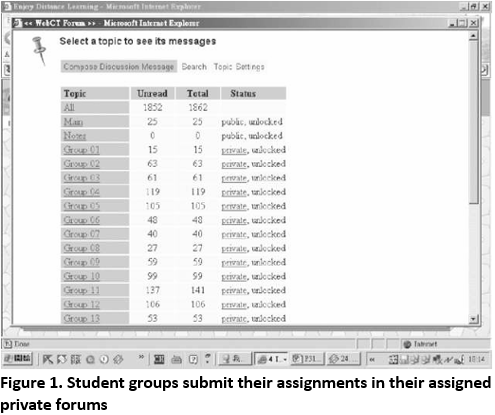
Online peer review of assignments is a good strategy to encourage students to interact and engage in focused discussions with each other. A design to enhance student-student interaction was implemented on the assignment of a course on nursing for an undergraduate program where the teacher first required her students to submit their assignments, done in groups, to their pre-assigned private forum on the course website (Figure 1); she then specified a timeline for group members to review each others' work and provide comments online. In this case, these students were taking on dual roles as authors and evaluators. Students were engaged actively in the group activity. A high level of interaction between group members was observed in the assignment discussion forums, although some group's participation levels were higher than others. Multiple contributions from peer group members facilitated a broadening of perspectives in the learning process. Furthermore, the asynchronous mode of discussion provided a better opportunity for students to reflect and learn flexibly in their own time. Ultimately, these students' skills as reflective practitioners may be enhanced.
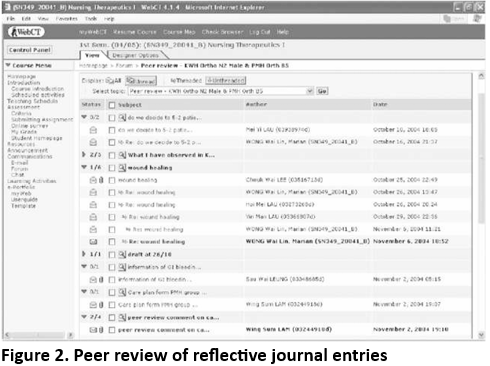
Building online journals/blogs is another way to encourage students to interact with each other. As illustrated in the previous case, developing reflective skills is important for student nurses. In the workplace, they need to communicate well with other clinical professionals and develop critical thinking skills to make sound judgments. To promote supportive peer learning in developing these skills in nursing, the students were asked to post reflective journals in an assigned online forum. They submitted their experiences and reflections of clinical practice for their peers to review and comment (Figure 2). In order to encourage the postings of journals and the provision of feedback for others' writing, grades were allocated depending on both the original journal entries posted and the quality and quantity of feedback that students provided to their peers. The majority of students were motivated in this case because the effort needed to provide good-quality feedback was recognized. Students did not perceive themselves as taking on more work, and they were appreciative of the heightened awareness of the quality of their performance. Conclusively, the assessment promoted rich student-student interactions.
Note that both of these interaction-with-peers exemplars require input from the instructors in the form of: 1) setting up the activity; 2) maintaining a "virtual presence" during the activity; and 3) providing feedback via calculations that lead to grades and/or written commentary after the completion of the activity.
 الاكثر قراءة في Teaching Strategies
 اخر الاخبار
اخبار العتبة العباسية المقدسة

الآخبار الصحية


مواضيع ذات صلة
 قسم الشؤون الفكرية يصدر كتاباً يوثق تاريخ السدانة في العتبة العباسية المقدسة
 "المهمة".. إصدار قصصي يوثّق القصص الفائزة في مسابقة فتوى الدفاع المقدسة للقصة القصيرة
 (نوافذ).. إصدار أدبي يوثق القصص الفائزة في مسابقة الإمام العسكري (عليه السلام)