Grammar
Tenses
Present

Present Simple
Present Continuous
Present Perfect
Present Perfect Continuous
Past
Past Simple
Past Continuous
Past Perfect
Past Perfect Continuous
Future
Future Simple
Future Continuous
Future Perfect
Future Perfect Continuous
Parts Of Speech
Nouns
Countable and uncountable nouns
Verbal nouns
Singular and Plural nouns
Proper nouns
Nouns gender
Nouns definition
Concrete nouns
Abstract nouns
Common nouns
Collective nouns
Definition Of Nouns
Animate and Inanimate nouns
Nouns
Verbs
Stative and dynamic verbs
Finite and nonfinite verbs
To be verbs
Transitive and intransitive verbs
Auxiliary verbs
Modal verbs
Regular and irregular verbs
Action verbs
Verbs
Adverbs
Relative adverbs
Interrogative adverbs
Adverbs of time
Adverbs of place
Adverbs of reason
Adverbs of quantity
Adverbs of manner
Adverbs of frequency
Adverbs of affirmation
Adverbs
Adjectives
Quantitative adjective
Proper adjective
Possessive adjective
Numeral adjective
Interrogative adjective
Distributive adjective
Descriptive adjective
Demonstrative adjective
Pronouns
Subject pronoun
Relative pronoun
Reflexive pronoun
Reciprocal pronoun
Possessive pronoun
Personal pronoun
Interrogative pronoun
Indefinite pronoun
Emphatic pronoun
Distributive pronoun
Demonstrative pronoun
Pronouns
Pre Position
Preposition by function
Time preposition
Reason preposition
Possession preposition
Place preposition
Phrases preposition
Origin preposition
Measure preposition
Direction preposition
Contrast preposition
Agent preposition
Preposition by construction
Simple preposition
Phrase preposition
Double preposition
Compound preposition
prepositions
Conjunctions
Subordinating conjunction
Correlative conjunction
Coordinating conjunction
Conjunctive adverbs
conjunctions
Interjections
Express calling interjection
Phrases
Sentences
Clauses
Grammar Rules
Passive and Active
Preference
Requests and offers
wishes
Be used to
Some and any
Could have done
Describing people
Giving advices
Possession
Comparative and superlative
Giving Reason
Making Suggestions
Apologizing
Forming questions
Since and for
Directions
Obligation
Adverbials
invitation
Articles
Imaginary condition
Zero conditional
First conditional
Second conditional
Third conditional
Reported speech
Demonstratives
Determiners
Direct and Indirect speech
Linguistics
Phonetics
Phonology
Linguistics fields
Syntax
Morphology
Semantics
pragmatics
History
Writing
Grammar
Phonetics and Phonology
Semiotics
Reading Comprehension
Elementary
Intermediate
Advanced
Teaching Methods
Teaching Strategies
Assessment

State verbs
 المؤلف:
GRAHAM KATZ
المؤلف:
GRAHAM KATZ
 المصدر:
Adjectives and Adverbs: Syntax, Semantics, and Discourse
المصدر:
Adjectives and Adverbs: Syntax, Semantics, and Discourse
 الجزء والصفحة:
P223-C8
الجزء والصفحة:
P223-C8
 2025-04-24
 880
880




+
-
20
State verbs
We are concerned with a contrast between the class of event verbs and the class of state verbs, so let us be clear about which verbs we are calling state verbs. Besides the grammatically special have and be, we can list: appear, appreciate, believe, belong, concern, consist, contain, depend, desire, equal, hate, hear, imagine, involve, know, like, love, matter, mean, need, own, owe, perceive, possess, prefer, realize, recognize, remember, resemble, see, seem, smell, taste, tend, think, understand, want, and wish.1 These verbs share a number of syntactic and semantic properties (see Sag 1973, Dowty 1979, and especially Hinrichs 1985 for extensive discussion). To illustrate, we see in (1) that, without additional context, the state verb appreciate is acceptable in simple present tense (1a), but not in the progressive (1b) or the wh-cleft construction (1c).
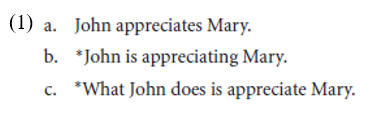
Verbs that behave like appreciate in the above environments will be taken to be state verbs and those that behave like kiss will be taken to be event verbs. If the claim we made in the introduction about the state verb/event verb contrast is correct, then we expect manner adverbs to appear only with kiss-like verbs and not with appreciate-like verbs.
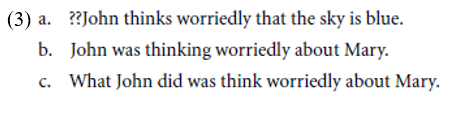
It should be pointed out that a number of the verbs listed above have eventive uses as well as stative uses. This can be illustrated with the verb think: when used in the progressive (as in 2b) or as part of a wh-cleft (as in 2c) it has an eventive reading, while when used in the simple present tense (as in 2a) it has a stative reading.

As expected, on the eventive readings think is compatible with manner adverbial modification while on the stative readings it is not:
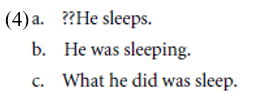
We are also uninterested in the frequently miscategorized verbs sleep, hold, and wait (whichMaienborn 2005 has confusingly termed “state” verbs).While these may seem to share many semantic features with statives, they do not behave grammatically as such, as indicated in (4):
These verbs appear naturally with manner adverbs, but this is not of interest to us here, as we fully accept that these verbs have a Davidsonian argument. More problematic, and less readily dismissed, is the sit-stand-lie class, which Dowty (1979) calls “interval statives.” These clearly have both stative and eventive readings (depending, apparently, on the agentivity of the subject):
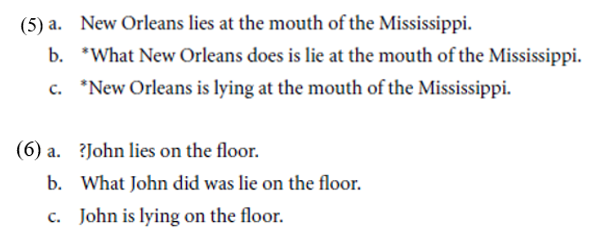
In contrast to the eventive/stative contrast of think-type verbs, these verbs can be modified by manner adverbials on both the stative and on the eventive readings:
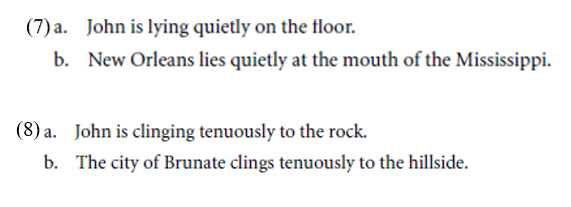
It is not clear whether this indicates ambiguity, or whether the stative interpretations in (7b) and (8b) are some sort of metaphorical extension of the event usage with concomitant metaphorical shift of the adverb meaning (Schafer 2002).
Leaving aside modifiers of non-core state verbs and focusing on the class of core state verbs such as love, know, own, and consist of, which express psychological, legal, or physical states, we are left with the following cases of manner-modified stative verbs:

Our central question, then, is whether the cooccurrence of such core state verbs with manner adverbs indicates that these state verbs have a “Davidsonian” argument. To address this, we turn to a brief discussion of manner adverbials and review why a Davidsonian analysis of event verb manner modification is an appealing one.
1 This list adapted from an online learner grammar of English (www.myenglishteacher.net).
 الاكثر قراءة في Linguistics fields
 اخر الاخبار
اخبار العتبة العباسية المقدسة

الآخبار الصحية


مواضيع ذات صلة
 قسم الشؤون الفكرية يصدر كتاباً يوثق تاريخ السدانة في العتبة العباسية المقدسة
 "المهمة".. إصدار قصصي يوثّق القصص الفائزة في مسابقة فتوى الدفاع المقدسة للقصة القصيرة
 (نوافذ).. إصدار أدبي يوثق القصص الفائزة في مسابقة الإمام العسكري (عليه السلام)