Grammar
Tenses
Present

Present Simple
Present Continuous
Present Perfect
Present Perfect Continuous
Past
Past Simple
Past Continuous
Past Perfect
Past Perfect Continuous
Future
Future Simple
Future Continuous
Future Perfect
Future Perfect Continuous
Parts Of Speech
Nouns
Countable and uncountable nouns
Verbal nouns
Singular and Plural nouns
Proper nouns
Nouns gender
Nouns definition
Concrete nouns
Abstract nouns
Common nouns
Collective nouns
Definition Of Nouns
Animate and Inanimate nouns
Nouns
Verbs
Stative and dynamic verbs
Finite and nonfinite verbs
To be verbs
Transitive and intransitive verbs
Auxiliary verbs
Modal verbs
Regular and irregular verbs
Action verbs
Verbs
Adverbs
Relative adverbs
Interrogative adverbs
Adverbs of time
Adverbs of place
Adverbs of reason
Adverbs of quantity
Adverbs of manner
Adverbs of frequency
Adverbs of affirmation
Adverbs
Adjectives
Quantitative adjective
Proper adjective
Possessive adjective
Numeral adjective
Interrogative adjective
Distributive adjective
Descriptive adjective
Demonstrative adjective
Pronouns
Subject pronoun
Relative pronoun
Reflexive pronoun
Reciprocal pronoun
Possessive pronoun
Personal pronoun
Interrogative pronoun
Indefinite pronoun
Emphatic pronoun
Distributive pronoun
Demonstrative pronoun
Pronouns
Pre Position
Preposition by function
Time preposition
Reason preposition
Possession preposition
Place preposition
Phrases preposition
Origin preposition
Measure preposition
Direction preposition
Contrast preposition
Agent preposition
Preposition by construction
Simple preposition
Phrase preposition
Double preposition
Compound preposition
prepositions
Conjunctions
Subordinating conjunction
Correlative conjunction
Coordinating conjunction
Conjunctive adverbs
conjunctions
Interjections
Express calling interjection
Phrases
Sentences
Clauses
Part of Speech
Grammar Rules
Passive and Active
Preference
Requests and offers
wishes
Be used to
Some and any
Could have done
Describing people
Giving advices
Possession
Comparative and superlative
Giving Reason
Making Suggestions
Apologizing
Forming questions
Since and for
Directions
Obligation
Adverbials
invitation
Articles
Imaginary condition
Zero conditional
First conditional
Second conditional
Third conditional
Reported speech
Demonstratives
Determiners
Direct and Indirect speech
Linguistics
Phonetics
Phonology
Linguistics fields
Syntax
Morphology
Semantics
pragmatics
History
Writing
Grammar
Phonetics and Phonology
Semiotics
Reading Comprehension
Elementary
Intermediate
Advanced
Teaching Methods
Teaching Strategies
Assessment

What next educators?
 المؤلف:
John Cornwall and Sue Soan
المؤلف:
John Cornwall and Sue Soan
 المصدر:
Additional Educational Needs
المصدر:
Additional Educational Needs
 الجزء والصفحة:
P87_C6
الجزء والصفحة:
P87_C6
 2025-04-09
 738
738




+
-
20
What next educators?
Following the assessment and problem-solving period, it is necessary for educators to share and use the information gathered successfully, so that the learner’s behavior is not just temporarily adjusted. If there is an over-reliance on ‘behavioral strategies’, this can happen. However, in busy schools, this is not easy, and spending time on developing positive relationships is often seen as peripheral to the process of teaching. A therapeutic approach to education does actually mean working with the relationships involved and in fact, socially and psychologically, it is central to the whole process. Emotions and feelings are inextricably tied up in the process of learning and teaching and cannot be ignored. Robert Dilts’ Unified Field Theory (O’Connor and Seymour, 1990) (Figure 1) provides a useful model for considering how educators interact with learners when teaching.
O’Connor and Seymour (1990) explain the terms used by Dilt as:
■ Behavior is the outward manifestation of our inner thoughts, feelings, identity, beliefs and spirit.
■ Capability is the range of personal or emotional, social, academic, physical and practical skills we bring to bear on life events.
■ Beliefs are inner maps we use to make sense of the world – they give stability and continuity.
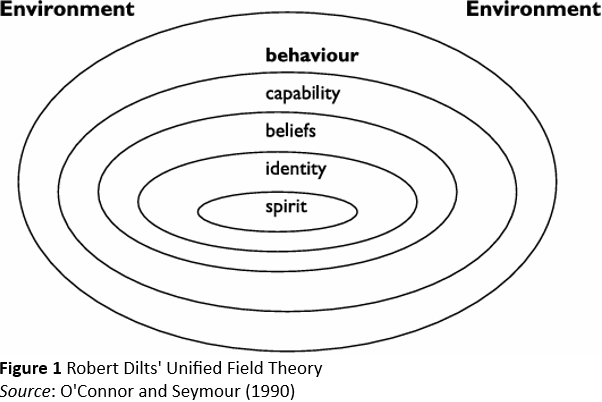
■ Identity incorporates all of the outer levels and such things as self-esteem, confidence, security, etc.
■ Spirit is the deepest intangible levels of our being or personality – what we sometimes call ‘our hidden depths’.
Change at the higher (or innermost) levels will always affect lower (outer) levels. The impact of change at higher levels is greater than at lower levels. Developing new skills will change a whole range of behavior. For example, enhancing self-esteem will change many behaviors and spiritual vision may change a person’s whole life and most of the behaviors in it.
 الاكثر قراءة في Teaching Strategies
 اخر الاخبار
اخبار العتبة العباسية المقدسة

الآخبار الصحية


مواضيع ذات صلة
 قسم الشؤون الفكرية يصدر كتاباً يوثق تاريخ السدانة في العتبة العباسية المقدسة
 "المهمة".. إصدار قصصي يوثّق القصص الفائزة في مسابقة فتوى الدفاع المقدسة للقصة القصيرة
 (نوافذ).. إصدار أدبي يوثق القصص الفائزة في مسابقة الإمام العسكري (عليه السلام)