commA Realized as [a].
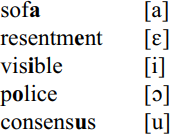
In general, in NigE, vowels in unstressed syllables, which are produced as [ə] or [ɪ] or deleted in native varieties of English, can be realized as either [a], [ε], [ɪ] , [ɔ] or [u], usually depending on the spelling (Simo Bobda 1997):
Unlike in native varieties of English, in NigE function words do not have strong and weak forms. But is always realized as [bɔt] and the is realized as [ða] or [da] in Southern NigE and [za] in Hausa English.
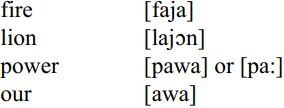
In all triphthongs, glide formation processes apply that change the middle vowels into the corresponding semi-vowels (Simo Bobda 1997) as in
In Yoruba English, nasalization of vowels preceding nasals occurs, and often also a dropping of nasals in word-final position can be observed (Jowitt 1991). For example, win will be pronounced  . In Hausa English, sometimes a glottal stop is produced before a vowel, which can have an emphasizing function (Jowitt 1991).








