

Grammar


Tenses


Present

Present Simple

Present Continuous

Present Perfect

Present Perfect Continuous


Past

Past Simple

Past Continuous

Past Perfect

Past Perfect Continuous


Future

Future Simple

Future Continuous

Future Perfect

Future Perfect Continuous


Parts Of Speech


Nouns

Countable and uncountable nouns

Verbal nouns

Singular and Plural nouns

Proper nouns

Nouns gender

Nouns definition

Concrete nouns

Abstract nouns

Common nouns

Collective nouns

Definition Of Nouns

Animate and Inanimate nouns

Nouns


Verbs

Stative and dynamic verbs

Finite and nonfinite verbs

To be verbs

Transitive and intransitive verbs

Auxiliary verbs

Modal verbs

Regular and irregular verbs

Action verbs

Verbs


Adverbs

Relative adverbs

Interrogative adverbs

Adverbs of time

Adverbs of place

Adverbs of reason

Adverbs of quantity

Adverbs of manner

Adverbs of frequency

Adverbs of affirmation

Adverbs


Adjectives

Quantitative adjective

Proper adjective

Possessive adjective

Numeral adjective

Interrogative adjective

Distributive adjective

Descriptive adjective

Demonstrative adjective


Pronouns

Subject pronoun

Relative pronoun

Reflexive pronoun

Reciprocal pronoun

Possessive pronoun

Personal pronoun

Interrogative pronoun

Indefinite pronoun

Emphatic pronoun

Distributive pronoun

Demonstrative pronoun

Pronouns


Pre Position


Preposition by function

Time preposition

Reason preposition

Possession preposition

Place preposition

Phrases preposition

Origin preposition

Measure preposition

Direction preposition

Contrast preposition

Agent preposition


Preposition by construction

Simple preposition

Phrase preposition

Double preposition

Compound preposition

prepositions


Conjunctions

Subordinating conjunction

Correlative conjunction

Coordinating conjunction

Conjunctive adverbs

conjunctions


Interjections

Express calling interjection

Phrases

Sentences

Clauses

Part of Speech


Grammar Rules

Passive and Active

Preference

Requests and offers

wishes

Be used to

Some and any

Could have done

Describing people

Giving advices

Possession

Comparative and superlative

Giving Reason

Making Suggestions

Apologizing

Forming questions

Since and for

Directions

Obligation

Adverbials

invitation

Articles

Imaginary condition

Zero conditional

First conditional

Second conditional

Third conditional

Reported speech

Demonstratives

Determiners

Direct and Indirect speech


Linguistics

Phonetics

Phonology

Linguistics fields

Syntax

Morphology

Semantics

pragmatics

History

Writing

Grammar

Phonetics and Phonology

Semiotics


Reading Comprehension

Elementary

Intermediate

Advanced


Teaching Methods

Teaching Strategies

Assessment
Phonotactic constraints
المؤلف:
Mark Aronoff and Kirsten Fudeman
المصدر:
What is Morphology
الجزء والصفحة:
P78-C3
2026-04-04
42
Phonotactic constraints
Phonotactic constraints limit the possible phonological shapes of stems and words. Phonotactic constraints are often, but not always, connected with syllable structure.
At their most basic, phonotactic constraints determine the minimum length of content words in particular languages. For example, in Mohawk, each content word contains at least two syllables (Michelson 1988, cited by Hayes 1995: 47). Other languages require that content words consist of at least a heavy syllable, where heavy means that the syllable contains a long vowel, diphthong, or a vowel and a weight-bearing (moraic) consonant.1 Many languages do not have minimal word constraints, including Romanian, Hungarian, and Icelandic (Hayes 1995: 88–9).
Does English have a minimal word constraint? An analysis of nick-names suggests that it does (see McCarthy and Prince 1998: 287–8). Here is a list of some English first names and their corresponding short forms, or nicknames:
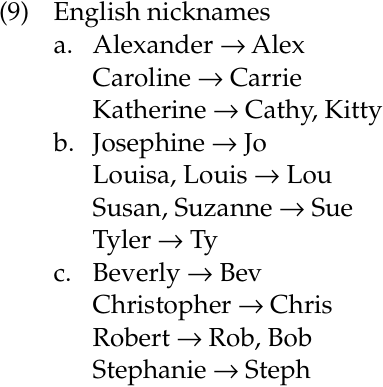
Even if we were to keep going, we would find that any nickname we can think of falls into one of these three sets. They are either polysyllabic (9a) (in this case, bisyllabic) names or monosyllabic names (9b–c) that have either a diphthong, a coda, or both. No native English nick names consist of a single, light syllable. From this data, it seems that English falls in with the set of languages that have a minimal word constraint. Even the shortest of names, nicknames, must consist minimally of a heavy syllable or two light syllables. And it is difficult, if not impossible, to find an English content word that contradicts this conclusion.
We also find that languages have restrictions on the possible shapes of roots. Nida (1965: 66) reports that in the Mayan languages, roots are predominantly of the shape CVC and in Bantu they are generally CVCV. In Hebrew, Arabic, and other Semitic languages, roots generally consist of three consonants: CCC.
1 If you are not already familiar with the terms “weight-bearing consonant” and “mora,” you do not need to learn them. We mention them in this context only to be complete. If you are interested in reading further on the topic, a good starting point is Hayes (1989).
الاكثر قراءة في Phonology
اخر الاخبار
اخبار العتبة العباسية المقدسة
الآخبار الصحية

قسم الشؤون الفكرية يصدر كتاباً يوثق تاريخ السدانة في العتبة العباسية المقدسة
"المهمة".. إصدار قصصي يوثّق القصص الفائزة في مسابقة فتوى الدفاع المقدسة للقصة القصيرة
(نوافذ).. إصدار أدبي يوثق القصص الفائزة في مسابقة الإمام العسكري (عليه السلام)


