0
EN
1
المرجع الالكتروني للمعلوماتية

Grammar

Tenses

Present

Present Simple

Present Continuous

Present Perfect

Present Perfect Continuous

Past

Past Simple

Past Continuous

Past Perfect

Past Perfect Continuous

Future

Future Simple

Future Continuous

Future Perfect

Future Perfect Continuous

Parts Of Speech

Nouns

Countable and uncountable nouns

Verbal nouns

Singular and Plural nouns

Proper nouns

Nouns gender

Nouns definition

Concrete nouns

Abstract nouns

Common nouns

Collective nouns

Definition Of Nouns

Animate and Inanimate nouns

Nouns

Verbs

Stative and dynamic verbs

Finite and nonfinite verbs

To be verbs

Transitive and intransitive verbs

Auxiliary verbs

Modal verbs

Regular and irregular verbs

Action verbs

Verbs

Adverbs

Relative adverbs

Interrogative adverbs

Adverbs of time

Adverbs of place

Adverbs of reason

Adverbs of quantity

Adverbs of manner

Adverbs of frequency

Adverbs of affirmation

Adverbs

Adjectives

Quantitative adjective

Proper adjective

Possessive adjective

Numeral adjective

Interrogative adjective

Distributive adjective

Descriptive adjective

Demonstrative adjective

Pronouns

Subject pronoun

Relative pronoun

Reflexive pronoun

Reciprocal pronoun

Possessive pronoun

Personal pronoun

Interrogative pronoun

Indefinite pronoun

Emphatic pronoun

Distributive pronoun

Demonstrative pronoun

Pronouns

Pre Position

Preposition by function

Time preposition

Reason preposition

Possession preposition

Place preposition

Phrases preposition

Origin preposition

Measure preposition

Direction preposition

Contrast preposition

Agent preposition

Preposition by construction

Simple preposition

Phrase preposition

Double preposition

Compound preposition

prepositions

Conjunctions

Subordinating conjunction

Correlative conjunction

Coordinating conjunction

Conjunctive adverbs

conjunctions

Interjections

Express calling interjection

Phrases

Sentences

Clauses

Part of Speech

Grammar Rules

Passive and Active

Preference

Requests and offers

wishes

Be used to

Some and any

Could have done

Describing people

Giving advices

Possession

Comparative and superlative

Giving Reason

Making Suggestions

Apologizing

Forming questions

Since and for

Directions

Obligation

Adverbials

invitation

Articles

Imaginary condition

Zero conditional

First conditional

Second conditional

Third conditional

Reported speech

Demonstratives

Determiners

Direct and Indirect speech

Linguistics

Phonetics

Phonology

Linguistics fields

Syntax

Morphology

Semantics

pragmatics

History

Writing

Grammar

Phonetics and Phonology

Semiotics

Reading Comprehension

Elementary

Intermediate

Advanced

Teaching Methods

Teaching Strategies

Assessment

قم بتسجيل الدخول اولاً لكي يتسنى لك الاعجاب والتعليق.

Vowel variation in contemporary Norfuk

المؤلف:  John Ingram and Peter Mühlhäusler

المصدر:  A Handbook Of Varieties Of English Phonology

الجزء والصفحة:  796-43

2024-05-06

1479

+

-

20

Vowel variation in contemporary Norfuk

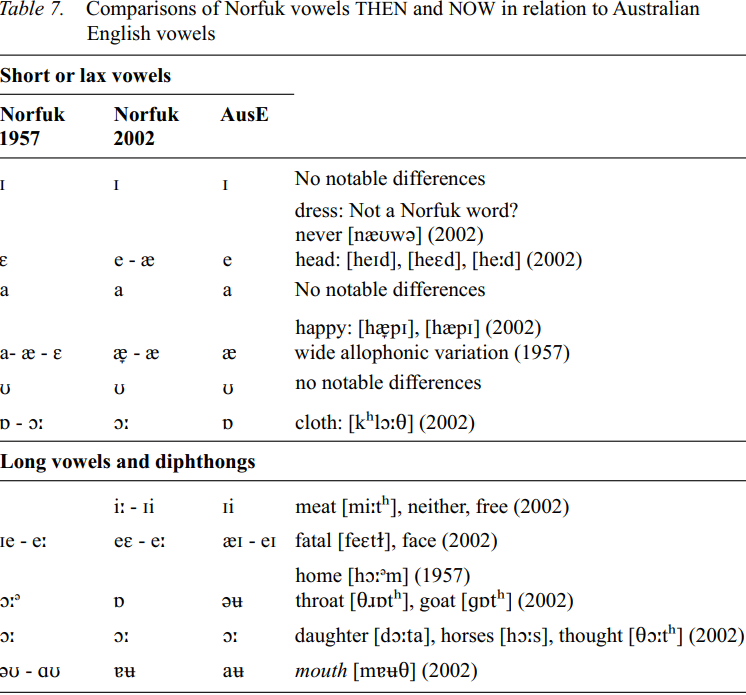
From the keyword list a number of comparisons were attempted, to try to ascertain vowel shifts or lexical changes in pronunciation that may have taken place in Norfuk over the period of the late 1950s to the present day. These comparisons are summarized in Table 7 below. The data sets are too small for any but the most tentative observations. However, they generate some useful hypotheses to guide subsequent inquiry.


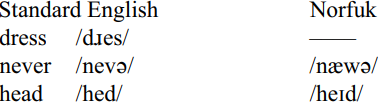
There is no evidence of substantial change in phonetic realization of the short lax vowels [ɪ- ε- a- ʊ] between the Flint samples from 1957 and the keyword sample from 2002. One might look for evidence that Norfuk [ε] has raised towards the Australian English equivalent ([e], bed). But this was apparent in only one token elicitation of dress, a word that is probably not part of Norfuk vocabulary. It is interesting to note that words in Norfuk which have cognate forms in standard English (e.g. never, head) are not only categorically distinct in length or vowel quality from the standard Australian or Norfolk English pronunciation, but are so in ways that represent alternative phoneme categories in standard English. This is what might be expected if Norfuk speakers were using standard English phonemic categories to differentiate lexical items of Norfuk from their cognates in standard English. Early Norfuk probably had no phonemic contrast between [ε] and [æ]. Note the wide variability in [æ ~ a] English-sourced Norfolk words from the Flint sample.
 

There is possibly a lesson here for teaching Norfuk to English speakers. In certain cases, an English word may be given ‘Norfuk’ color simply by substituting one English vowel phoneme for another. A similar case of phonemic mapping between standard English and Norfuk arises in cognate forms involving the back vowels /əʊ, ɔ:, ɒ​/. These sounds are usually realized in Norfuk as long [ɔ:], often with a centering off-glide, or as short [ɔ:]. English source words containing /əʊ/ can flag their Norfuk status by phonemicizing as /ɔ:/ or /ɒ/.
In this way, as in the case of /e/ words discussed above, systematic substitutions by phonetically related sounds may be employed to mark the special status of Norfuk lexical items. Whether this is what in fact happens is a matter of speculation, but should be testable through further analysis of the phonetic forms and distributions of these sounds in the Flint corpus and further elicitation of contemporary speech samples.


اخر الاخبار

اشترك بقناتنا على التلجرام ليصلك كل ما هو جديد

