Vowels TRAP, BATH, DANCE
In New York City, and elsewhere in the Mid-Atlantic region, the historical “short a” vowel class is split into two phonemes. The complicated distribution of these phonemes, labeled here lax /æ/ and tense /æə/, is defined by phonological, morphological, and lexical patterns. The lax /æ/ occurs consistently before voiceless stops, /tʃ/, and /l/ (e.g., cat, lap, back, match, pal). The tense /æə/ generally occurs before voiced stops,  , voiceless fricatives, and front nasals (e.g., bad, badge, bath, ham, dance). If, however, the vowel is followed by an unstressed syllable, the choice of phoneme depends on the morphological status of that syllable. The tense vowel appears when the syllable is a separate morpheme as in the case of an inflectional suffix (e.g., badges, dragging). The lax vowel appears when the unstressed syllable is part of the root morpheme (e.g., clamor, dragon). Function words such as an, am, can and had are exceptions to the phonological rule as they occur with lax phoneme. Thus, the auxiliary can and the noun can (as in the metal container) form a minimal pair for the lax/tense contrast. In the environments of a following voiced fricative or /ŋ/ (e.g., jazz, bang) the occurrence of /æ/ and /æə/ is variable. Before /v/, for example, the lax phoneme predominates, but avenue, in which /æə/ is usual, stands as a lexical exception. More details about the patterning of these phonemes can be found in Labov (1994: 335) and Labov, Yaeger, and Steiner (1972: 48–52).
Phonetically the tense phoneme is distinguished from the lax by lengthening and raising. The vowel often appears as an ingliding diphthong with the nucleus varying in height from [æ] to  . Labov (1966) found the height of this vowel to vary sociolinguistically. The higher variants (i.e.,
 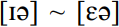 ) occur more commonly among speakers from the lower end of the socioeconomic hierarchy and in less formal speaking styles.








