Upgliding diphthongs GOAT
As we saw above, the Long Mid Mergers have not taken place in East Anglia. There are therefore two vowels at this point in the East Anglian vowel system. Paralleling the vestigial distinction in the front vowel system between the sets of made and maid, corresponding to the distinction between the ME monophthong and diphthong, there is a similar distinction in the back vowel system which, however, is by no means vestigial in the northern part of the area. The distinction is between /u:/ =  , descended from ME
  , and /Λu/ =
  , descended from ME /ou/. Thus pairs such as moan ≠ mown, road ≠ rowed, nose ≠ knows, sole ≠ soul are not homophonous.
ME  plus /l/ also gives /Λu/, as in hold. Words such as bowl and shoulder have /au/ in the older dialect, however.
One further complication is that, in modern speech, adverbial no has /u:/ while the negative particle no has /Λu/: No, that’s no good  .
.
There are two additional complications. One is that, as we have already seen, words descended from the ME monophthong may also have  , i.e. road can be either
  or /ru:d/.
Secondly, as was mentioned briefly above, many words from the set of GOOSE which are descended from ME /o:/ may have /u:/ rather than  . That is, words such as boot may be pronounced either
  or /bu:t/. In the latter case, they are of course then homophonous with words such as boat. Therefore rood may be homophonous either with rude or with road which, however, will not be homophonous with rowed.
It is probable that this alternation in the GOOSE set is the result of lexical transfer, perhaps under the influence of earlier forms of RP, from  to /u:/. Forms in /u:/ are more typical of middle-class than of working-class speech; and phonological environment can also have some effect:
  before /l/ as in school has much lower social status than it does before other consonants. Words which in my own lower-middle class Norwich speech have
  rather than /u:/ include: who, whose, do, soon, to, too, two, hoot, loot, root, toot, soup, chose, lose, loose, through, shoe. I have no explanation at all for why, for example, soon and moon do not rhyme in my speech. There is also considerable individual variation: my mother has
  in chose and root, for instance, and my late father had /u:/ in who. Note that this alternation never occurs in the case of those items such as rule, tune, new etc. which have historical sources other than ME/o:/; these words always have
  . For very many speakers, then, rule and school do not rhyme.
In summary:
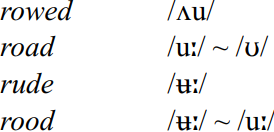
Two modern developments should also be noted. First, the phonetic realization of /u:/ in the northern area is currently undergoing a rather noticeable change, with younger speakers favoring a fronter first element  . This is more advanced in Lowestoft, Gorleston and Yarmouth than in Norwich. Secondly, in the southern zone, the moan: mown distinction is now very recessive, so that for most speakers /Λu/ is used in both lexical sets and /u:/ has disappeared. As a consequence, GOOSE words can no longer alternate in their pronunciation.








