Lysosomes
Lysosomes are membrane-bound organelles that function as the “stomachs” of eukaryotic cells. They contain about fifty different enzymes that break down all types of biological molecules including proteins, nucleic acids, lipids, and carbohydrates. Cells transport material into lysosomes, the material is digested by the enzymes, and the digested molecules are moved back into the cytosol for use by the cell. Both extracellular materials brought into the cell by endocytosis and obsolete intracellular materials are degraded in the lysosome.
Lysosomes vary in size and shape, but have several common features. They are surrounded by a single membrane, have an acidic interior pH level of about 5, and carry a high content of digestive enzymes. All of the digestive enzymes found in the lysosome require an acidic environment to function properly and are called acid hydrolases. The low pH of the lysosome is maintained by membrane proteins that pump protons (H+ ions) from the cytosol into the lysosome.
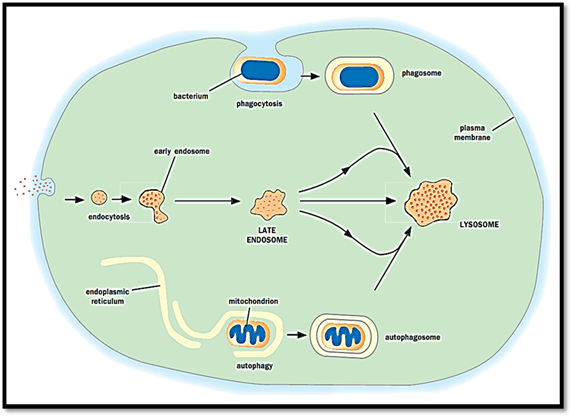
Three routes to degradation in lysosomes
In addition to the proton pumps, the lysosomal membrane contains many other proteins that transport the digested molecules out of the lyso- some and into the cytosol. Although it may seem dangerous for cells to contain enzymes that can digest most biological molecules, the contents of the cell are doubly protected from the digestive enzymes of the lysosome. First, the enzymes are enclosed in the lysosomal membrane and second, even if the enzymes were to leak out of the lysosome, they would not be active at the neutral pH of the cytosol.
Extracellular materials to be degraded in the lysosome are brought into the cell by either pinocytosis or phagocytosis. Pinocytosis, which occurs in all eukaryotic cells, is the internalization of extracellular fluid and small macromolecules by means of small vesicles that pinch off the inside of the plasma membrane. These small vesicles carrying endocytosed molecules are initially delivered to membranous organelles called endosomes. It is not precisely clear how molecules to be degraded progress from endosomes to lysosomes. Endosomes may actually mature into lysosomes when newly made acid hydrolases are delivered to the endosome.
Phagocytosis, which occurs in only specialized cell types, is the ingestion of large particles such as cell debris or whole microorganisms. Phagocytic cells engulf large particles by forming a large intracellular vesicle containing the engulfed particle. The large vesicle then fuses with a lysosome, resulting in a single membranous organelle in which the digestive enzymes break down the ingested particle.
Intracellular materials, such as old organelles, are brought into a lyso- some by a process called autophagy. For example, when a mitochondrion comes to the end of its ten-day life, it is engulfed by membrane derived from the endoplasmic reticulum. The newly enclosed mitochondrion then fuses with a lysosome, resulting in its degradation by the acid hydrolases.
A group of genetic disorders caused by defective lysosomal enzymes demonstrates the importance of lysosomes. Called lysosomal storage diseases, these disorders are characterized by the harmful accumulation of undigested substances. The accumulated materials impair or kill the affected cells, resulting in skeletal or muscular defects, mental retardation, or even death.
References
Hunziker, Walter, and Hans J. Geuze. “Intracellular Trafficking of Lysosomal Membrane Proteins.” Bioessays 18 (1996): 379-389.
Kornfeld, Stuart, and Ira Mellman. “The Biogenesis of Lysosomes.” Annual Review of Cell Biology 5 (1989): 483-525.
Mellman, Ira. “Endocytosis and Molecular Sorting.” Annual Review of Cellular and Developmental Biology 12 (1996): 575-625.








