Phonological rules
Rules of English consonant allophony also support the postulation of the syllable, insofar as those rules are best stated with reference to the syllable. The best-known such rule is the aspiration rule. As is commonly recognized and explicitly assumed in our previous discussion of the aspiration rule, voiceless stops are aspirated at the beginning of a syllable, explaining the aspiration in [ph ɪt, ph lat, ə.ˈph ɪr, ʌ.ˈph laj] but not in [spɪt, splɪt, ʌ.ˈspɛ.rə.gəs, slæp, æpt].
Another rule of American English which refers to the syllable is the one glottalizing syllable-final voiceless stops, where /p t k/ become unreleased glottalized [p˺ t˺ k˺] after a vocoid in the same syllable. There is dialectal variation in the extent to which all voiceless consonants undergo this rule, but examples involving t (which is the most susceptible to glottalization) include hit, heart, catkin, Atkins, light, clout, heights, hearts, atlas, atlantic, and Watney’s. By contrast, there is no glottalization of t in stem, apt, belt, mattress, atrocious. In the word stem, t is clearly not preceded by a vocoid at all, so the conditions of the rule are not satisfied: likewise in apt and belt. In mattress, atrocious, the cluster tr is a cluster at the beginning of the second syllable, so while t is preceded by a vocoid, it is not in the same syllable. Consequently, there is no glottalization in these examples. On the other hand, there is glottalization in atlas, atlantic since *tl is not a permitted initial cluster in English; these words are syllabified as at.las, at.lan.tic. Likewise tn is not an allowed cluster at the beginning of the syllable, so Watney’s is syllabified Wat.ney’s. Since t is in the same syllable as the preceding vocoid, the consonant becomes glottalized.
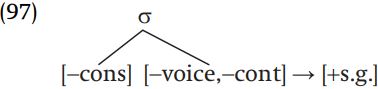
The rule of glottalization provides important evidence regarding the nature of the syllable. The required relationship between the target consonant and the triggering vocoid is that they must be in the same syllable – the consonant does not have to be at the end of the syllable, see [kwaɹt˺s] ‘quartz.’ This means that the “syllable” is not just a boundary ordered between segments – the phonological significance of the syllable goes beyond encoding the concepts “syllable-initial” and “syllable-final.” Being in a syllable is a property shared by a span of segments. Analogous to the autosegmental representation of H linked to multiple vowels in Shona seen in (24), the segments of [kwaɹt˺s] are linked to one syllable entity, notated as σ.

The rule deriving glottalized consonants can accordingly be formulated as (97).
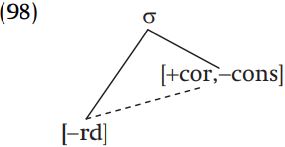
r-unrounding. A third rule of English phonology providing evidence for the syllable is the one which pertains to rounding of r. In some dialects, r is realized both as a rounded and an unrounded rhotic approximant, [ɹ] and [ɹ w], following the rule that /ɹ w/ unrounds after a nonround vowel in the same syllable. Thus r is round in [ɹ wejɲdʒ ] range, [t h ɹ wej] tray, [stɹ wej] stray, [fɹ wej] fray, also in [kɔɹw] core, [tʊɹw] tour where the vowel preceding r in the syllable is round, and in [ʌˈɹwej] array where the preceding vowel is in a separate syllable; but r is unrounded in [kaɹ] car, [kaɹt] cart, [ˈbɪɹ] beer, [hɛɹld] Harold. The following rule unrounds /ɹ w/ after a tautosyllabic nonround vowel.