The autonomy of all features
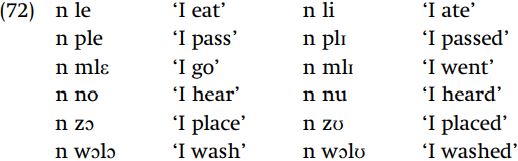
An example of segmental phenomena which are reminiscent of autosegmental tonal properties is floating segmental features as morphemes. One such case is seen in Vata, where the past-tense marker can be argued to be simply the specification [+high], which is suffixed to the stem and is realized phonetically on the last vowel.
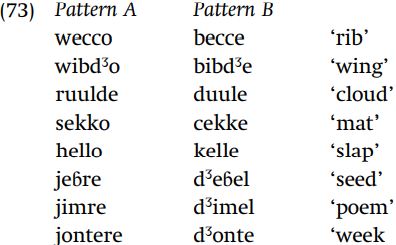
A second example comes from Fula, where a particular agreement pattern (“pattern B” below) is marked by a prefix composed of the segmental specification [– continuant] which causes an initial continuant to become a stop.
Aramaic CP. Azerbaijani Aramaic provides evidence for treating the feature [constricted pharynx] ([CP]) autosegmentally. This dialect has a contrast between pharyngealized or emphatic vowels (A E I U O) specified as [+CP], and plain vowels (a e i u o). In most words, either all of the vowels are emphatic, or none of them is.

Some words may have nonemphatic vowels followed by emphatic vowels. In such a case, the first emphatic vowel is always a low vowel.

These distributional properties will play an important role in arguing for an autosegmental treatment of [CP].
In line with the fact that all vowels in a word generally agree in the feature [CP], (76) shows that suffixes harmonize in [CP] with the preceding vowel.
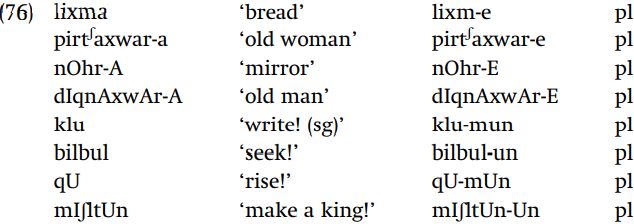
[CP] will spread through a whole sequence of suffixes.

We will assume that the only value underlyingly marked for this feature is [+CP], and that [+CP] spreads to the right by the following rule:
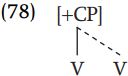
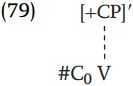
This rule thus explains why [+CP] vowels are always followed by [+CP] vowels. However, we also need to explain why roots with a [+CP] specification (generally) have [+CP] beginning with the first vowel. We can assume that, in the general case, the specification [+CP] is not associated with any particular vowel, but is just floating, and an unassociated [+CP] specification is associated with the first vowel of the word by the following rule:
The derivation of mIʃItUn-Un ‘make a king (pl)!’ shows these rules.

There are some suffixes whose vowels are invariably emphatic; that vowel is always the vowel [A]. No suffixes are invariably plain.
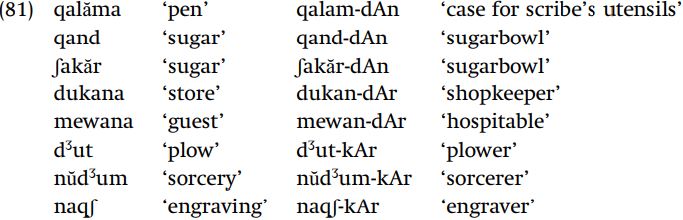
These suffixes will be assumed to have underlying [CP] specifications, in contrast to most other suffixes which are unspecified for [CP]. Since the suffix vowel is lexically associated with [+CP], it does not associate with the first vowel of the word, and since it does not associate with the first vowel of the word, [+CP] does not spread to any vowels before that of the suffix.
We also find spreading of [+CP] between members of a compound. In the examples of (82), [+CP] spreads from the first compound to the second.

This is the expected pattern: [+CP] spreads rightward from the first member of the compound to the second.
If the second member of the compound has [+CP] vowels, [+CP] spreads through the second member of the compound.
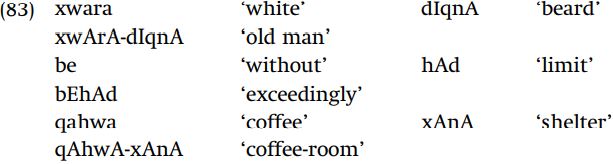
This apparent exceptional leftward spreading of [+CP] is nothing of the sort. Rather, the second member of the compound has a floating [+CP] specification; in a compound, that feature links to the first vowel of the word by rule (79), and then spreads to the right.

Another case of [+CP] appearing to the left of the morpheme where it originates is seen in (85), where a prefix is added to a root with a floating [+CP] specification.
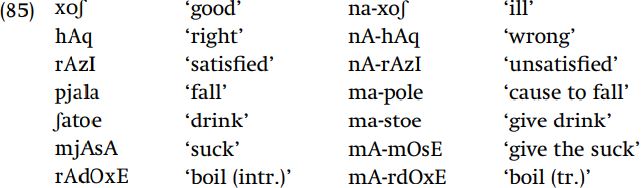
Given the assumption that a root specification of [+CP] is not generally associated in the underlying form (except in roots such as (75) where [+CP] is unpredictably associated with a noninitial low vowel), our analysis predicts that the [+CP] specification will link to the first vowel of the word, which will be the prefix vowel in this case, and spreads to the right thereafter.
The locational suffix -istan has the interesting property that it causes all vowels in the word to which it is attached to become [+CP],

This makes sense if the suffix -istan also has a floating specification [+CP], which automatically associates with the first vowel of the stem and then spreads rightward.









