Identifying phonological regularities
Vowel harmony. Having grouped the examples in this fashion, a phonological regularity can be detected. For the suffix hin ~ hun, the vowel u appears when the preceding vowel is u, and i appears in the suffix after any other vowel. The suffix it ~ ut obeys this same rule. The suffixes k’a ~ k’o and al ~ ol have the vowel o after o. This can be explained by positing a rule of vowel harmony between the suffix vowel and whatever vowel precedes it, where /a/ assimilates to /o/ and /i/ assimilates to /u/.
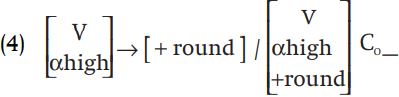
The variable notation – αhigh... αhigh... – expresses the condition that the vowels must have the same value of [high], i.e. the harmonizing vowel must be [+high] after a [+high] round vowel, and [-high] after a [-high] round vowel, in order for the harmony rule to apply.
Vowel shortening. The next problem to tackle is the variation in the shape of the stem. A useful next step in trying to analyze that variation is to see whether the variants can be arranged into a small number of groups, organized according to the nature of the difference between the two stem shapes. In looking for such an organization, notice that some stems alternate in terms of having long versus short vowels, and in terms of having versus lacking a second vowel. Accordingly, we organize the data into the following classes of stem alternations (including the class of stems which have no alternation).
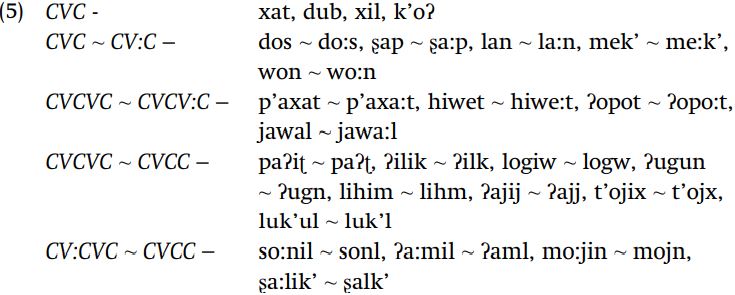
The initial hypothesis is that the invariant CVC stems have the underlying shape CVC. If there is no reason to make the underlying form be different from the surface form, the two forms should be assumed to be identical. Building on that decision, we will now set forth a hypothesis for stems which vary in shape between CVC and CV:C. It is highly unlikely that these stems also have the underlying shape CVC, since that would make it hard to account for stems such as /xat/ which are invariant CVC. We could not predict whether a stem vowel is supposed to have a length alternation or not, and the reasoning that leads to hypothesizing an underlying distinction /xat/ vs. /do:s/ which is contextually neutralized is exactly the same as that which leads to hypothesizing that in Russian, the word for ‘time’ is underlyingly /raz/ and for ‘forest’ it is /les/.
Given the conclusion that stems like do:s ~ dos have an underlying CV:C form, under what circumstance is the underlyingly long vowel of the stem shortened? Taking /do:s/ as a representative, and mechanically combining the assumed underlying stem with what we take to be the underlying form of the suffix, we arrive at the following underlying and surface relations.

The change of /a/ to [o] is due to vowel harmony. There is also a change in vowel length before k’a and hin, and not before -al and -it. These suffixes are distinguished by whether they begin with a consonant or a vowel, thus whether combining the stem and suffix would result in the sequence V:CC. Scanning the entire data set reveals an important generalization, that a long vowel is always followed by CV, that is, a long vowel only occurs in an open syllable. The discovery of this generalization allows us to posit the following vowel shortening rule.

This rule is all that is needed to explain both the invariant CVC stems and the alternating CV:C ~ CVC stems. Underlyingly /do:s-hin/ undergoes (7) and gives the surface form [doshin] – all other forms preserve the underlying length of the vowel. The existence of this rule also explains why we do not find the surface sequence V:CC – a long vowel before a cluster of two consonants – anywhere in the data, as such sequences undergo vowel shortening.
We turn next to the stems with the shape CVCVC ~ CVCV:C such as p’axat ~ p’axa:t. Since we have already encountered a rule which accounts for alternations in vowel length, we should immediately suspect that this length alternation is the same as the one just accounted for in CV:C ~ CVC stems. When we inspect the contexts where the long-vowel variant occurs, we see that there are long vowels when a vowel-initial suffix is added, and short vowels when a consonant-initial suffix is added. In other words, these stems are virtually the same as /CV:C/ stems, except that they have the underlying shape /CVCV:C/. We initially hypothesized that there was a rule of vowel shortening based on /CV:C/ stems, and that rule nicely handled those data. The way we formulated that rule was quite general, since it only said “shorten a long vowel before two consonants.” Such a statement predicts that, if there are other stem shapes such as /CVCV:C/, they too will undergo that rule. We have now discovered that such stems do undergo the shortening rule, providing independent support for that rule.
Epenthesis. This reduces the unsolved part of the problem to two remaining classes of stems. In one of those, there is an alternation between presence versus absence of a vowel, and in the second group there is an alternation in vowel length as well as an alternation in the presence versus lack of a vowel in the second syllable; this should make us suspect that the vowel shortening rule applies to the second of these sets. Concentrating on the contexts where the stem has the shape CV(:)CVC as opposed to the shape CVCC, we notice that CV(:)CVC appears before consonant-initial suffixes and CVCC appears before vowel-initial suffixes. We do not know at this point whether the second vowel is underlyingly part of the stem and is deleted in one context, or whether the vowel is inserted in a different context. Therefore, we will consider both possibilities: consideration of alternative hypotheses is an essential part of problem solving.
First suppose that the vowel is not part of the underlying representation of the stem. In that case, we assume the following representations

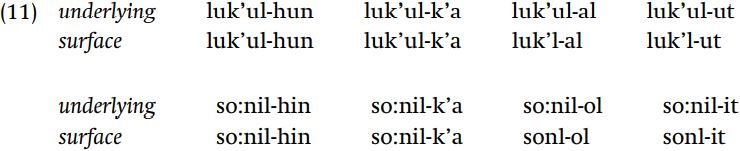
Focusing on the hypothesized underlying representations where a vowel might be inserted, we notice that a vowel appears only where the underlying representation has a sequence of three consonants. Looking at all of the data, we notice that there are no surface sequences of three or more consonants, making such an epenthesis approach plausible.
In order for an epenthesis solution to work, the actual quality of the inserted vowel must be completely predictable. If we were to discover that the quality of the second vowel is unpredictable, then it would necessarily be part of the underlying representation since unpredictble information must be in the underlying form. The vowel in the second syllable is always high, and is round when the preceding vowel is high and round. In other words, the vowel in question is a high vowel whose backness and roundness is predictable, given the rule of vowel harmony, and thus the vowel is fully predictable. Given the harmony rule, we can assume that the second vowel is i. It is then possible to account for these examples by applying the following rule of epenthesis.
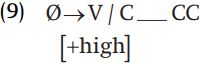
Given (9), the underlying form of the CVCiC ~ CVCC stems would be /CVCC/ and the underlying form of the CV:CiC ~ CVCC stems would be /CV:CC/. For stems like /ʔilk/, epenthesis applies to underlying /CVCC+CV(C)/ to give surface [CVCiC+CV(C)]: /ʔilk-hin/ ! [ʔilikhin]. The alternant CVCC before VC suffixes ~ [ʔilkal] ~ directly reflects the underlying form.
For /CV:CC/ stems like /ʂa:lk’/, epenthesis will also apply to underlying /CV:CC+CV(C)/, giving the surface form [CV:CiC+CV(C)]: /ʂa:lk-hin/ ! [ʂa: likhin]. When a VC suffix is added to such stems, there is no epenthesis, but we do find shortening of the underlyingly long vowel which stands before a consonant cluster: (/ʂa:lkal/ ! [ʂalkal]). The rules of vowel harmony, epenthesis, and vowel shortening, combined with our analyses of underlying representations, account for all aspects of the data in (1). We conclude that epenthesis is a possible account of these alternations.
The preceding analysis has assumed a rule of epenthesis based on underlying representations of the form /CVCC/ and /CV:CC/, but we should explore the competing hypothesis that the vowel found in these stems is not inserted, and is part of the underlying representation. Under that hypothesis, underlying representations of the relevant stems would be the following.

Presuming that these are the underlying stems, a rule of vowel deletion is required to explain the discrepancy between surface and underlying forms, which can be seen in (11).
In forms which involve an alternation between a vowel and ∅, the context for vowel deletion would initially appear to be in an open syllable. This statement would produce too general a rule, since there are many vowels in open syllables, viz. xatal, k’oʔit, do:sit, p’axathin, and p’axa:tal among others. In some of these, deletion of a vowel would lead to a word-initial consonant cluster, i.e. we would predict *xtal, *k’ʔit, *dsit, *p’xathin, and *p’xa:tal, and we see no word-initial clusters of consonants. If we are to have vowel deletion, the rule must be restricted from creating such clusters, so one way to enforce that requirement is to require the target of deletion to be preceded by the sequence VC. Thus, we might hypothesize the following syncope rule, one found in many languages.

This rule still makes incorrect predictions, since in fact there are vowels in the context VC_CV, as shown by forms such as p’axa:tal, ʔopo:tit, which according to (12) should be deleted. Since all such examples involve long vowels, it is a simple matter to restrict the assumed deletion rule to short vowels.

With this rule of vowel syncope, the problem of vowel ~ Ø alternations can also be accounted for. The remaining details of the analysis are exactly the same as they are under the assumption that there is a rule of vowel insertion.








