Mongo: B-deletion and resolution of vowel hiatus
Sometimes, what needs to be remarked about the interaction between processes is the failure of one rule to apply to the output of another rule. This is illustrated in (40), (41), and (46) with examples from Mongo (Congo). The first four examples demonstrate the shape of the various subject prefixes when they stand before a consonant
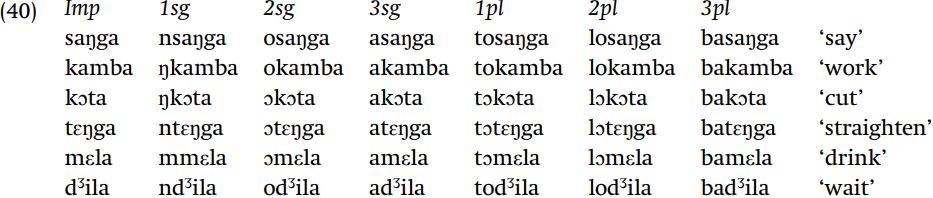
The underlying forms of the subject prefixes are /N/ (which stands for a nasal consonant, whose exact place of articulation cannot be determined), /o/, /a/, /to/, /lo/, and /ba/. There is a vowel harmony process assimilating the closed vowel /o/ to the open vowel [ɔ] when the following syllable contains either of the open vowels [ε] or [ɔ], and the prefix for first-singular subject assimilates in place of articulation to the following consonant.
The examples in (41) show how the subject prefixes are realized if the verb root begins with a vowel.
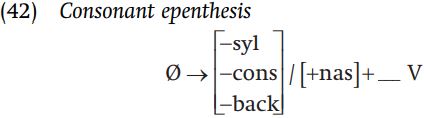
 When the first-singular subject prefix stands before the root, it has the shape [ndʒ ], which we will treat as being the result of insertion of [dʒ ] between the prefix and a vowel-initial root. (We might also assume the prefix /ndʒ /, which simplifies before a consonant, since such three-consonant sequences, viz. /ndʒ -saŋga/, do not exist in the language.
The vowel /a/ deletes before another vowel, as shown by the third-singular and third-plural forms /a-εna/ ! [εna] and /ba-εna/ ! [bεna].

The prefixes /o/, /to/, and /lo/ undergo a process of glide formation where /o/ becomes [w] before a vowel.

In the case of /to/ and /lo/ a further process affricates these consonants before a glide.
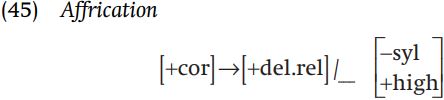
This affrication process must apply after glide formation, since it applies to a sequence of consonant plus glide that is created by the application of glide formation from an underlying consonant-plus-vowel sequence.
The final set of examples illustrates verb roots which underlyingly begin with the consonant /b/. As these data show, when underlying /b/ is preceded by a vowel, it is deleted.

Thus, surface [oina] derives from /obina/ and [baina] derives from /babina/, via the following rule.
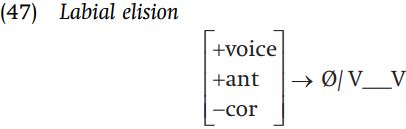
In this case, even though deletion of /b/ creates new sequences of o+V and a+V which could in principle undergo the rules of a-deletion and glide formation, those rules do not in fact apply. In other words, in this case the grammar must contain some kind of explicit statement regarding the interaction of these processes, such as an explicit ordering of the rules, which guarantees that the output of b-deletion does not undergo glide formation or a-deletion. By ordering the b-deletion rule so that it applies after the glide formation and vowel truncation rules, we explain why those two rules fail to apply, just in case the consonant b is deleted intervocalically. The ordering where b-deletion precedes vowel truncation and glide formation, illustrated in (48b), results in ungrammatical forms, which shows that that ordering of the rules is incorrect. (“NA” means that the rule cannot apply, because the conditions called for in the rule are not satisfied in the string.)
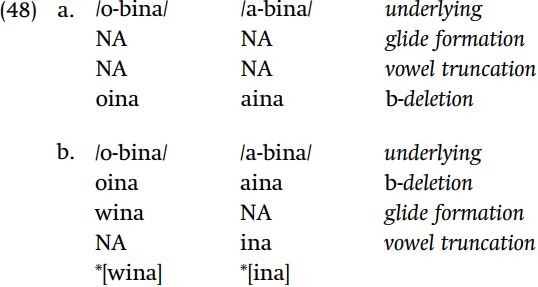
Mongo thus provides an example of the failure of rules – especially vowel truncation and glide formation – to apply to the output of a specific rule – b-deletion – which we explain by ordering b-deletion after the vowel rules.








