Kamba: palatalization and glide formation
There is a phonological process in Kamba (Kenya) whereby the combination of a velar consonant plus the glide j fuses into an alveopalatal affricate. This can be seen in (5), which involves the plain and causative forms of verbs. In the examples on the left, the verb is composed of the infinitive prefix /ko-/ (which undergoes a process of glide formation before another vowel, becoming [w]) followed by the verb root (e.g. -kam- ‘milk’), plus an inflectional suffix -a. In the righthand column we can see the causative of the same verb, which is formed by suffixing -j- after the verb root before the inflectional marker -a.
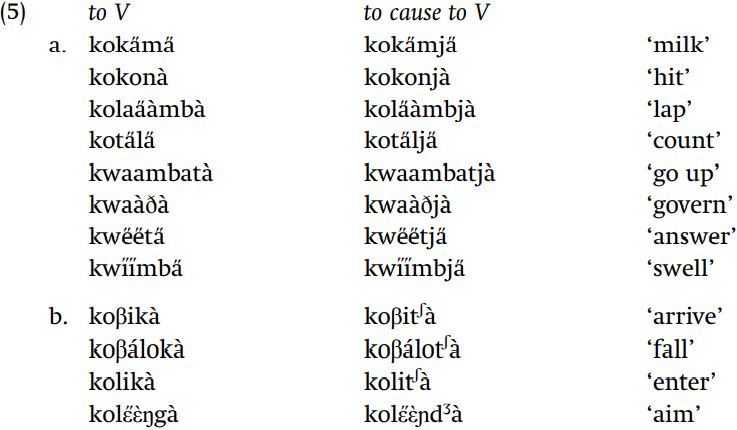

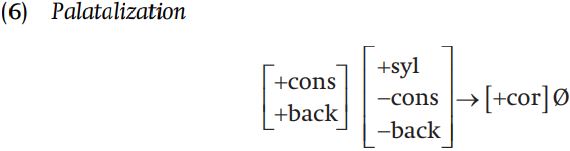
The examples in (a) illustrate the causative affix following various nonvelar consonants of the language. In (b), we see the causative of various roots which end in k or g, where by analogy to the data in (a) we predict the causatives /koβikjà/, /koβálokjà/, /kolε̋ὲŋgjà/, and so on. Instead of the expected consonant sequences kj, gj, we find instead that the velar consonant has been replaced by an alveopalatal affricate, due to the following rule:
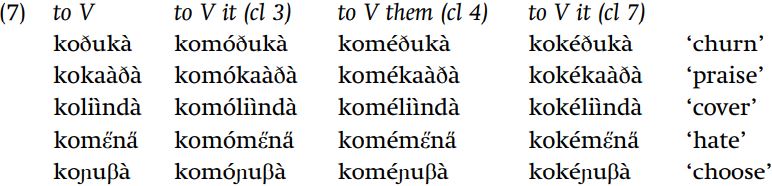
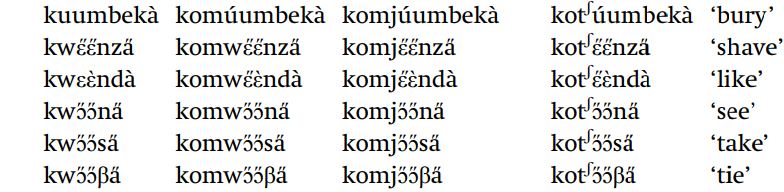
Examples of glide formation are also seen in (5), where the vowel /o/ in the infinitive prefix becomes [w] before another vowel. This process of glide formation is further illustrated in (7) and (8). In (7), you can see across all of the columns that the prefix for the infinitive is /ko/, and appears phonetically as such when it stands before another consonant. The last three data columns show that the prefixes marking different classes of objects are /mó/ for class 3, /mé/ for class 4, and /ké/ for class 7 (Kamba nouns have a dozen grammatical agreement classes, analogous to gender in some European languages).
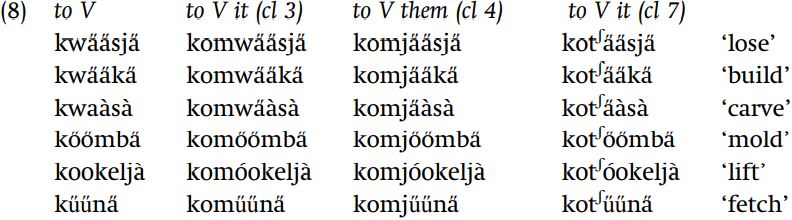
When the verb root begins with a vowel, we would predict a sequence of vowels such as *koasja for ‘to lose,’ in lieu of a rule modifying vowel sequences. Vowel sequences are avoided in Kamba by the application of the rule of glide formation, according to which any nonlow vowel becomes a glide before another vowel.
The Glide Formation rule can be formalized as (9).

While this rule does not explicitly state that the resulting glide is [+high], that value is predictable via structure preservation, given the fact that the language does not have glides that are [-high].
This rule would be expected to apply to underlying forms such as /kouna/ ‘to fetch’ and /ko-omba/ ‘to mold,’ since those forms have an underlying sequence of a vowel /o/ followed by another vowel. Applying that rule would result in *[kwűűna̋] and *[kwőőmba̋], but these are not the correct forms. We can resolve this problem once we observe that the glide [w] never appears before the tense round vowels [u, o] (but it can appear before the vowel [ɔ], as seen in [kwɔ̋ɔ̋na̋] ‘to see’ from /ko-ɔna/).
It does not help to restrict rule (9) so that it does not apply before /o, u/, since the vowel /e/ does actually undergo glide formation before these vowels (/ko-me-okelya/ becomes [komjóokeljà] ‘to lift them’ and /ko-méűna̋/ becomes [komjűűna̋] ‘to fetch them’). What seems to be a restriction on glide formation is highly specific: the tense round vowel fails to surface as a glide only if the following vowel is o or u. Furthermore, the round vowel does not merely fail to become a glide, it actually deletes, therefore we can’t just rewrite (9) so that it doesn’t apply before [u, o], since that would give *[koűna̋] and *[koőmba̋]). Two rules are required to account for these vowel-plus-vowel combinations. A very simple solution to this problem is to allow the most general form of the Glide Formation rule to apply, imposing no restrictions on which vowels trigger the rule, and derive the intermediate forms kwűűna̋ and kwőőmba̋. Since we have observed that the surface sequences [wo] and [wu] are lacking in the language, we may posit the following rule of glide deletion, which explains both why such sequences are lacking and what happened to the expected glide in the intermediate forms.

Glide Formation first creates a glide, and some of the glides so created are then deleted by (10).
Another crucial rule interaction which we observe in (8) is between Glide Formation and Palatalization. As we have seen, Palatalization specifically applies to kj and gj, and Glide Formation creates glides from vowels, which can trigger application of Palatalization. This is shown in the derivation of [kotʃ a̋a̋sja̋] from /ko-ké-a̋a̋sja̋/
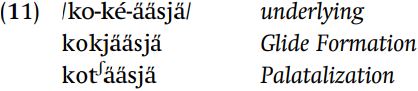
Thus Glide Formation creates phonological structures which are crucially referenced by other phonological rules.








