Verbs and situations
Overview
Verbs and situations is about verb meanings. A simplified account of the semantic ingredients that make a clause (such as Robby brought me the news) is that a verb (brought, in this case) “says something about” – that is, interrelates – the entities referred to by noun phrases (here Robby, me and the news). Among the reasons why this is only partly correct is that not all noun phrases are referring expressions (for instance, in Blinko was a famous clown, the noun phrase a famous clown puts Blinko into a category, rather than being used to refer to some clown), and it is not only verbs that categorize or interrelate entities (for example, most of the meaning of the preposition on in Those cups are on the shelf could alternatively be carried by a verb, The shelf supports those cups; and the sentence They made a fool of him, containing the noun fool, has a paraphrase with a verb They fooled him). There is nonetheless enough truth in the idea to justify talking of a clause as expressing a proposition by having a verb as its semantic centre and some accompanying referential expressions.
Verbs differ in whether they demand one, two or three noun phrases (italicized in Examples (4.1) and (4.2). Later discussion will show that this can have systematic effects on meaning.

In place of noun phrases, some verbs will accept preposition phrases (for example to her in 4.2a). And sometimes positions are filled by embedded clauses (like the that-clauses in 4.2c–e). A clause usually has a verb of its own and can carry a proposition, for example: Spring has come early carries a proposition about the start of a season. In (4.2c, e) the same clause is not free-standing, but has been embedded (which is to say “packed into”) another clause as object of the verb confirm. In (4.2d, e) we see a clause embedded as the subject. The word that is one of the markers made available by English grammar to mark a clause as embedded.
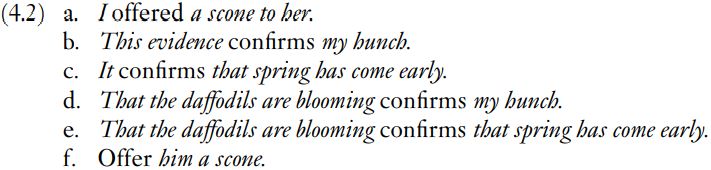
The term argument is used to cover all kinds of obligatory, potentially-referential constituents that verbs require, whether they are noun phrases (like This evidence) or embedded clauses (like that the daffodils are blooming or that spring has come early) or preposition phrases. (In this context argument does not mean ‘dispute’.) Example (4.2a) has three arguments. The main clauses in (4.2b–e) each have two arguments. Example (4.2f) has three arguments, because the “understood” subject ‘you’ counts as an argument.
Especially with verbs, meaning is a property not just of individual words, but is affected by the constructions they appear in. The following is an instance showing how the array of arguments in a clause can influence the way the meaning of a verb is understood. Until I read a newspaper headline Robbers spray victims to sleep (Fiji Post, 1 June 1995), the verb spray was not, for me, one that took an embedded clause. However, on seeing it with the clause victims to sleep as its second argument, I immediately understood that spray was causative here: the robbers caused the victims to fall asleep by spraying something at them.
We will discuss causative verbs, with and without an embedded clause indicating the situation caused. With causatives, the proposition carried by the embedded clause is entailed by the whole sentence: thus, if it is true that ‘the robbers sprayed the victims to sleep’, it must also be true that ‘the victims slept’. We will speak about research based on Zeno Vendler’s influential account (1967) of ways that verbs and their arguments indicate how a situation is structured in time. Aspect is the general term for the encoding in language of the time profiles of events, for example whether things build up to a climax or just continue unchanged. It is aspect as a property of English words1 that is considered here. We will take the discussion further, focusing mainly on aspect as marked in the grammar of English.








