Grammatical aspect in English: Progressive and Simple aspect
Putting stative verbs on one side, we can say that English verbs occur in the Progressive or Simple forms. The Progressive is a syntactic construction consisting of be plus the participle in -ing. The Simple form consists of just the verb stem plus the suffixes whose central or prototypical forms are -s or -ed. Examples are given in (9)–(11).
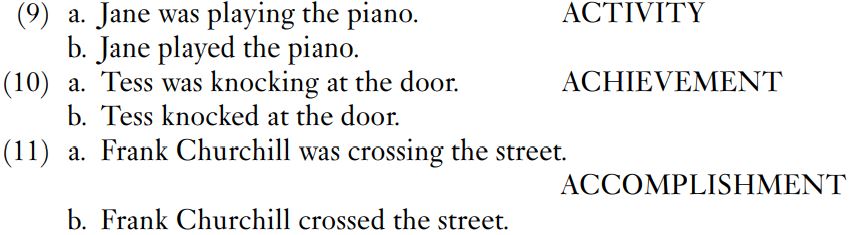
All the above examples present events as taking place in past time. (Tense and time will be discussed below.) Presented with such examples out of context, native speakers of English take the Progressive examples of ACTIVITY or ACCOMPLISHMENT verbs to present a single event as ongoing. They take the examples with the Simple form as presenting a single completed event. This is not the only possible interpretation of the Simple form in the past tense, for adverbs such as every day or four or five times a day can be added to examples such as (9b), (10b) and (11b), giving them a habitual interpretation. That is, they present an event as happening regularly over a long period of time, as a habit. Consider now the examples in (12)–(14).
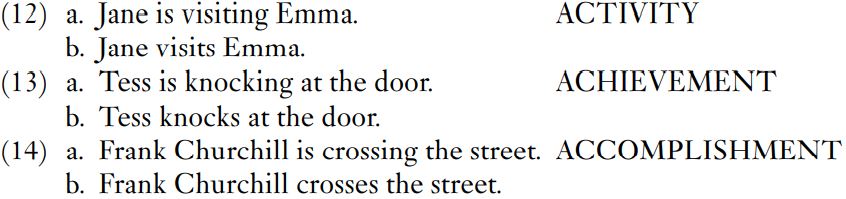 The examples with the Progressive forms, like the ones in (9)–(11), are interpreted as presenting a single event as ongoing. (In the case of the achievement verb in (13), the knocks are repeated, but it is possible to interpret the series of repeated knocks as a single event. For present purposes, we concentrate on (12) and (14).)
Out of context, the Simple forms are typically interpreted as presenting an event as habitual: Jane visits Emma every Tuesday, Tess always knocks at the door before she comes in, Frank Churchill crosses the street every time he sees Mr Knightley approaching. These Simple forms in the present tense can be given single-event interpretations, but only in special contexts. One is the ‘sporting commentary’, with many examples such as Savage runs up, bowls and Dither is out lbw. The other is a type of narrative in the present tense, either literary – Tess knocks at the door. Receiving no reply, she opens it, shouts ‘Hello’ and goes into the hall – or joke – This man goes into a Glasgow bar with a crocodile on a lead and asks the barman ‘Do you serve X?’
Progressive contrasts with Simple, but what exactly is signaled by the contrast? It seems that verbs in the Progressive, whether in past or present tense, are typically used to present a single event as ongoing.
The Simple form presents an event as completed. Past-tense Simple forms typically present a single event as completed (but this interpretation can be overruled by an adverb such as every Friday). In the present tense, outside the special contexts mentioned above, they are typically interpreted as presenting an event as habitual. That is, verbs in the Simple form present an event as completed but leave it unspecified whether the event is single or repeated. In the past tense, the singleevent interpretation is the favorite and neutral, but in present tense the habitual interpretation is the favorite and neutral.








