What is the head of a noun phrase?
Questions can be asked about the traditional view of nouns as the head of noun phrases. It remains true that the noun controls the other constituents in noun phrases but particular problems affect noun phrases. Consider first the pairs of examples in (12)–(14).
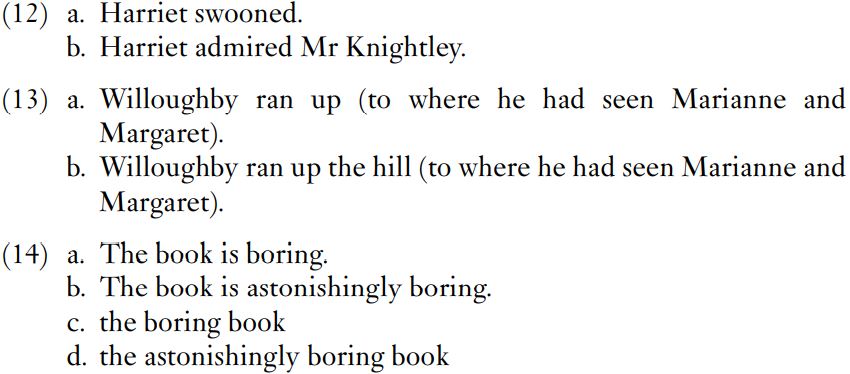 Examples (12a, b) show that a verb or a verb and its modifiers occur in the same slot in a clause. Examples (13a, b) show that a preposition or a preposition and its complement occur in the same slot. Examples (14a–d) show that an adjective or an adjective and its modifiers occur in the same slot, whether as complement of is or modifying a noun. In other words, the entire phrase occurs in the same slots in clauses as the head word. (Looking at where particular types of word or types of phrase are to be found in phrases, clauses and sentences is not unlike botanists, say, searching for specimens of a particular plant and plotting on maps where the plant grows. The botanists are said to be studying the geographical distribution of the plant, its distribution over the country; similarly, linguists talk of studying the distribution of words and phrases over phrases, clauses and sentences, not to mention larger texts, studied in discourse analysis. Having said all that, we can now provide the technical way of putting it: the head of a phrase and the phrase itself have the same distribution.)
The above does not apply to all nouns. It applies to proper nouns, which normally do not allow modifiers – but see (15b, c) below.
 Examples (15a–c) tell us something about the noun phrases that occur followed by a phrase such as wishes to ask you some awkward questions. To introduce the technical way of putting it, linguists talk of words and phrases occurring in frames or environments. In the frame or environment ___ wishes to ask you some awkward questions we find either the head noun Ethel on its own, as in (15a), or the example discussed above in which Ethel is modified by a definite article and a relative clause – (15b), or Ethel, not modified by a definite article but only by a prepositional phrase, as in (15c).
Plural nouns such as golfers likewise have the same distribution as any phrases of which they are head, as shown by (16).
 In the environment ___ can be good company we find golfers on its own, as in (16a); we find enthusiastic golfers with large handicaps, as in (16b) – that is, the head noun modified by an adjective and a prepositional phrase; and we find these enthusiastic golfers that I met at the nineteenth hole, as in (16c) – that is, the head noun golfers modified by the demonstrative these and a relative clause. Analogous examples can be produced for singular mass nouns such as sand or flour.
The phrases that do not conform to the above patterns are those containing singular count nouns such as golfer, which cannot occur on its own but requires an article or demonstrative as shown by (17). (Golfer in (17a) and (17d) is not a nickname. If it were, it would be a proper noun and (17a) would be acceptable.)

Many analysts have responded to the above pattern of distribution by suggesting that what we have been calling noun phrases in (17a–d) do not have nouns as their heads. Instead, they propose that the determiner is the head and that the phrases should be called determiner phrases. Phrases containing proper nouns or plural nouns or singular mass nouns are to be analyzed as determiner phrases containing a determiner that happens to be zero. This approach makes it attractive to recognize two types of head: syntactic heads that control the distribution of phrases and determines their type – determiner, adjective, prepositional phrase and so on, and semantic heads that control the sort of complements and adjectives that can occur. In an introductory textbook, we do not need to choose between one or the other approach; the fact remains that dependency relations are central to syntactic structure.








