Recognizing clauses
There are reliable rules of thumb for recognizing the different types of clause. Some of the rules have to do with constituent structure or the complementiser, but most of them exploit the concept of modification.
Rules of thumb
For any given finite subordinate clause:
A Does it modify another clause? If it does, it is an ADVERBIAL CLAUSE.
For example, in (10) the clause in italics modifies the entire clause in roman type. It establishes a time for the entire situation of leaving the furniture behind and is an adverbial clause of time.

B Does it modify a verb? If it does, it is a (VERB) COMPLEMENT CLAUSE .
For example, in (11) the clause in italics modifies the verb reported. Indeed, the clause A motorist has reported is incomplete without the complement clause.

NB: Verb complement clauses function as subject or object of a clause.
C Does it modify a noun? If it does, it could be a RELATIVE CLAUSE or a COMPLEMENT CLAUSE.
C(i) Is the subordinate clause introduced by a WH word such as who, which, where, or by a prepositional phrase such as in which? If it is, it is a relative clause.
For example, in (12) and (13) the clauses in italics are relative clauses.

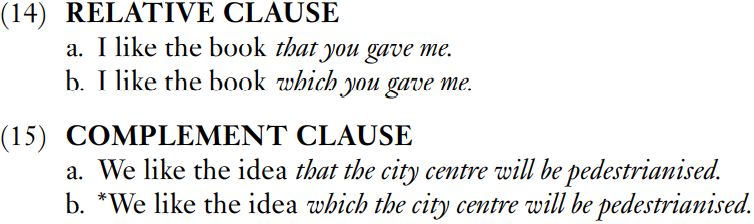
C(ii) Is the subordinate clause introduced by that? If it is, it could be either a relative clause or a complement clause. If it is a relative clause, that can be replaced by which and so on, as in (14). If it is a complement clause, that cannot be replaced by a WH word, as shown by (15).
Note that there are some examples that go counter to C(ii). In the question why she bothered phoning, the reason why they refused and the problem where to leave our furniture, the nouns question, reason and problem are followed by WH clauses, but these clauses are complements. Other, more formal, variants are the question of why she bothered phoning and the problem of where to leave our furniture. In the latter examples the nouns question and problem are linked to the WH clause by the preposition of. Relative clauses are never linked to nouns in this way. We will treat these apparent counter-examples as fixed phrases, since a very limited number of nouns are modified by WH complement clauses.
There is a further useful test that distinguishes between relative and noun complement clauses. Consider the verb complement clause above and in (3) and all the adverbial clauses we have looked at. If you remove the complementiser, you are left with a complete clause; the removal of that from that she had met Wickham in (3a) leaves she had met Wickham, and the removal of Although from Although Mr D’Arcy disliked Mrs Bennet in (8c) leaves Mr D’Arcy disliked Mrs Bennet. The removal of that from the noun complement clause that she could subscribe to a library in (5) leaves she could subscribe to a library.
Removal of the complementiser from relative clauses produces a different result. In (7a), the removal of which from which Mrs Dashwood accepted leaves Mrs Dashwood accepted. This is not a complete clause, since accepted requires a noun phrase to its right. The removal of who from who saved Marianne in (7b) leaves saved Marianne. This clause is incomplete because the verb requires a noun to its left. It makes no difference whether a given relative clause is introduced by a WH word or that, as in (7d). The removal of that in the latter leaves we liked, which lacks a noun phrase to its right and is incomplete.








