Transposition
Many sequences of words can be moved together into different slots in a clause; this is evidence that the words form a phrase. Let us go back to (3a), Jeeves shimmered into the room. We can think of (3a) as being converted to (3c) by the words into the room being moved, or transposed, to the front of the clause. This transposition indicates that the three separate words combine into a larger block, a phrase. Transposition also applies to phrases without prepositions. The words the results in (5) can be moved to the front of the clause to give The results Barbara handed to Alan on Tuesday, a clause that is appropriate if the speaker or writer continues, for example, The actual scripts she kept until Friday.
The above examples of transposition have to do with a sequence of words being moved from one position in a clause to another position without any other changes in the clause. (Remember the comment ,that the clause is a unit of analysis within which we can talk coherently about the order of phrases and the fact that phrases can occupy different positions.) Transposition is one of the tests that reveal whether a given sequence of words make up a phrase or are just words that happen to come one after the other. If you know English well, you may be tempted to think that such a test is unnecessary; but two facts speak against this temptation. One is that in spite of the vast amount of research on English syntax in the twentieth century we still come across examples whose structure is not obvious. The second fact is that many linguists work not just on languages other than English but on languages which have been little studied or not studied at all. In these circumstances, tests such as transposition are essential.
The test of transposition is also applied in a slightly different fashion. Consider the active clause in (6a) and the passive clause in (6b).
 The phrase the pupils in this math class is at the beginning of the clause in (6a) and refers to the people doing the giving. The same sequence is at the end of the clause in (6b) and is the complement of the preposition by. In contrast with (3a) and (3b), the differences between (6a) and (6b) consist of more than just a group of words being moved from one position to another. Example (6a) contains gave, while (6b) contains the words were and given. Example (6b) also contains the prepositional phrase by the pupils in this math class, whereas (6a) has no prepositional phrase. When we use ‘transposition’ with respect to examples such as (6a) and (6b), we are talking about sequences of words that turn up in a particular order in one position in one construction and about the same sequences of words turning up in the same order in another construction. The sequence the pupils in this math class occurs in the different constructions in (6a) and (6b).
The test of transposition applies to other sequences of words, as shown by (7).
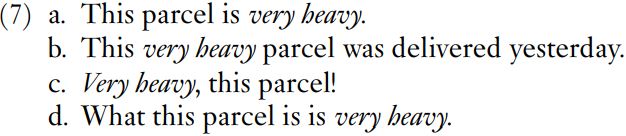
In (7a), the sequence of words/the phrase very heavy is the complement of is; in (7b) it is the modifier of parcel. It turns up at the beginning of the spoken construction in (7c). In (7d) it is also the complement of is, but in a special emphatic construction. Very can be replaced by words such as astonishingly, and the sequence can be made longer – astonishingly and frighteningly heavy – but can still be transposed, as shown in This parcel is astonishingly and frighteningly heavy, this astonishingly and frighteningly heavy parcel was delivered yesterday, What this parcel is is astonishingly and frighteningly heavy
Examples (3a) and (3c) show that a sequence of words introduced by a preposition – into the room – can be transposed. Another example is given in (8).









