Our discussion of syntax begins with two central ideas. The first is that certain relationships hold between words whereby one word, the head, controls the other words, the modifiers. A given head may have more than one modifier, and may have no modifier. The second idea is that words are grouped into phrases and that groupings typically bring together heads and their modifiers. In the large dog, the word dog is the head, and the and large are its modifiers. In barked loudly, the word barked is the head and loudly the modifier. (Criteria for recognizing heads and modifiers will be given below.)
A phrase, then, is a group of interrelated words. As we will see, groups of interrelated words can be moved around inside clauses as a single unit; here, we concentrate on the fact that in such groups we recognize various links among the words, between heads and their modifiers. This relationship of modification is fundamental in syntax. It will play an important role in the account of different types of clause and is crucial to discussions of word order in different languages.
How are we to understand the statement ‘one word, the head, controls the other words, the modifiers’? Consider the sentences in (1)–(2), which also introduce the use of the asterisk – ‘*’ – to mark unacceptable examples.
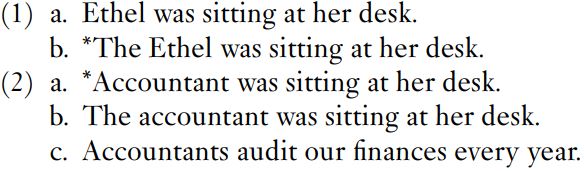
Example (1a) is a grammatical sentence of English, but (1b) is not grammatical (at least as an example of standard English). Ethel is a type of noun that typically excludes words such as the and a. (Here, we will use nouns that accord with their traditional definition as words that denote people, places and things.) Accountant is a different type of noun; if it is singular, as in (2a), it requires a word such as the or a. In (2c), accountants consists of accountant plus the plural suffix -s and denotes more than one accountant. It does not require the. Plural nouns, of course, exclude a or an but allow words such as some or more, as shown in (3).

Another type of noun, which includes words such as salt, sand and water, can occur without any word such as the, a or some, as in (4a, b), and can occur in the plural but only with a large change in meaning. Example (4c) can only mean that different types of salt were spread.

Note too that a plural noun such as gritters allows either less or fewer, as in (5d) and (5c), whereas salt requires less and excludes fewer, as in (5a) and (5b).

The central property of the above examples is that Ethel, accountant, salt and gritter permit or exclude the plural suffix and permit or exclude words such as the, a, some, less and fewer – note that Ethel excludes the, a, some, less and fewer; salt in (4a) excludes a and fewer; gritters excludes a; accountant allows both the and a, and so on.
We have looked at phrases with nouns as the controlling word, but other types of word exercise similar control. Many adjectives such as sad or big allow words such as very to modify them – very sad, very big – but exclude words such as more – sadder is fine but more sad is at the very least unusual. Other adjectives, such as wooden, exclude very and more – *very wooden, *more wooden. That is, wooden excludes very and more in its literal meaning, but note that very is acceptable when wooden has a metaphorical meaning, as in The policeman had a very wooden expression.
Even a preposition can be the controlling word in a group. Prepositions link nouns to nouns (books about antiques), adjectives to nouns (rich in minerals) and verbs to nouns (aimed at the target). Most prepositions must be followed by a group of words containing a noun, or by a noun on its own, as in (They sat) round the table, (Claude painted) with this paintbrush, (I’ve bought a present) for the children. A small number of prepositions allow another preposition between them and the noun: In behind the woodpile (was a hedgehog), (An owl swooped on the rabbit) from up in the beech tree. In allows behind and from allows up. That is, the preposition controls whatever word or phrase follows it. Another aspect of this control can be seen from the fact that in standard English prepositions can be followed by pronouns, but they exclude I, he, she, we and they and require me, him, her, us and them: *I’ve bought a present for she, I’ve bought a present for her.








