Fundamental Group
The fundamental group of an arcwise-connected set  is the group formed by the sets of equivalence classes of the set of all loops, i.e., paths with initial and final points at a given basepoint
  , under the equivalence relation of homotopy. The identity element of this group is the set of all paths homotopic to the degenerate path consisting of the point
  . The fundamental groups of homeomorphic spaces are isomorphic. In fact, the fundamental group only depends on the homotopy type of
  . The fundamental group of a topological space was introduced by Poincaré (Munkres 1993, p. 1).
The following is a table of the fundamental group for some common spaces  , where
  denotes the fundamental group,
  is the first integral homology group,
  denotes the group direct product,
  denotes the free product,
  denotes the ring of integers, and
  is the cyclic group of order
  .
.
space ( ) ) |
symbol |
 |
 |
| circle |
 |
 |
 |
| complex projective space |
 |
0 |
0 |
| figure eight |
|
 |
 |
| Klein bottle |
|
 |
 |
 -torus -torus |
 |
 |
 |
| real projective plane |
 |
 |
 |
| sphere |
 |
0 |
0 |
The group product  of loop
  and loop
  is given by the path of
  followed by the path of
  . The identity element is represented by the constant path, and the inverse of
  is given by traversing
  in the opposite direction. The fundamental group is independent of the choice of basepoint because any loop through
  is homotopic to a loop through any other point
  . So it makes sense to say the "fundamental group of
  ."
."
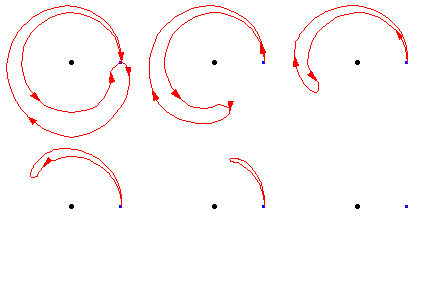
The diagram above shows that a loop followed by the opposite loop is homotopic to the constant loop, i.e., the identity. That is, it starts by traversing the path  , and then turns around and goes the other way,
  . The composition is deformed, or homotoped, to the constant path, along the original path
  .
.
A space with a trivial fundamental group (i.e., every loop is homotopic to the constant loop), is called simply connected. For instance, any contractible space, like Euclidean space, is simply connected. The sphere is simply connected, but not contractible. By definition, the universal cover  is simply connected, and loops in
  lift to paths in
  . The lifted paths in the universal cover define the deck transformations, which form a group isomorphic to the fundamental group.
The underlying set of the fundamental group of  is the set of based homotopy classes from the circle to
  , denoted
 ![[S^1,X]](https://mathworld.wolfram.com/images/equations/FundamentalGroup/Inline50.gif) . For general spaces
. For general spaces  and
and  , there is no natural group structure on
 ![[X,Y]](https://mathworld.wolfram.com/images/equations/FundamentalGroup/Inline53.gif) , but when there is,
, but when there is,  is called a co-H-space. Besides the circle, every sphere
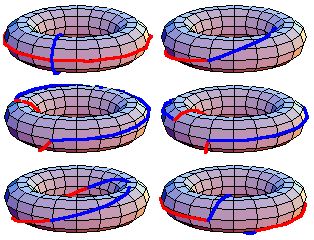
  is a co-H-space, defining the homotopy groups. In general, the fundamental group is non-Abelian. However, the higher homotopy groups are Abelian. In some special cases, the fundamental group is Abelian. For example, the animation above shows that
  in the torus. The red path goes before the blue path. The animation is a homotopy between the loop that goes around the inside first and the loop that goes around the outside first.
Since the first integral homology  of
of  is also represented by loops, which are the only one-dimensional objects with no boundary, there is a group homomorphism
which is surjective. In fact, the group kernel of  is the commutator subgroup and
  is called Abelianization.
The fundamental group of  can be computed using van Kampen's theorem, when
  can be written as a union
  of spaces whose fundamental groups are known.
When  is a continuous map, then the fundamental group pushes forward. That is, there is a map
  defined by taking the image of loops from
  . The pushforward map is natural, i.e.,
  whenever the composition of two maps is defined.
REFERENCES:
Hatcher, A. Algebraic Topology. Cambridge, England: Cambridge University Press, 2006.
Munkres, J. R. Elements of Algebraic Topology. New York: Perseus Books Pub., 1993.








