Jacobsthal Number
The Jacobsthal numbers are the numbers obtained by the  s in the Lucas sequence with
  and
and  , corresponding to
  and
and  . They and the Jacobsthal-Lucas numbers (the
  s) satisfy the recurrence relation
 |
(1)
|
The Jacobsthal numbers satisfy  and
and  and are 0, 1, 1, 3, 5, 11, 21, 43, 85, 171, 341, ... (OEIS A001045). The Jacobsthal-Lucas numbers satisfy
  and
and  and are 2, 1, 5, 7, 17, 31, 65, 127, 257, 511, 1025, ... (OEIS A014551). The properties of these numbers are summarized in Horadam (1996).
Microcontrollers (and other computers) use conditional instructions to change the flow of execution of a program. In addition to branch instructions, some microcontrollers use skip instructions which conditionally bypass the next instruction. This winds up being useful for one case out of the four possibilities on 2 bits, 3 cases on 3 bits, 5 cases on 4 bits, 11 on 5 bits, 21 on 6 bits, 43 on 7 bits, 85 on 8 bits, ..., which are exactly the Jacobsthal numbers (Hirst 2006).
The Jacobsthal and Jacobsthal-Lucas numbers are given by the closed form expressions
where  is the floor function and
  is a binomial coefficient. The Binet forms are
Amazingly, when interpreted in binary, the Jacobsthal numbers  give the
  th iteration of applying the rule 28 cellular automaton to initial conditions consisting of a single black cell (E. W. Weisstein, Apr. 12, 2006).
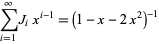
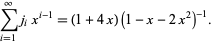
The generating functions are
 |
(8)
|
 |
(9)
|
The Simson formulas are
Summation formulas include
Interrelationships are
 |
(14)
|
 |
(15)
|
 |
(16)
|
 |
(17)
|
 |
(18)
|
 |
(19)
|
 |
(20)
|
 |
(23)
|
 |
(24)
|
 |
(25)
|
 |
(26)
|
 |
(27)
|
 |
(28)
|
 |
(29)
|
 |
(30)
|
 |
(31)
|
 |
(32)
|
 |
(33)
|
(Horadam 1996).
REFERENCES:
Bergum, G. E.; Bennett, L.; Horadam, A. F.; and Moore, S. D. "Jacobsthal Polynomials and a Conjecture Concerning Fibonacci-Like Matrices." Fib. Quart. 23, 240-248, 1985.
Hirst, C. "Hopscotch--Multiple Bit Testing." May 15, 2006. https://www.avrfreaks.net/index.php?module=FreaksAcademy&func=viewItem&item_id=229&item_type=project.
Horadam, A. F. "Jacobsthal and Pell Curves." Fib. Quart. 26, 79-83, 1988.
Horadam, A. F. "Jacobsthal Representation Numbers." Fib. Quart. 34, 40-54, 1996.
Sloane, N. J. A. Sequences A001045/M2482 and A014551 in "The On-Line Encyclopedia of Integer Sequences."
Hoggatt and Bicknell, in ÒConvolution Triangles,Ó FQ 10 (1972), 599-608),








